
Category: Buyer’s Guide / Tech Resources Reading Time: 7 Minutes
You have scoured the forums, sourced a Dana 60 Kingpin front axle, and you are ready to build the ultimate 1-ton rig. But as you compile your parts list, you hit a common stumbling block: the brake lines.
With so many options for off road brake lines on the market, how do you know which ones will actually fit your 40-year-old axle and your modern suspension? Buying the wrong lines means leaks, poor performance, or worse—a line snapping on the trail.
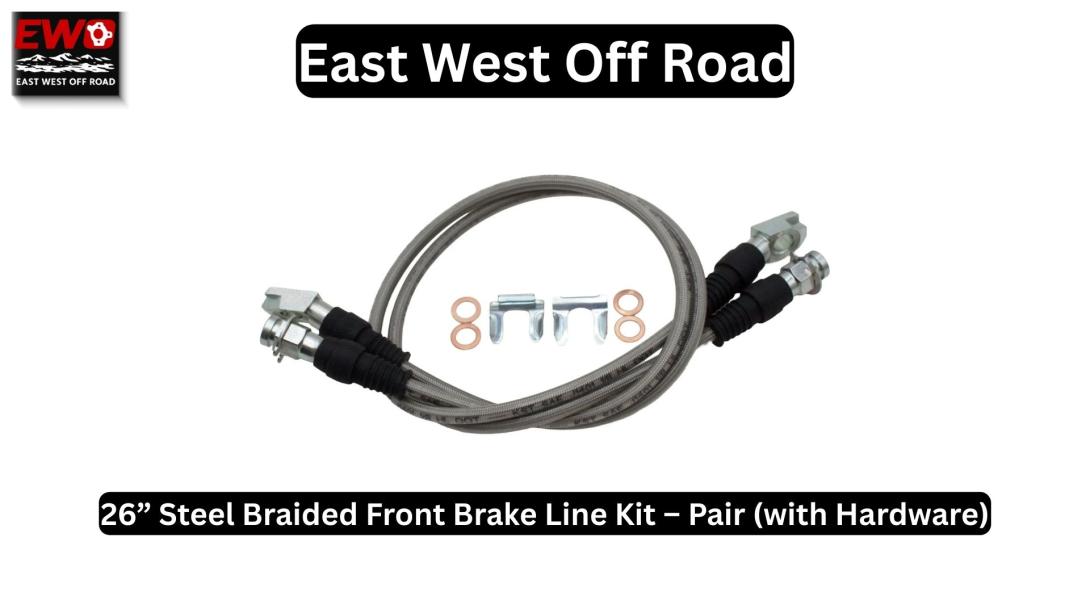
In this comprehensive guide, we break down the four critical factors you must consider when specifying Dana 60 brake lines, and why the East West Offroad brake kit (Part E63014 brake lines) is the benchmark for Solid Axle Swap brake kit applications.
Factor 1: Length & Articulation
The number one reason for brake line failure off-road is insufficient length.
- The Stock Limitation: Factory Chevy K30 brake lines were designed for leaf springs with limited travel.
- The Modern Requirement: If you are building a Jeep JK 1-ton swap or a Toyota Tacoma SAS brake lines setup with coil-overs, your suspension "droop" (downward travel) is massive.
- The Verdict: You need extended brake lines. We recommend 26 inch brake lines as the industry standard. This length accommodates high articulation brake lines setups, preventing the hose from acting as a limiting strap when you hit your suspension droop brake line limit.
Factor 2: Material & Construction
Not all "braided" lines are created equal. For a heavy duty front brake lines application, you need more than just a shiny exterior.
- Inner Core: Look for a PTFE lined brake hose. Unlike rubber, Teflon (PTFE) is chemically inert and does not degrade with aggressive brake fluids.
- Reinforcement: The steel braided construction is mandatory for rock crawler hydraulic lines. It physically prevents the inner tube from swelling under pressure, which is the key to fix spongy brake pedal off road issues.
- Protection: Ensure the line has a UV resistant brake hose coating (usually PVC) to prevent grit from working into the braid, offering true cut resistant brake lines durability.
Factor 3: Hardware Compatibility
The Kingpin Dana 60 parts ecosystem is a mix of metric and imperial standards. Getting this wrong guarantees a leak.
- Caliper End: Most Chevy K20 front calipers and JB6 caliper brake lines (1979-1991 era) require a 10mm banjo brake line fitting. The EWO kit includes 10mm x 1.5 banjo fitting bolts and copper crush washers 10mm to ensure a perfect seal on OEM and RuffStuff dual-bleed calipers.
- Chassis End: Your vehicle's hard line likely ends in a 3/8-24 thread. The EWO kit features a direct-fit 3/8-24 inverted flare brake line female fitting. This means you don't need a universal 3/16 brake line hose adapter stack—it just works.
Factor 4: Mounting Strategy
How you secure the line is just as important as the line itself.
- The Problem: Generic auto parts store hoses come with fixed brackets that rarely line up with custom shock towers.
- The Solution: Choose a kit with weld on brake line tabs. The EWO kit includes these weld on frame brackets hydraulic mounts and brake line retaining clips. This allows you to create custom fabrication brake lines routing that moves safely with your suspension, providing essential overheating brake fluid protection by keeping lines away from the exhaust.
Comparison: Why EWO Wins
You could try to piece together a kit from Skyjacker extended brake lines, Crown Performance brake lines, or Russell Performance braided lines. However, the EWO 26” Steel Braided Kit is purpose-built for the Dana 60 disc brake conversion.
It serves as a direct, high-stock availability RuffStuff brake line alternative (comparable to R2539) that is ready to ship extended brake lines straight to your door. Whether you are restoring a Squarebody Chevy 4x4 brakes system or building a dedicated rock bouncer brake plumbing chassis, this kit checks every box.
Shop the guide:(https://www.eastwestoffroad.com/product/26%22-steel-braided-front-brake-line-kit-pair-(with-hardware)