

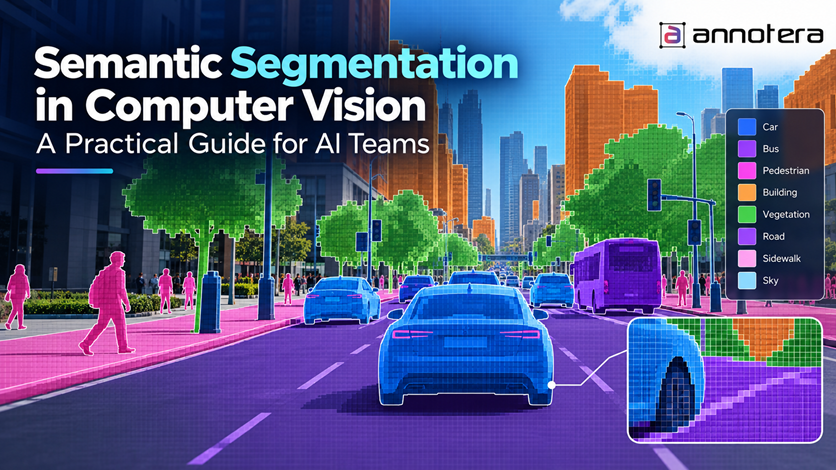
Computer vision systems need more than the ability to recognize objects in an image. Many real-world applications require AI models to understand exactly which pixels belong to roads, vehicles, pedestrians, buildings, medical structures, or other elements. This is where semantic segmentation becomes essential.
Semantic segmentation is a computer vision technique that assigns a predefined class label to every pixel in an image. It enables AI models to interpret visual scenes at a detailed level, supporting applications such as autonomous driving, medical imaging, robotics, retail analytics, and industrial inspection.
For AI teams developing reliable computer vision models, understanding the annotation process, quality requirements, and implementation challenges is critical. This practical guide explains how semantic segmentation works and how organizations can build high-quality datasets for their AI initiatives.
What Is Semantic Segmentation in Computer Vision?
Semantic segmentation is an image annotation technique in which every pixel is assigned to a category, such as road, sky, person, vehicle, or vegetation. Unlike image classification, which identifies the overall content of an image, or object detection, which locates objects using bounding boxes, semantic segmentation provides pixel-level information.
For example, an autonomous driving model may identify a car using a bounding box. However, semantic segmentation can distinguish the precise pixels representing the car from surrounding objects, road surfaces, and background elements.
It is important to distinguish semantic segmentation from instance segmentation. Semantic segmentation assigns the same class label to all pixels belonging to a category, even when multiple objects of that category appear in an image. Instance segmentation goes further by distinguishing individual objects within the same class.
This pixel-level understanding helps AI systems interpret complex environments and make more precise predictions.
Why Is Semantic Segmentation Important for AI Teams?
High-quality segmentation data directly influences how effectively computer vision models learn spatial relationships and recognize visual patterns.
Here are several important benefits:
- Improved scene understanding: Models learn to distinguish between different regions, objects, and background elements.
- Greater spatial precision: Pixel-level labels provide detailed information that bounding boxes cannot capture.
- Better decision-making: AI systems can use segmented regions to support navigation, inspection, measurement, and object interaction.
- More reliable performance: Consistent annotations help reduce training noise and improve model evaluation.
- Support for complex environments: Segmentation datasets can represent irregular shapes, overlapping objects, and intricate boundaries.
These advantages make semantic segmentation particularly valuable when visual accuracy is essential to an application's performance.
Key Applications of Semantic Segmentation
Semantic segmentation supports a wide range of computer vision use cases across industries.
1. Autonomous Driving
Self-driving systems must understand roads, sidewalks, traffic signs, vehicles, pedestrians, and obstacles. Segmentation labels help models identify drivable areas and distinguish safe navigation zones from potential hazards.
Datasets should include varied lighting conditions, weather patterns, road types, and traffic scenarios to improve robustness.
2. Medical Imaging
In medical applications, segmentation can identify anatomical structures, organs, lesions, and other regions of interest. Precise pixel-level annotations help train models for image analysis and clinical research, subject to appropriate validation and clinical oversight.
3. Robotics and Industrial Automation
Robots use visual information to navigate environments, recognize surfaces, and interact with objects. Semantic segmentation helps classify floors, obstacles, workspaces, and relevant objects, supporting navigation and task planning.
4. Retail and Smart Environments
Retail analytics and intelligent monitoring systems can use segmentation to identify product regions, shelf areas, floor spaces, and other visual elements. These datasets can support applications such as shelf analysis, space utilization, and scene understanding.
How Does the Semantic Segmentation Workflow Work?
A structured annotation workflow helps AI teams maintain dataset consistency while controlling labeling costs and turnaround times.
Step 1: Define the label taxonomy
Establish the classes the model must recognize. Define clear boundaries between categories, rules for ambiguous objects, and instructions for handling partially visible elements. A well-designed taxonomy reduces disagreements between annotators.
Step 2: Prepare and organize the images
Collect representative images that reflect the model's intended deployment environment. Check for corrupted files, duplicates, inconsistent image formats, and insufficient representation of important scenarios.
Step 3: Perform pixel-level annotation
Annotators use polygon-based tools, brushes, or other segmentation interfaces to assign class labels to relevant pixels. Complex boundaries, thin structures, overlapping visual elements, and low-visibility objects require particular attention.
Step 4: Conduct quality assurance
Review annotations for missing regions, incorrect class assignments, boundary inaccuracies, and inconsistent labeling decisions. Depending on project requirements, quality checks may include automated validation, independent reviews, and targeted re-annotation.
Step 5: Export and validate the dataset
Convert annotations into the required format, such as class-index masks or other framework-compatible representations. Verify image-mask alignment, class mappings, file integrity, and compatibility with the model training pipeline.
Best Practices for High-Quality Semantic Segmentation
Building a useful dataset requires more than labeling every pixel. AI teams should adopt practices that improve consistency, coverage, and long-term usability.
- Create detailed annotation guidelines: Document class definitions, edge cases, occlusion rules, and examples of correct and incorrect annotations.
- Prioritize difficult visual conditions: Include shadows, reflections, low-light scenes, unusual object shapes, and cluttered backgrounds where relevant.
- Maintain class balance: Monitor underrepresented classes that could otherwise receive insufficient attention during training.
- Use automated pre-labeling carefully: AI-assisted tools can accelerate annotation, but generated masks require human verification, especially around object boundaries.
- Track measurable quality indicators: Evaluate class-level accuracy, boundary quality, annotation completeness, inter-annotator agreement, and error rates.
- Version datasets and guidelines: Record annotation changes, taxonomy updates, and quality-review outcomes to support reproducibility.
Teams should also separate training, validation, and test data carefully to reduce data leakage and obtain a more realistic assessment of model performance.
Common Challenges and How to Address Them
Semantic segmentation projects can become complicated when images contain small objects, ambiguous boundaries, overlapping classes, or inconsistent lighting. These conditions make it difficult to assign accurate labels to every pixel.
Another challenge is annotation scalability. Manually labeling high-resolution images can require substantial time, particularly when projects involve millions of pixels per image or complex class taxonomies.
AI-assisted annotation, reusable workflows, and structured quality checks can help address these issues. Active learning can also prioritize images where the model is uncertain or where existing annotations reveal recurring errors.
For organizations with large datasets or specialized requirements, image annotation outsourcing services can provide access to trained annotators, defined quality-control processes, and scalable project execution. Selecting an experienced image annotation company is especially important when annotation consistency, data security, and delivery timelines affect model development.
How to Choose the Right Semantic Segmentation Partner
Before outsourcing a segmentation project, AI teams should evaluate a provider's technical capabilities and operational processes.
Consider whether the provider can support custom taxonomies, complex polygon or mask annotation, multi-stage quality assurance, and the required data-export formats. Ask how annotators handle ambiguous cases, how disagreements are resolved, and how quality metrics are reported.
Security practices also matter. Providers should follow appropriate access controls, confidentiality requirements, and secure data-handling procedures.
Finally, conduct a pilot project using representative images before committing to large-scale production. Measure annotation accuracy, consistency, turnaround time, and the amount of rework required. These results offer a more practical basis for selecting a partner than pricing alone.
Conclusion
Semantic segmentation is a foundational technique for developing computer vision systems that need precise, pixel-level scene understanding. Its effectiveness depends on a well-defined taxonomy, representative images, accurate annotation, and systematic quality assurance.
By combining human expertise with carefully validated AI-assisted workflows, organizations can build datasets that support more reliable model training and evaluation. For AI teams looking to scale these efforts, Annotera provides image annotation support designed around project requirements, dataset quality, and operational consistency.
Ready to build high-quality computer vision datasets? Connect with Annotera to explore image annotation solutions tailored to your AI training and segmentation requirements.