
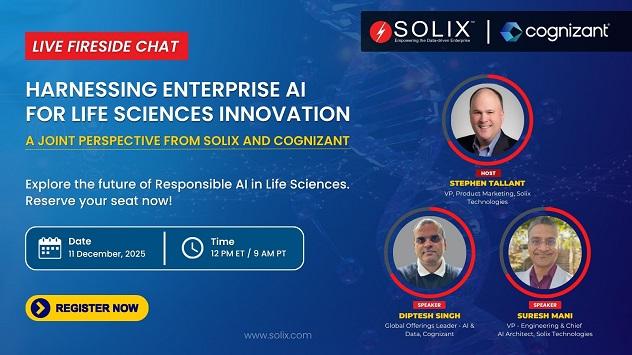
As artificial intelligence becomes deeply embedded in research, clinical operations, regulatory affairs, and commercial workflows, the need for Responsible AI in Life Sciences has never been greater. AI is now powering predictive analytics, safety monitoring, molecular modeling, operational automation, and real-world evidence generation — but these capabilities must be deployed in a way that is ethical, transparent, compliant, and scalable.
During the Solix webinar, “Harnessing Enterprise AI for Life Sciences Innovation,” industry experts shared how organizations can adopt AI responsibly at enterprise scale. This article summarizes the key insights and explains why responsible AI frameworks are becoming the backbone of digital transformation across pharma and biotech.
Why Responsible AI Matters in Life Sciences
AI is transforming life sciences, but it operates within one of the world’s most highly regulated environments. Every insight, prediction, or model output has the potential to impact patient safety, clinical outcomes, regulatory submissions, or ethical decision-making.
This makes Responsible AI in Life Sciences an enterprise-level requirement rather than an optional best practice.
Responsible AI ensures:
- Ethical deployment of algorithms
- Transparency in how models make decisions
- Fair and unbiased outcomes
- Protection of sensitive patient and clinical data
- Compliance with global regulations
- Trust among scientific, clinical, and regulatory stakeholders
Without responsible AI, organizations risk non-compliance, data privacy breaches, model errors, and loss of scientific credibility.
Enterprise Governance: Building the Foundation for Responsible AI
A major theme from the webinar was the importance of enterprise governance. Governance creates the guardrails that define how AI systems are developed, validated, deployed, and monitored across teams.
Strong enterprise governance includes:
- Centralized AI oversight committees
- Approved standards for model development
- Documentation and audit trails
- Controlled access to model inputs and outputs
- Defined accountability for AI-driven decisions
Governance ensures that AI systems remain aligned with corporate, scientific, and regulatory expectations — even as adoption scales across global teams.
Ethical AI: Protecting Patients, Data, and Scientific Integrity
Ethical AI is at the heart of responsible AI. In the webinar, experts emphasized that AI models must operate within ethical boundaries, especially when they influence treatment pathways, patient selection, or scientific outcomes.
An ethical AI framework includes:
- Bias detection and mitigation
- Fairness across diverse patient groups
- Avoidance of harmful or discriminatory outputs
- Transparent reasoning for clinical or operational decisions
- Human-in-the-loop oversight
Ethical AI protects both patients and organizations by ensuring that models behave predictably and safely within their intended use.
Data Privacy: Securing Sensitive Clinical and Patient Data
Life sciences organizations handle some of the most sensitive data in the world — clinical records, genomic information, lab data, safety data, and patient-reported outcomes. AI introduces new risks if data is used improperly, stored insecurely, or accessed without authorization.
Responsible AI requires strong data privacy controls, such as:
- Encryption of data at rest and in transit
- Fine-grained role-based access
- Tokenization and anonymization
- Compliance with HIPAA, GDPR, and global regulations
- Continuous monitoring for unauthorized access
The Solix webinar highlighted that compliance cannot be layered on top of AI — privacy must be embedded into the architecture of every system and workflow.
Model Transparency: Making AI Explainable, Auditable & Trustworthy
AI models often rely on complex neural networks that can act like “black boxes.” In life sciences, this lack of interpretability is unacceptable, especially for models that may influence clinical decisions or regulatory submissions.
Model transparency ensures that AI outputs can be explained in scientific and regulatory terms.
Key components include:
- Explainability tools for model behavior
- Documentation of training datasets
- Version control for model updates
- Clear reasoning behind predictions
- Audit logs showing who accessed or modified models
Transparency builds trust among clinicians, regulators, and researchers — and helps avoid unexpected model behavior.
AI Risk Management: Identifying, Assessing & Mitigating AI Risks
AI introduces unique risks — from inaccurate predictions to operational failures or unintentional bias. The webinar made it clear that AI risk management must be part of the enterprise governance framework.
Effective risk management includes:
- Identifying risks early in the AI lifecycle
- Performing risk assessments for data, models, and workflows
- Monitoring performance drift over time
- Creating mitigation strategies for high-risk use cases
- Establishing clear escalation paths for model failures
AI risk management ensures that organizations can scale AI confidently while minimizing unintended consequences.
Scaling Responsible AI Across Global Life Sciences Enterprises
Scaling AI responsibly requires more than technology — it requires alignment across data, people, processes, and governance.
The Solix webinar outlined critical steps for enterprise-wide adoption:
1. Standardize AI Development Processes
Use common frameworks for model building, validation, and deployment.
2. Build a Centralized AI Governance Layer
Ensure consistent oversight across multiple business units and geographies.
3. Use a Secure Enterprise AI Platform
Provide unified access, compliance controls, and integrated workflows.
4. Integrate Responsible AI Policies into Daily Operations
Embed ethical and governance principles into every decision and workflow.
5. Monitor AI Continuously Post-Deployment
Track model drift, bias, and performance to ensure ongoing compliance.
This structured approach allows organizations to scale innovation without compromising ethics or compliance.
The Role of Enterprise AI Platforms in Enabling Responsible AI
An enterprise AI platform plays a pivotal role in enabling responsible AI at scale. These platforms unify data, models, policies, and governance controls under one secure ecosystem.
Capabilities include:
- End-to-end model lifecycle management
- Automated audit trails
- Integrated compliance workflows
- Centralized data governance
- Real-time monitoring of AI performance
- Role-based access to sensitive information
With a platform-centric approach, organizations can adopt AI rapidly while ensuring accountability and transparency.
Top Takeaways from the Solix Webinar
✔ Responsible AI in Life Sciences is Now Mission-Critical
AI impacts scientific, clinical, and regulatory decisions — requiring strict oversight.
✔ Enterprise Governance Ensures Safe, Compliant AI Adoption
Centralized policies and controls prevent inconsistent or unsafe AI usage.
✔ Ethical AI Protects Patients & Reduces Compliance Risk
Fair, transparent, and unbiased models support trustworthy outcomes.
✔ Data Privacy Must Be Built into the AI Architecture
Life sciences data demands the highest levels of security and compliance.
✔ Continuous AI Risk Management is Essential for Scalability
Monitoring drift, performance, and bias protects long-term AI reliability.
Why Responsible AI Will Define the Future of Life Sciences
In 2025 and beyond, AI will not only accelerate science — it will shape patient outcomes, regulatory strategy, research productivity, and enterprise competitiveness.
Organizations that adopt responsible AI today will be:
- More compliant
- More trusted by regulators
- More efficient in clinical and R&D operations
- Better positioned for global innovation
- More resilient to risks and model failures
Responsible AI isn’t just a framework — it is the future of life sciences intelligence.
Join the Webinar to Learn More
Learn how to scale responsible AI across your R&D, clinical, regulatory, and commercial teams.
👉 Register now:
Enterprise AI for Life Sciences