

Prediction markets have evolved from niche platforms into powerful financial ecosystems where individuals and businesses can profit by forecasting real-world events. In 2026, these markets are not just about betting on outcomes; they are data-driven platforms fueled by blockchain, AI, and global participation. From political outcomes to crypto trends, people are finding innovative ways to generate income through prediction markets.
Let’s break down how this growing industry works and how people are turning insights into profits.
What Are Prediction Markets?
Prediction markets are platforms where users trade on the outcome of future events. These events can range from elections and sports results to financial markets and global trends. Each prediction is treated like an asset, and its price reflects the probability of that outcome happening.
For example, if a contract predicting “Bitcoin will hit $100K” is trading at $0.70, it implies a 70% probability. If the prediction turns out to be correct, traders earn profits based on their positions.
How People Are Making Money
1. Trading Based on Market Sentiment
Many users treat prediction markets like stock trading. They analyze trends, news, and public sentiment to buy low and sell high. If they anticipate a shift in probability before others, they can profit from price movements.
This approach requires:
- Strong research skills
- Awareness of global events
- Quick decision-making
2. Arbitrage Opportunities
Arbitrage is one of the most common strategies in 2026. Traders look for price differences across multiple platforms or markets and exploit them for guaranteed profit.
For example:
- If one platform values an event at 60% probability
- Another platform values it at 70%
Traders can buy low on one and sell high on the other, locking in a profit regardless of the outcome.
3. Data-Driven Predictions Using AI
With the rise of AI tools, users are leveraging machine learning models to improve prediction accuracy. These tools analyze massive datasets, including historical trends, social media sentiment, and economic indicators.
Professional traders now rely on:
- Predictive analytics
- Automated trading bots
- Real-time data processing
This has significantly increased the success rate for experienced users.
4. Liquidity Providing
Some users act as liquidity providers. They supply funds to markets so others can trade more easily. In return, they earn transaction fees or incentives.
This method is less risky compared to active trading and offers passive income opportunities.
5. Event Specialization
Instead of predicting everything, many successful traders specialize in specific niches such as:
- Crypto markets
- Politics
- Sports betting
- Tech industry trends
By focusing on one domain, they build deep expertise and improve prediction accuracy, leading to consistent profits.
How Does Polymarket Make Money?
A common question people ask is: how does polymarket make money?
Platforms like Polymarket generate revenue through:
- Transaction fees on trades
- Market creation fees
- Spread margins between buy and sell prices
Additionally, they benefit from increased user activity, as more trades mean more fee collection. Some platforms also integrate token-based economies, where value appreciation of native tokens contributes to revenue.
Rise of Online Prediction Market Solutions
In 2026, businesses are not just participating in prediction markets—they are building them.
Companies are increasingly adopting online prediction market solutions to:
- Engage users
- Generate new revenue streams
- Offer decentralized forecasting tools
These solutions are customizable and can be integrated into various industries such as finance, gaming, and enterprise decision-making.
Why Businesses Are Investing in Prediction Market Platforms
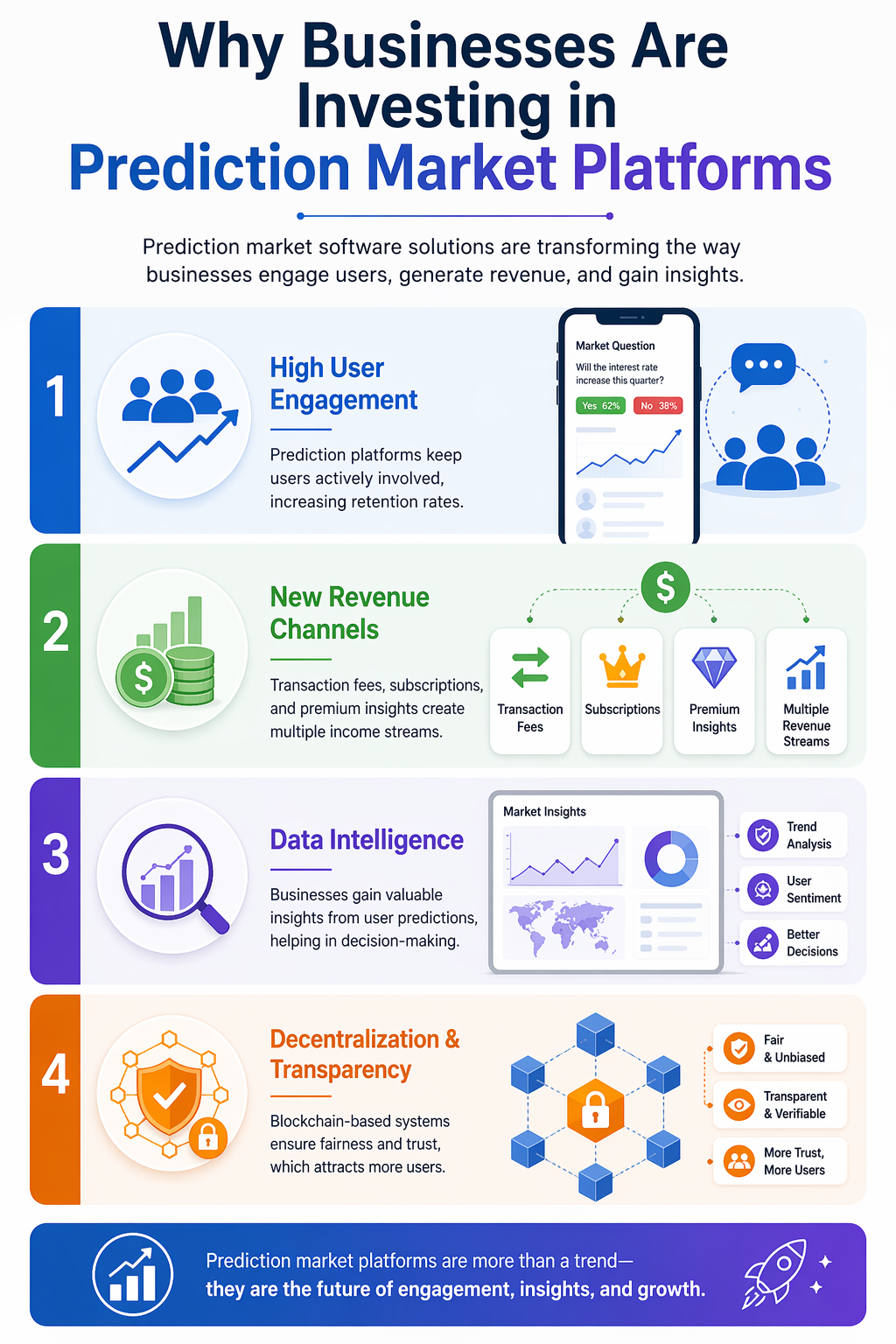
The demand for prediction market software solutions is growing rapidly due to several benefits:
1. High User Engagement
Prediction platforms keep users actively involved, increasing retention rates.
2. New Revenue Channels
Transaction fees, subscriptions, and premium insights create multiple income streams.
3. Data Intelligence
Businesses gain valuable insights from user predictions, helping in decision-making.
4. Decentralization & Transparency
Blockchain-based systems ensure fairness and trust, which attracts more users.
The Role of White Label Solutions
One of the biggest trends in 2026 is the adoption of white-label prediction market software. Instead of building platforms from scratch, businesses use ready-made solutions that can be customized with their branding.
Benefits include:
- Faster time to market
- Lower development cost
- Scalable infrastructure
- Pre-built features like wallet integration and smart contracts
This approach is ideal for startups and enterprises looking to enter the prediction market space quickly.
Choosing the Right Development Partner
If you’re planning to build a prediction market platform, selecting the right development partner is crucial. A reliable prediction market software development Company USA can help you:
- Design scalable architecture
- Integrate blockchain technology
- Ensure regulatory compliance
- Build secure trading systems
Working with experienced developers ensures your platform is robust, user-friendly, and ready to compete in a fast-growing market.
Future of Prediction Markets
Prediction markets are expected to become mainstream financial tools in the coming years. With advancements in AI, blockchain, and decentralized finance, these platforms will offer even more opportunities for profit.
Key trends to watch:
- Integration with DeFi ecosystems
- Expansion into enterprise forecasting
- AI-powered prediction engines
- Increased regulatory clarity
Final Thoughts
Prediction markets in 2026 are no longer experimental—they are a proven way to generate income and build innovative business models. Whether you are a trader, investor, or entrepreneur, the opportunities are vast.
From leveraging data-driven strategies to launching your own platform using prediction market software solutions, the space is full of potential. Businesses looking to enter this domain can benefit from scalable and customizable tools like white label prediction market software.
If you’re considering building your own platform, partnering with experts like NetSet Software can give you a competitive edge with reliable and future-ready development solutions.
Frequently Asked Questions (FAQs)
1. What are prediction markets and how do they work?
Prediction markets are platforms where users trade on the outcomes of future events. Each outcome is priced based on probability, and users can buy or sell positions to make a profit depending on how accurate their predictions are.
2. How do people actually earn money from prediction markets?
Users make money by trading contracts based on event outcomes, identifying price inefficiencies (arbitrage), using data-driven insights, or providing liquidity to earn fees. Success depends on research, timing, and strategy.
3. How does Polymarket make money?
Polymarket earns revenue mainly through transaction fees on trades, spreads between buy and sell prices, and sometimes market creation fees. Increased trading activity directly boosts its earnings.
4. What are online prediction market solutions for businesses?
Online prediction market solutions are ready-to-use platforms that allow businesses to launch their own prediction markets. These solutions help companies engage users, generate revenue, and collect valuable forecasting data.
5. Why should businesses consider white label prediction market software?
White label prediction market software allows businesses to quickly launch a fully functional platform with their own branding. It reduces development time, lowers costs, and provides scalable features like blockchain integration and secure trading systems.