
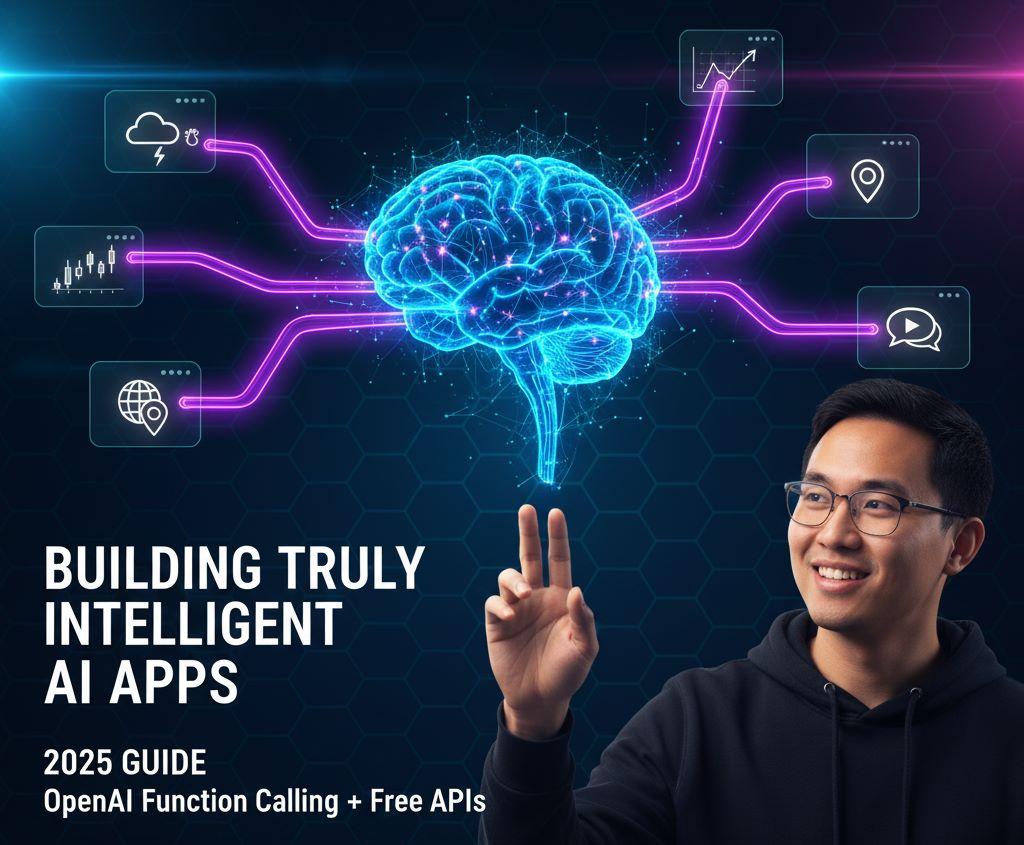
The landscape of artificial intelligence (AI) is rapidly evolving, and OpenAI continues to be at the forefront of driving innovation. One of the most exciting developments in recent times is the introduction of function calling in OpenAI’s language models (LLMs). This feature allows developers and businesses to seamlessly integrate external services through APIs, expanding the capabilities of LLMs in ways that were previously unthinkable.
In this article, we'll explore how function calling works, the advantages it brings to businesses, and how you can use it to connect OpenAI's models to some of the best free APIs available in 2025. Whether you're a developer, entrepreneur, or just an AI enthusiast, this guide will walk you through the essential aspects of function calling, demonstrating how it can enhance your LLM applications and create more powerful, flexible solutions.
What Is Function Calling in OpenAI?
Function calling refers to the ability of OpenAI’s models, such as GPT, to trigger external functions or APIs during a conversation. Essentially, it allows the AI to "call" an external service to perform a specific task, whether it’s retrieving real-time data, running calculations, or even interacting with third-party platforms. This is a major leap forward in AI, as it empowers developers to build applications where the model can dynamically interact with external systems, retrieve useful data, or trigger actions based on user input.
For instance, rather than simply providing static answers based on pre-existing knowledge, OpenAI’s LLMs can now fetch live information (like weather updates, stock prices, or news) by calling a relevant API during the conversation. This enhances the model’s utility, making it more responsive, contextually aware, and adaptable.
Why Function Calling Matters
In traditional AI systems, the models would work in isolation. They had a fixed dataset, meaning their responses were confined to the knowledge they had at the time of training. But this is no longer the case with OpenAI’s function calling. By connecting to APIs, the model can dynamically pull in real-time data, extending its functionality and making it far more versatile.
Some key benefits of function calling include:
- Real-Time Data Access: AI models can now access up-to-the-minute information, whether it’s live sports scores, cryptocurrency prices, stock market updates, or news headlines.
- Task Automation: With function calling, LLMs can automate processes that previously required manual intervention. For example, they could initiate actions like sending emails, creating calendar events, or generating reports based on user instructions.
- Personalized Experiences: By integrating APIs for things like user preferences, purchase history, or location data, the model can offer hyper-personalized recommendations or responses.
- Better User Interaction: Function calling can improve the conversational experience by enabling models to fetch answers to specific queries that are not part of their training data, like “What’s the weather like in Paris today?”
- Access to Specialized Services: Through APIs, models can tap into third-party services like translation tools, image generation, payment gateways, or even machine learning models for specific tasks.
How to Connect OpenAI’s LLMs to APIs
Connecting OpenAI’s LLMs to APIs is relatively straightforward, especially for developers familiar with API integration. Here's a step-by-step guide on how to do it:
- Create an OpenAI Account: First, you need to sign up for an OpenAI account. Once you're registered, you’ll get API access to OpenAI’s models.
- Choose the API You Want to Integrate: OpenAI’s function calling allows you to connect to any external API that offers an open, accessible interface. Some popular APIs you might consider include:
- Weather APIs: Fetch real-time weather data (e.g., Weatherstack).
- Financial APIs: Pull up-to-date stock prices, currency exchange rates, or market trends (e.g., Marketstack, Yahoo Finance).
- News APIs: Get the latest headlines or breaking news from trusted sources (e.g., Mediastack API).
- Machine Learning APIs: Access advanced tools for text analysis, image generation, and natural language processing (e.g., Google Cloud Vision, IBM Watson).
- Obtain API Keys: For most APIs, you’ll need to sign up on the respective platforms and obtain an API key. This key is what allows your application to interact with their services securely.
- Set Up API Endpoints: Once you have the necessary keys, you’ll set up the endpoints in your OpenAI code. This typically involves configuring HTTP requests to interact with the chosen API.
- Write Function Calls in Your Application: In your application code, you can define functions that make calls to the external API based on user input or certain triggers. For example, if a user asks for the latest weather in a specific city, you would create a function to make an API call to retrieve that data and present it in the response.
- Test and Deploy: Before going live, make sure to test the integration thoroughly to ensure that all API calls work correctly and the data is returned accurately. Once everything is set up, deploy your solution.
The Future of OpenAI and Function Calling
The advent of function calling in OpenAI’s models opens the door to a new era of AI-driven applications. As the technology continues to evolve, it is expected that more API integrations will become available, offering even more diverse functionalities. Developers can look forward to enhanced personalization, smarter automation, and more intelligent interactions that combine the power of AI and real-time data.
Moreover, the expansion of free APIs means that small businesses, startups, and individual developers can leverage these tools without breaking the bank. By integrating OpenAI’s models with these APIs, it’s possible to create sophisticated, cost-effective solutions that were once the domain of large corporations.
OpenAI’s function calling is a groundbreaking development that unlocks an entire universe of possibilities for developers and businesses. By connecting OpenAI’s models to the best free APIs, you can create powerful applications that deliver real-time data, automate tasks, and offer personalized experiences. Whether you’re working on a chatbot, a news aggregator, or an AI-powered assistant, the ability to call external APIs will significantly enhance your application’s functionality and user engagement.
For developers looking to stay ahead of the curve, integrating OpenAI’s function calling with free APIs is an essential skill in 2025. The ability to leverage external data sources and automate tasks via function calls ensures that your AI-powered solutions are more dynamic, flexible, and ready for the future.
So, if you haven’t explored OpenAI’s function calling yet, now is the time to start experimenting with API integrations to take your AI applications to the next level!
Developers can build AI features that are faster to develop, easier to debug, and safer to scale.
If you’re serious about building dependable AI-powered software in 2025, this guide is a strong starting point:
🔗 https://blog.apilayer.com/openai-function-calling-how-to-connect-llms-to-the-best-free-apis-2025/
Because great AI isn’t just smart it’s well engineered.