

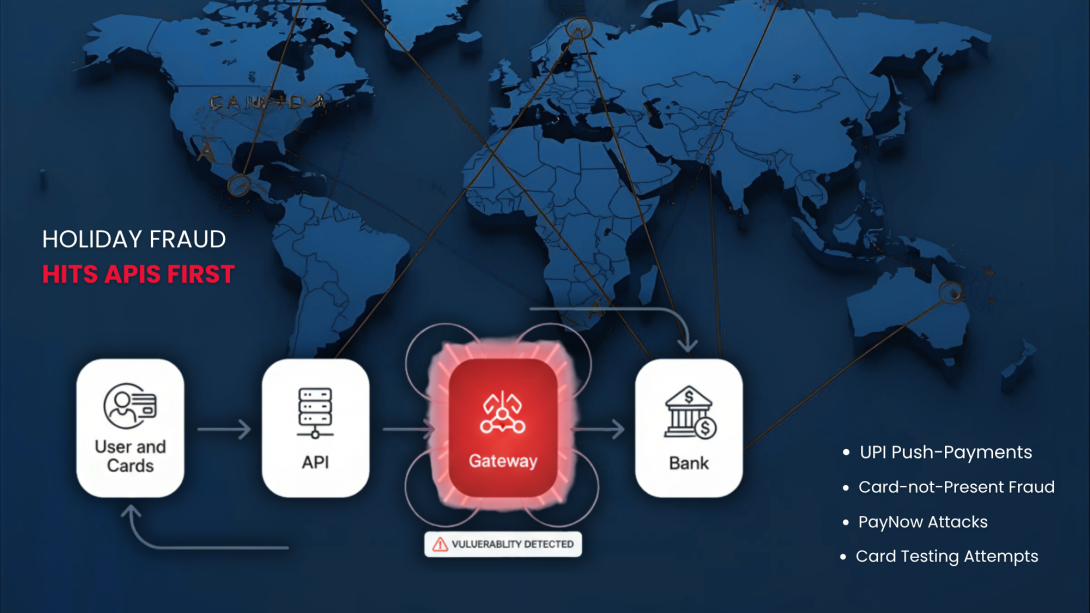
Every holiday season — from Black Friday in the USA and Canada to Singles’ Day in Singapore and Diwali in India — global payment traffic surges to its highest point. However, as transaction volumes increase, so does the risk of fraud. In fact, during major festive shopping windows, fraud attempts increase 3–5 times faster than legitimate transactions.
What most merchants don’t see is that fraudsters no longer rely on basic scams—they target the invisible infrastructure behind payments: APIs, integrations, webhooks, and payment gateways. Attackers exploit weak authentication, static API keys, misconfigured endpoints, replay attacks, unvalidated callbacks, and business logic flaws that emerge during traffic spikes. During holiday peaks, even minor misconfigurations can become major vulnerabilities.
Different regions face different threats:
- USA/Canada: Card-testing, card-not-present (CNP) fraud, chargeback abuse
- Singapore: PayNow manipulation, wallet exploits, QR-based attacks
- India: UPI fraud, push-payment scams, intent-flow hijacking
At Infosprint, our security teams have observed spear-phishing, business email compromise (BEC), and API misconfigurations across various sectors, including manufacturing, pharmaceuticals, e-commerce, and IT/ITES. Our VAPT audits regularly uncover issues such as unnecessary open ports, un-sanitized data flow, and PUA presence on business systems — all of which become high-value attack vectors during holiday sales.
To counter these threats, businesses must adopt stronger authentication methods (such as OAuth 2.0, mTLS, and token rotation), validate every webhook, implement region-specific controls (including 3DS, biometrics, and UPI SafePay), perform stress testing, and monitor cross-border transactions separately.
Holiday fraud isn’t a seasonal nuisance — it’s a predictable, preventable API-layer attack pattern.
Merchants that strengthen their integrations today will avoid major financial losses tomorrow.
👉 Read the full threat analysis on Infosprint to learn how to secure your payment ecosystem before the festive surge.