

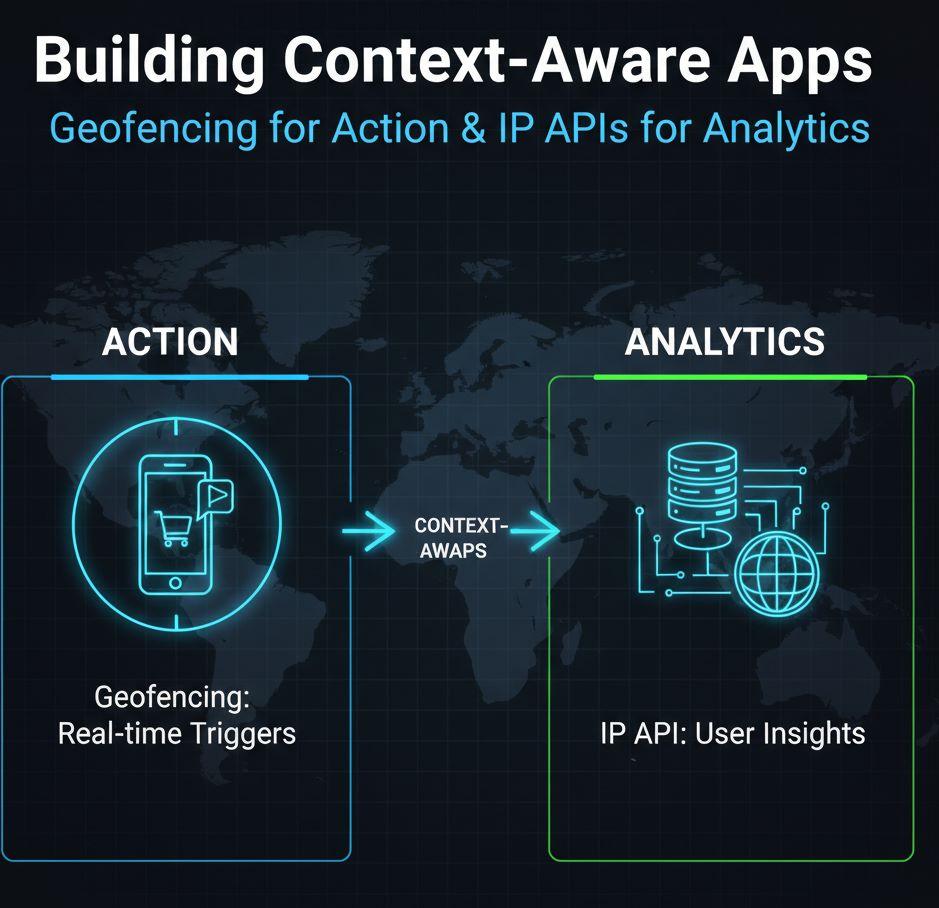
Modern applications are no longer judged only by features. They are judged by how well they understand users in real time. This is where context-aware apps stand apart. By responding intelligently to a user’s location, behavior, and environment, these apps create experiences that feel timely, relevant, and personal.
After more than a decade working with marketing teams, developers, and API-first companies, one pattern is clear: the most successful digital products don’t rely on a single data signal. They combine real-time action triggers with deep location analytics. Integrating geofencing for immediate responses and IP-based location intelligence for insights is one of the most effective ways to achieve this balance.
This article explores how combining geofencing and IP-based analytics helps teams build smarter, more scalable context-aware applications.
Why Context-Aware Apps Matter More Than Ever
Users expect apps to adapt automatically, without repeated inputs or friction. Whether it’s showing region-specific content, enforcing access rules, or optimizing engagement, context awareness is now a baseline requirement.
From a business perspective, context-aware apps:
- Increase user engagement and retention
- Reduce unnecessary interactions
- Enable smarter automation
- Improve analytics accuracy
Location is one of the strongest context signals available, but relying on only one location method often creates blind spots.
Understanding the Two Pillars of Location Intelligence
What Geofencing Brings to the Table
A geofencing api allows developers to define virtual geographic boundaries around physical locations. When a device enters, exits, or remains within that boundary, an event is triggered. These triggers are ideal for real-time actions such as notifications, access control, or feature activation.
Geofencing is especially effective for:
- Mobile-first experiences
- Real-world interactions (stores, venues, campuses)
- Time-sensitive actions
However, geofencing relies heavily on device permissions, GPS availability, and battery optimization rules. When those signals disappear, so does your context.
Where IP-Based Location Analytics Fit In
An ip address API provides location intelligence based on network-level data rather than device sensors. It identifies attributes such as country, city, region, timezone, ISP, and connection type.
This approach is powerful for:
- Backend analytics
- Desktop and server-side applications
- Traffic analysis and segmentation
- Security and compliance insights
IP-based data doesn’t require GPS or user interaction, making it reliable for analytics even when real-time tracking isn’t possible.
Why Using Only One Approach Creates Gaps
Many apps rely entirely on geofencing for location awareness. Others depend solely on IP-based analytics. Both approaches work, but only partially.
Common limitations include:
- Users disabling location permissions
- GPS inaccuracies indoors
- No geofencing support on desktop traffic
- Lack of historical or aggregated location insights
This is why forward-thinking teams combine action-based location triggers with analytics-driven location intelligence.
The Power of Combining Real-Time Action and Analytics
When geofencing handles what should happen now, IP-based analytics answer what is happening overall.
Together, they allow teams to:
- Trigger immediate, location-based experiences
- Analyze regional behavior trends
- Identify usage patterns across markets
- Improve personalization strategies
For example, a mobile app may trigger a geofence-based in-app message when a user enters a specific area, while backend systems analyze broader regional engagement patterns using IP data.
A Practical Architecture for Context-Aware Apps
A scalable context-aware setup often includes:
- Frontend or mobile layer using geofencing events
- Backend services enriched with IP-based location data
- Event pipelines for analytics and automation
- Privacy controls to manage consent and data handling
This layered approach ensures real-time responsiveness without sacrificing long-term insights.
High-Impact Use Cases Across Industries
Retail and On-Demand Services
Geofencing enables instant engagement when users are nearby, while IP-based analytics help teams understand demand across regions and optimize expansion strategies.
SaaS and Digital Platforms
Location-based feature access, pricing logic, and regional onboarding flows become easier when analytics support decision-making behind the scenes.
Security and Risk Management
Combining geofence signals with IP-based checks helps detect anomalies, suspicious access patterns, and location inconsistencies without adding friction for users.
Out-of-the-Box Ideas for Smarter Context Awareness
Here are a few advanced ideas I’ve seen work well in real-world products:
- Context scoring: Combine location, time, and usage behavior into a single score that determines app responses.
- Silent geofencing: Use geofences purely for analytics, not user-facing actions.
- Geo-based A/B testing: Test features or messaging by region using IP insights.
- Fallback logic: When geofencing data is unavailable, use IP-based signals to maintain contextual relevance.
These approaches go beyond basic location tracking and help apps feel intelligent rather than reactive.
Privacy, Compliance, and Performance Considerations
Context-aware apps must be built responsibly. Best practices include:
- Requesting only necessary permissions
- Using IP-based data in aggregated or anonymized form
- Being transparent about location usage
- Optimizing for performance and battery life
Done correctly, combining these approaches improves user trust instead of eroding it.
The Future of Context-Aware Applications
We are moving toward systems that don’t just respond to location, but anticipate intent. Predictive context engines, smarter automation, and privacy-first analytics will define the next generation of apps.
Teams that invest now in combining action-driven and insight-driven location intelligence will be better positioned to scale globally and adapt quickly.
FAQs
What is the main difference between geofencing and IP-based location data?
Geofencing focuses on real-time, device-based triggers, while IP-based data provides broader analytics and backend insights.
Can IP-based location work without user permission?
Yes, IP-derived data does not rely on GPS or device permissions, making it useful for analytics and server-side use cases.
Is combining both approaches safe for user privacy?
When implemented responsibly with consent, anonymization, and transparency, the combination can be privacy-compliant and user-friendly.
Do context-aware apps work on desktop platforms?
Yes. While geofencing is mainly mobile-focused, IP-based analytics support desktop and server-side environments.
If you want to add reliable, scalable location intelligence to your applications, IPstack makes it simple.
With fast, accurate IP-based geolocation data, IPstack helps teams:
- Understand user location at scale
- Improve analytics and personalization
- Support global applications without complexity
👉 Explore IPstack today and start building smarter, context-aware experiences:
https://IPstack.com/
Recommended Resources:
- How to expose APIs to LLMs without breaking security
- OpenAI Function Calling: How to Connect LLMs to The Best Free APIs (2025)
- 12 Best Financial Market APIs for Real-Time Data in 2025
- Geofencing vs. Geolocation: Key Differences and Top APIs for Each
- 10 Free & Affordable APIs Every Startup Developer in 2025 Should Know About