

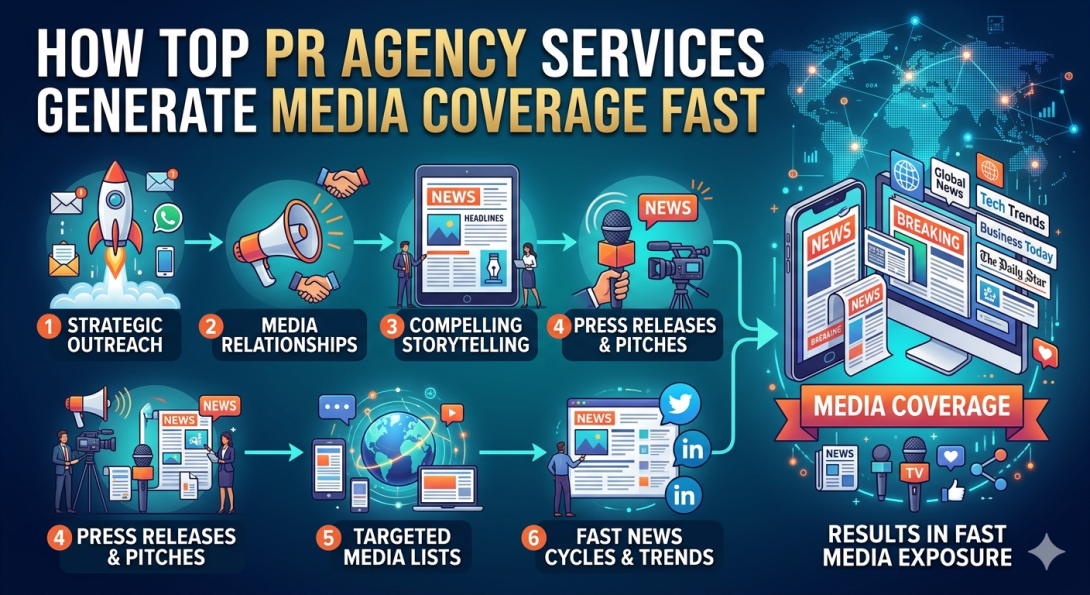
Press release distribution cost depends on reach, targeting, word count, multimedia, editorial support, reporting, and the level of PR strategy included. A Top PR agency does not price distribution only by sending a release to websites. It prices the value of reaching the right media, at the right time, with a message that can earn trust.
For general readers and business owners, the simplest way to understand pricing is this: wider reach usually costs more, but wider reach is not always better. A local restaurant opening, a startup funding announcement, a product launch, and a corporate financial update all need different distribution routes. Therefore, the best budget is the one connected to business goals, not vanity numbers.
Quick answer: Press release distribution cost is mainly influenced by geography, media targeting, content length, multimedia, industry type, urgency, editing, and reporting. Businesses should compare providers by deliverables, not only by headline price, because low-cost distribution may exclude important services.
A business that wants stronger planning can work with a Top PR agency to clarify goals before buying distribution. A company that only needs publishing may choose a press release wire for direct announcement delivery. However, brands that need strategy, positioning, and follow-up often need broader PR support.
Why a top PR agency starts cost planning with audience and geography
A Top PR agency starts by asking who needs to see the announcement. Audience comes before price because distribution without relevance wastes money. A healthcare update, real estate launch, SaaS funding story, or retail expansion each requires a different media map. As a result, the first cost factor is not the platform itself but the audience segment.
Geography is the second major factor. Local distribution is usually more focused, while national and global distribution require broader media access. International campaigns may also need language adaptation, regional targeting, and compliance review. Therefore, businesses should define whether the release is local, regional, national, or global before comparing quotes.
Companies that want strategic direction often compare a public relations agency with direct wire options. This helps them decide whether they need simple publishing or full campaign guidance.
Audience targeting is the first cost lever for credible media visibility today
Audience targeting affects both price and performance. If a release is sent to a broad database without audience filters, the business may pay for reach that does not convert into attention. However, if the release targets specific reporters, trade outlets, financial platforms, regional publications, or industry readers, the campaign becomes more precise.
Better targeting can raise the cost because it requires planning, segmentation, and list quality. Still, it can also reduce waste. For example, a B2B software company does not need every lifestyle website. It needs technology, startup, investor, and business media. This is why many brands prefer top PR firms when message-market fit matters.
Questions to ask before choosing a regional or global distribution route plan
Before buying distribution, businesses should ask five questions. First, where are the target customers located? Second, which media outlets influence those customers? Third, does the announcement need investor, consumer, trade, or local coverage? Fourth, should the campaign include only English-language media or multiple markets? Fifth, will the release need follow-up outreach after publication?
These questions make pricing easier to understand. A regional campaign may be enough for a local service business. A global campaign may be better for a technology, finance, crypto, or export-focused company. Clear geography prevents overspending.
How press release wire reach changes pricing across local national and global markets
A press release wire distributes announcements across media networks, online news sites, databases, and selected industry channels. The broader the reach, the higher the expected cost. Local distribution may cover city or state-level outlets. National distribution aims for wider media visibility. Global distribution can include multiple countries, languages, and industry categories.
The key difference between local and global distribution is audience scale. Local distribution focuses on relevance in a smaller market. Global distribution focuses on visibility across many regions. Therefore, global distribution often includes more network access, stronger syndication, and more technical setup.
Businesses often compare best newswire services USA when they want American market visibility. Companies with international goals may review global newswire distribution to understand whether broader reach supports their campaign.
Geographic scope decides whether distribution remains focused or becomes expensive quickly overall
Geographic scope can make or break a PR budget. A small business opening a branch may not need national distribution. A startup raising funding may need national business coverage. A financial company may need investor-focused channels. A multinational announcement may need global distribution.
The danger is paying for reach that does not support the goal. For example, a local event should not automatically buy global exposure. At the same time, a company announcing an international partnership should avoid a narrow local plan. The best approach is to match the release with the market where decision-makers live, search, and read.
What PR wire services include beyond sending your announcement to media outlets
PR wire services can include more than simple publishing. Many providers offer editorial checks, formatting, headline review, category selection, image uploads, search visibility, distribution reports, and publication links. These services influence price because they affect campaign quality and accountability.
A release that is poorly formatted may be published but ignored. A release with a clear headline, strong summary, quote, media angle, and relevant category has a better chance of being noticed. Therefore, businesses should ask what is included before comparing cost.
Some providers focus on simple digital syndication. Others offer premium media targeting, industry lists, and post-campaign reporting. Brands looking for stronger visibility may compare premium newswire distribution service options instead of choosing the cheapest plan.
Newswire categories separate investor audiences from consumer readerships across markets and regions
Categories matter because not all media audiences are the same. Investor news, consumer news, technology updates, product launches, event announcements, and financial updates should not be treated equally. A strong provider places the release in the right category so media platforms can understand the announcement faster.
This affects cost when specialized distribution is involved. Financial, technology, healthcare, crypto, and legal announcements may require more careful targeting. For example, a company announcing quarterly results may need a financial newswire service. A consumer brand launching a new product may need lifestyle, retail, and business channels instead.
What to include in a professional release before submitting to editors today
A professional press release should include a clear headline, short summary, dateline, newsworthy opening paragraph, supporting details, executive quote, boilerplate, media contact, and relevant links. It should answer who, what, when, where, why, and how within the first few paragraphs.
Businesses should avoid exaggerated claims, vague language, and unsupported statistics. Editors prefer direct information. A clean structure also reduces revision time. As a result, preparation can reduce extra editing charges and improve distribution speed.
How PR services for businesses balance budget speed credibility and measurable outcomes
PR services for businesses combine planning, writing, distribution, outreach, and reporting. The cost is usually higher than basic publishing because the provider supports the campaign before and after the release goes live. This can be useful for businesses that lack in-house PR knowledge.
Speed is another pricing factor. Standard distribution may be enough for evergreen announcements. However, crisis updates, event reminders, earnings-related news, or time-sensitive launches may require faster handling. Rush delivery can increase the final price because editorial teams must prioritize the release.
Credibility also matters. A release published on low-quality sites may create links, but it may not build trust. Businesses should focus on quality placements, clear messaging, and measurable reporting. This is why many companies compare PR companies before selecting a provider.
Why editorial review and compliance checks can influence release fees before approval
Editorial review protects both the business and the distribution partner. Review teams check whether the announcement is clear, accurate, properly formatted, and suitable for publication. Some industries need extra caution because claims may involve finance, healthcare, legal services, crypto, or investment topics.
Compliance checks can add cost when releases require verification or revision. However, these checks also reduce the risk of rejection. For example, unsupported claims like “best in the world” or “guaranteed returns” may create problems. A more balanced release improves trust and avoids unnecessary delays.
Why content complexity affects press release distribution pricing before media pickup happens
Content complexity affects press release distribution cost because longer, technical, or heavily regulated announcements require more work. A short company update is usually easier to edit and publish. A detailed product announcement, merger update, medical innovation, funding round, or financial notice may need stronger writing and review.
Word count can also influence pricing. Many distribution services set base limits and charge more for extra words. Multimedia, tables, embedded quotes, and multiple links can also affect the final quote. Therefore, businesses should keep the release concise and focused.
Companies comparing press release distribution pricing should ask what word count is included. They should also ask whether writing, editing, images, and reporting are included or billed separately.
Writing quality reduces revision cycles and protects distribution budgets during campaigns too
Strong writing can lower hidden costs. A clear release needs fewer revisions, fewer approvals, and less back-and-forth with editorial teams. Poor writing can delay publication and increase support time. It may also weaken the media angle.
A good press release starts with the news, not the company background. It explains why the announcement matters now. It includes facts, quotes, and context without sounding like an advertisement. This style helps journalists and AI search systems understand the release quickly. Businesses that need help may use business press release distribution with professional editorial support.
Multimedia assets often improve engagement but can increase distribution costs for brands
Multimedia can make a release more useful. Images, logos, videos, infographics, and product photos help readers understand the story faster. They can also improve visibility on some publishing platforms. However, multimedia may increase distribution cost because files require hosting, formatting, and platform support.
Businesses should not add multimedia only because it looks impressive. Each asset should support the story. A product launch may need images. An event announcement may need a speaker photo or venue image. A financial update may not need multiple visuals. Smart asset selection protects budget and keeps the release focused.
How to estimate multimedia value without overspending on attachments for coverage goals
To estimate multimedia value, ask whether the asset helps a journalist, customer, investor, or search user understand the news. If the answer is yes, the asset may be worth the cost. If the asset is decorative, it may not be necessary.
One strong image is often better than several weak attachments. Product photos, executive headshots, charts, and event visuals should be high quality. File names and captions should also be clear. Good multimedia supports discovery, but unnecessary multimedia adds cost without improving outcomes.
How event PR services change costs for launches conferences and community campaigns
event PR services have different cost drivers because timing is critical. An event release must reach people before the date, not after interest has passed. This means planning, calendar awareness, media reminders, and sometimes follow-up outreach become important.
Event campaigns may include pre-event announcements, speaker highlights, sponsor updates, registration pushes, live coverage, and post-event summaries. Each stage can affect pricing. A single announcement costs less than a full event campaign. However, a multi-stage plan can create more visibility and attendance.
Businesses planning conferences, trade shows, webinars, charity events, or product launches may need event promotion PR services. The cost should be judged by attendance goals, media relevance, and post-event value.
Local event campaigns usually need focused outreach instead of broad blasts online
Local event campaigns perform best when the release targets local media, community calendars, business publications, and niche audiences. Broad national blasts may look impressive, but they often miss the people who can actually attend. Focused outreach is usually more useful for city-level events.
For example, a restaurant opening needs local food writers, community publications, and neighborhood platforms. A healthcare seminar needs local health reporters and community groups. A startup demo day may need business and investor calendars. This is why many planners compare event public relations agency support before choosing distribution.
How to reduce event promotion costs without reducing media relevance or trust
Businesses can reduce event PR costs by planning early. Early planning avoids rush fees and allows enough time for media outreach. It also helps the team create one strong release instead of several weak updates.
Another way to reduce cost is to target only the most relevant outlets. Local campaigns do not need every national site. Clear event details also reduce editing time. Include the date, time, location, registration link, speakers, purpose, and audience benefit. Relevance saves money and improves response.
When PR services for startups need affordable packages instead of enterprise distribution
PR services for startups should match the company’s stage. A bootstrapped startup, seed-stage company, funded startup, and scaling company do not need the same PR package. Early-stage brands often need credibility, search visibility, and clear messaging more than massive reach.
Affordable packages can help startups announce launches, funding, partnerships, app releases, product updates, and founder stories. However, low cost should not mean low quality. A startup still needs a strong headline, clear proof points, and a reason the announcement matters.
Startups often compare startup PR packages USA when they need controlled costs. They may also review affordable PR services for startups to avoid enterprise-level spending before market traction is proven.
Startups should match PR packages to growth stage and investor goals carefully
Startup PR should support business milestones. A pre-launch company may need brand awareness. A funded company may need investor credibility. A SaaS company may need customer education. A marketplace may need trust and adoption. Each goal changes the right distribution plan.
Investors and customers also read announcements differently. Investors look for traction, market size, leadership, funding, and growth signals. Customers look for benefits, reliability, and trust. Therefore, startups should avoid generic releases. A targeted story can make a smaller budget work harder. A PR company for startups USA can help align the message with growth goals.
Questions startups should ask before buying PR services pricing for growth today
Startups should ask what is included in the package. Does it include writing, editing, distribution, media targeting, reports, or follow-up? Does the provider understand startup language? Can the release support fundraising, customer acquisition, hiring, or partnership goals?
Startups should also ask whether results are guaranteed. Ethical PR providers can guarantee distribution deliverables, but they cannot guarantee earned editorial coverage. This difference matters. Transparent answers help founders compare PR services pricing for small business without being misled.
How a press release distribution company prices reporting editing and strategic support
A press release distribution company may price services in layers. The first layer is distribution. The second layer is content support. The third layer is targeting. The fourth layer is reporting. The fifth layer is strategic guidance. Each layer adds value when used correctly.
Reporting is especially important because businesses need proof of delivery. A basic report may include published links and dates. A stronger report may include outlet categories, audience indicators, traffic estimates, search visibility, and engagement metrics. These details help teams judge whether the campaign worked.
Editing and strategy also influence price. A release written by a business owner may need professional restructuring. A campaign tied to reputation, funding, events, or investor news may need deeper positioning.
Editing and strategy support often decide whether distribution creates results that last
Distribution alone does not guarantee impact. The message must be newsworthy, readable, and aligned with business goals. Editing improves clarity. Strategy improves relevance. Together, they help the release work beyond publication.
For example, a product launch release should explain the market problem, product solution, customer benefit, and proof points. A corporate announcement should explain business significance. A local business release should explain community relevance. This is why some brands choose best press release distribution services that include more than basic syndication.
Reporting metrics help businesses judge distribution value after publication with confidence today
Reporting turns PR from guesswork into learning. After a campaign, businesses should review where the release appeared, which outlets were relevant, and whether the message was indexed by search engines. They should also review referral traffic, branded search changes, social shares, and media inquiries.
Not every campaign produces immediate sales. Some releases support trust, visibility, investor confidence, recruitment, or long-term brand authority. Good reporting explains these outcomes clearly. Businesses comparing PR distribution pricing should ask for sample reports before buying.
How a Top PR agency helps compare newswire distribution cost fairly today
A Top PR agency compares newswire distribution cost by deliverables, not promises. Two providers may quote different prices because they include different services. One may include writing and reporting. Another may charge extra for editing, images, word count, or premium categories. Therefore, the cheapest quote is not always the best value.
Fair comparison starts with equal requirements. Businesses should compare the same release length, same geography, same industry category, same multimedia needs, and same reporting expectations. This creates an apples-to-apples view of cost.
A company can also compare a public relations company with a self-service platform. The right choice depends on whether the campaign needs strategy, speed, authority, or simple distribution.
Comparing providers requires equal release length targeting and add-ons across all quotes
Provider comparison should be structured. Businesses should create one checklist and send it to every vendor. The checklist should include release length, target markets, preferred industries, images, publishing timeline, reporting format, and support level.
This process reveals real cost differences. A low base price may become expensive after adding required features. A higher package may include everything from the start. Businesses should also check whether the provider offers industry-specific support. For example, crypto, finance, healthcare, and events may need specialized handling. Comparing top newswire companies becomes easier when requirements are consistent.
Hidden fees become visible when businesses request itemized campaign estimates before purchase
Hidden fees often appear in word count, image uploads, rush distribution, premium targeting, extra links, edits, logos, reporting, and international regions. Businesses can avoid surprises by asking for itemized pricing. Itemized estimates show what is included and what costs extra.
This is especially important for companies with limited budgets. A small business may approve a low-cost package and later discover that editing or reporting is not included. Transparent estimates protect planning. They also help teams compare press release pricing across providers.
How to choose press release distribution pricing that fits business goals better
The best press release distribution pricing is the pricing that supports a measurable business goal. A company should not buy the largest package only because it sounds powerful. Instead, it should choose the plan that matches audience, timing, credibility, and expected outcomes.
For awareness campaigns, broad distribution may be useful. For local events, focused outreach may be better. For investor news, financial and business media categories matter. For startups, affordability and message clarity are often more important than global reach. Therefore, pricing should follow strategy.
Businesses can review PR services pricing to understand service levels. Small companies may compare PR agency for small business support when they need guidance without enterprise costs.
Budget choices should follow business goals rather than vanity reach metrics alone
Vanity reach can mislead buyers. A provider may claim large distribution numbers, but the real question is whether the release reaches relevant readers. Ten relevant outlets can sometimes be more valuable than hundreds of weak placements.
Businesses should define success before buying. Success may mean media pickup, branded search visibility, investor awareness, event registrations, product interest, partnership leads, or local trust. Once success is defined, pricing becomes easier to judge. A campaign for leads needs different support than a campaign for reputation. This practical approach helps businesses spend with purpose.
Frequently asked questions about press release distribution cost and Top PR agency pricing
1. What is press release distribution cost?
Press release distribution cost is the amount a business pays to publish and distribute an announcement through media networks, online news platforms, industry channels, or PR partners. The cost can include writing, editing, targeting, multimedia, reporting, and support. A Top PR agency may charge more than a basic platform because it adds strategy, positioning, and campaign guidance.
2. Why does press release distribution pricing vary so much?
Pricing varies because every campaign has different needs. Distribution geography, industry category, word count, multimedia, urgency, editorial review, and reporting all affect the quote. A local release costs less than a national or global campaign. A simple company update costs less than a technical, financial, healthcare, or product launch announcement requiring deeper review.
3. Is a press release wire cheaper than hiring a PR agency?
A press release wire is often cheaper when the business only needs distribution. However, a PR agency can be more valuable when the business needs strategy, writing, targeting, media advice, or campaign planning. The key difference is service depth. A wire sends the release, while an agency helps shape the story and improve relevance.
4. What should businesses check before buying PR wire services?
Businesses should check included word count, target regions, media categories, editing support, multimedia fees, publication timeline, reporting details, and revision policy. They should also ask whether the provider offers industry-specific targeting. This prevents hidden costs and helps the buyer understand whether the package supports awareness, credibility, traffic, event promotion, or investor visibility.
5. Do multimedia assets increase press release distribution cost?
Yes, multimedia assets can increase cost because images, videos, logos, PDFs, and infographics may require hosting, formatting, and platform support. However, multimedia can also improve understanding and engagement when it supports the story. Businesses should add visuals only when they help explain the announcement, such as product photos, event images, executive headshots, or charts.
6. Are event PR services priced differently from normal press releases?
Event PR services can be priced differently because timing, reminders, local targeting, and follow-up matter more. A single event announcement may be affordable, but a full event campaign can include pre-event promotion, speaker announcements, sponsor updates, media outreach, registration pushes, and post-event coverage. The right package depends on attendance goals and audience location.
7. What is the best PR option for startups with limited budgets?
Startups with limited budgets should choose packages that include clear writing, focused targeting, and useful reporting. They do not always need enterprise-level distribution. A startup should match the package to its milestone, such as launch, funding, partnership, app release, or product update. Affordable packages work best when the message is specific and newsworthy.
8. Can press release distribution guarantee media coverage?
Press release distribution can guarantee publishing or syndication deliverables if the provider offers them, but it cannot honestly guarantee earned editorial coverage from independent journalists. Journalists choose stories based on relevance, news value, timing, and audience fit. Businesses should be cautious of providers promising guaranteed major media coverage without clear terms and proof.
9. How can small businesses reduce press release distribution costs?
Small businesses can reduce costs by choosing focused geography, keeping releases concise, preparing complete information, avoiding unnecessary multimedia, and planning early to prevent rush fees. They should also request itemized quotes. A focused campaign is usually better than paying for broad distribution that does not reach customers, local media, or industry readers.
10. How should a Top PR agency explain campaign value?
A Top PR agency should explain campaign value through strategy, audience targeting, message quality, distribution scope, reporting, and business outcomes. It should show what is included in the price and why each element matters. Strong agencies help businesses understand whether the campaign supports visibility, credibility, SEO value, event attendance, investor awareness, or brand trust.
Final thoughts on choosing press release distribution cost with a Top PR agency
Press release distribution cost becomes easier to understand when businesses connect price with purpose. The main factors are audience, geography, word count, multimedia, industry category, urgency, editing, reporting, and strategic support. A low-cost package may work for simple announcements, but important campaigns often need better planning.
A Top PR agency helps businesses avoid waste by matching distribution to the right audience and outcome. A small business may need local visibility. A startup may need credibility. An event organizer may need attendance. A larger company may need national or global awareness. Each goal requires a different pricing approach.
Before choosing a provider, compare deliverables carefully and ask for itemized pricing. For a focused campaign that balances affordability, reach, and professional support, explore best press release distribution service for startups and choose a plan that fits your next announcement.
Read More Article: Budget PR Services USA for Small Business Marketing
Read More Article: PR Marketing Agency USA Solutions for Online Growth