
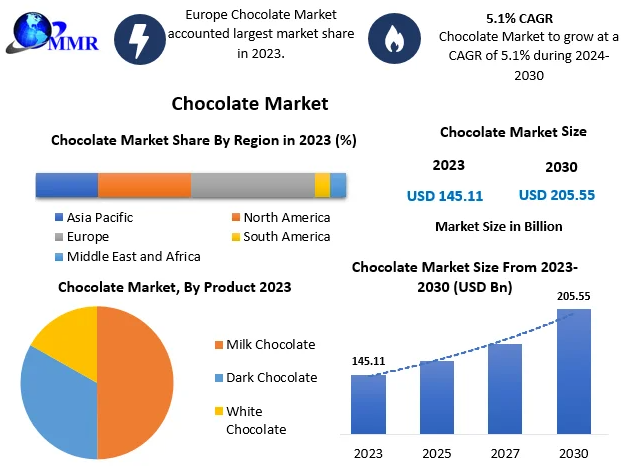
The Chocolate Industry continues to demonstrate robust growth potential, with strong drivers across all regions. A recent in-depth analysis provides a clear market estimation, expansive segmentation details, growth opportunities, and a focused look at major markets including the USA and Germany. A comprehensive commutator (competitive) analysis underscores key dynamics shaping the industry’s competitive landscape.
Gain Valuable Insights – Request Your Complimentary Sample Now @ https://www.maximizemarketresearch.com/request-sample/13157/
Market Estimation & Definition
The global chocolate market is estimated to be in the range of USD 130 billion to USD 140 billion as of 2024–2025. Industry projections suggest the market will grow steadily, reaching USD 172–220 billion by 2030–2033, reflecting a compound annual growth rate (CAGR) of 4–5%.
Definition: The chocolate market encompasses all forms of sweetened, cocoa-based confections—milk, dark, white, vegan/functional, and compound varieties—distributed through modern retail, online channels, convenience stores, and specialty outlets.
Market Growth Drivers & Opportunity
Several compelling factors are fueling continued expansion:
- Rising Disposable Incomes & Premiumization: Growing affluence—especially in developing markets—fuels demand for premium, artisanal, and functional chocolates. Demand for dark, vegan, and functional chocolate products has shown double-digit growth in many developed markets.
- Shifts in Consumer Preferences: Health awareness is pivoting consumers toward organic, sugar-free, vegan, and clean-label chocolates. This shift has reshaped product portfolios, with leading brands emphasizing reduced-sugar, organic certifications, and ethically sourced cocoa.
- E-commerce & Omnichannel Expansion: While supermarkets remain dominant, online retail is surging across regions. Personalized subscription boxes, direct-to-consumer strategies, and premium gifting assortments are becoming more prevalent.
- Cocoa-Price Saga & Supply Challenges: Cocoa prices have surged in recent years, surpassing historical highs due to weather disruptions, crop diseases, and supply-chain challenges in West Africa. This has forced manufacturers to adopt price increases, shrinkflation tactics, and recipe reformulation.
- Regional Resilience Differences: European consumers treat chocolate as a staple, showing resilience even amid price hikes. In contrast, American consumers often view chocolate as an impulse purchase, making them more price-sensitive. This difference has significant implications for brand strategies.
Feel free to request a complimentary sample copy or view a summary of the report: https://www.maximizemarketresearch.com/request-sample/13157/
Opportunities:
- Innovation in Health-Focused Products: Expanding portfolios with vegan, organic, and functional chocolates allows companies to differentiate and capture premium margins.
- Strengthening E-commerce Distribution: Direct-to-consumer strategies, coupled with omnichannel sales, provide greater reach and profitability.
- Geographically Strategic Sourcing: Producers with access to tariff-free trade agreements or diversified cocoa sourcing are better positioned to withstand commodity volatility.
Segmentation Analysis (Descriptive Format)
The global chocolate market can be segmented by product type, distribution channel, and region:
- By Type:
- Milk, Dark, and White Chocolates: These remain the foundation of global sales, with dark chocolate growing fastest due to perceived health benefits.
- Functional and Specialty Chocolates: Includes vegan, organic, and sugar-free variants, which are increasingly attractive to health-conscious consumers.
- Compound Chocolate: A growing sub-segment valued for cost-effectiveness and flexibility, projected to nearly double in size by the mid-2030s.
- By Distribution Channel:
- Supermarkets & Hypermarkets: Continue to dominate thanks to visibility, promotions, and broad product variety.
- Convenience Stores: Capture impulse buying and seasonal spikes, particularly in urban areas.
- Online Retail / E-commerce: Experiencing the fastest growth, driven by younger consumers and premium gifting demand.
- Specialty Retailers: Chocolatiers and health-food stores remain important outlets for artisanal and premium offerings.
- By Region:
- North America, Europe, Asia-Pacific, South America, and Middle East & Africa make up the primary regional markets, each with unique consumer behaviors and demand drivers.
Dive deeper into the market dynamics and future outlook: https://www.maximizemarketresearch.com/request-sample/13157/
Country-Level Analysis: USA & Germany
United States:
- The U.S. remains the single largest market in North America, contributing more than two-thirds of regional chocolate revenues.
- Rising cocoa prices and trade policies have placed pressure on U.S.-based producers, while imports from Canada and Mexico—benefiting from tariff advantages—gain competitive ground.
- Consumers are showing increasing interest in premium, organic, and clean-label products, while gifting assortments and seasonal chocolates remain strong.
- Potential headwinds include evolving consumer health behaviors, such as reduced snack consumption driven by weight-management trends.
Germany:
- Germany represents one of Europe’s largest chocolate markets, generating over USD 10 billion in annual sales, with growth expected to surpass 5% CAGR through 2030.
- German consumers demonstrate strong loyalty to premium, single-origin, and ethically sourced chocolates, with more than 70% indicating preference for higher-quality and sustainably produced options.
- Seasonal chocolates, particularly during Christmas and Easter, remain cultural staples driving consistent sales spikes.
- Overall, Germany is positioned as a resilient and steadily expanding premium chocolate hub within Europe.
Commutator (Competitive) Analysis
The chocolate market is highly competitive, shaped by global players, regional specialists, and artisanal innovators.
Key Competitive Dynamics:
- Supplier Power: Cocoa supply remains concentrated in West Africa, with disruptions creating volatility and raising supplier bargaining power.
- Buyer Power: In markets like the U.S., consumers are highly price-sensitive, while European consumers show greater brand loyalty and quality-driven purchasing habits.
- Barriers to Entry: While artisanal brands continue to emerge, large-scale entry is constrained by high capital costs, entrenched brand loyalty, and supply-chain complexities.
- Threat of Substitutes: Non-chocolate confections compete, but chocolate’s cultural appeal, tradition, and resilience during economic downturns provide stability.
- Rivalry Among Competitors: Intense, with companies competing across product innovation, sustainable sourcing, packaging, and pricing strategies.
Major Players:
Nestlé, Mars, Mondelēz International, Ferrero, Hershey, and Lindt dominate the global stage. Each leverages different strengths:
- Mondelēz & Lindt benefit from strong European roots and premium positioning, giving them resilience against rising costs.
- Hershey faces challenges in the U.S. with more elastic consumer demand and higher exposure to tariffs and cocoa price hikes.
- Ferrero leverages its diverse product portfolio and seasonal appeal, maintaining steady growth globally.
- Producers in Canada & Mexico gain strategic advantages in the North American market due to tariff-free access and proximity to U.S. consumers.
Overall, rivalry remains fierce, and success hinges on innovation, sustainability commitments, and agile responses to raw material volatility.
Conclusion
In summary, the global chocolate market remains on a strong upward trajectory, with consensus estimates placing the market between USD 130–142 billion in 2024–25 and projections pointing to USD 170–220 billion by the early 2030s, at a CAGR of 4–5%.
Key drivers include rising disposable incomes, consumer demand for premium and health-conscious products, and the continued growth of e-commerce. Challenges such as cocoa price volatility and supply-chain constraints pose hurdles, yet they are also spurring innovation and strategic sourcing.
About Us
Maximize Market Research is one of the fastest-growing market research and business consulting firms serving clients globally. Our revenue impact and focused growth-driven research initiatives make us a proud partner of majority of the Fortune 500 companies. We have a diversified portfolio and serve a variety of industries such as IT & telecom, chemical, food & beverage, aerospace & defense, healthcare and others.
Contact Maximize Market Research
MAXIMIZE MARKET RESEARCH PVT. LTD.
2nd Floor, Navale IT park Phase 3,
Pune Banglore Highway, Narhe
Pune, Maharashtra 411041, India.
+91 9607365656