
Precision Medicine Market Overview Analysis By Fortune Business Insights Analysis
Market Summary
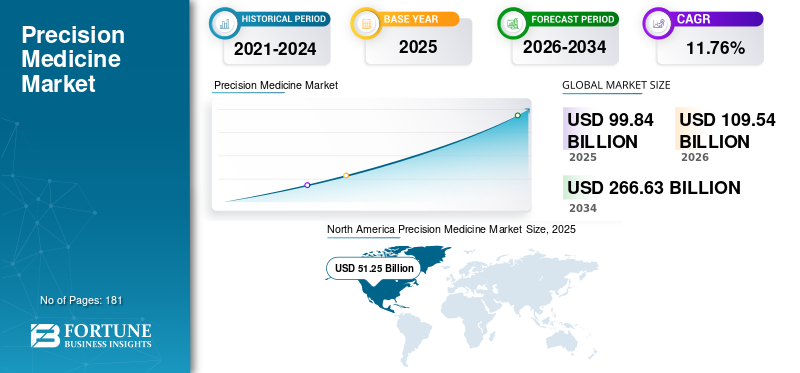
According to Fortune Business Insights: The global precision medicine market was valued at USD 99.84 billion in 2025 and is projected to grow from USD 109.54 billion in 2026 to USD 266.63 billion by 2034, exhibiting a CAGR of 11.76% during the forecast period. Precision medicine tailors treatment and prevention to individual characteristics such as genetic makeup, lifestyle, and environment, rather than using a one-size-fits-all approach, drawing on genomics, proteomics, and bioinformatics. Growth is supported by rising chronic disease, R&D activity, and demand for more effective treatments with fewer side effects. COVID-19 had a positive effect on the market by raising interest in individualized treatment and molecular diagnostics. North America led the market with a 51.33% share in 2025.
Key Market Trends
Advances in cell and gene therapy are a key trend, including FDA approvals such as Kymriah in 2022 and Casgevy and Lyfgenia for sickle cell disease in 2023. Strategic partnerships and collaborations among key companies are also shaping the market.
Get a Sample Research PDF: https://www.fortunebusinessinsights.com/enquiry/request-sample-pdf/110463
Key Market Drivers
The rising prevalence of chronic diseases such as cancer, cardiovascular disease, and diabetes is the primary driver. Significant healthcare spending on R&D, clinical trials, and government initiatives adds to growth, as does funding for precision medicine companies, such as Actio Biosciences' USD 55.0 million Series A in 2023.
Market Restraints
Data privacy and security concerns around genetic and health data are the main restraint. Data breaches, such as the October 2023 23andMe incident, which exposed details of about 14,000 individuals (0.1% of its clients), highlight the risk.
Market Opportunities
The cell and gene therapy pipeline, growing funding for precision medicine companies, and partnerships between diagnostics makers and drug developers offer clear opportunities. Software, the smallest product segment, is described as growing quickly.
Segmentation Analysis
By product, devices are the largest segment at 58.25% in 2026, while software is the smallest but growing quickly. By type, diagnostics lead with 47.49%, including genetic tests and biomarker tests, with therapeutics also holding a notable share. By indication, oncology is the largest at 31.93%, with neurology and psychiatry, immunology, and cardiology also significant. By end user, pharmaceutical and biopharmaceutical companies lead with 54.93%, followed by diagnostic laboratories and CROs.
Regional Outlook
North America led the market with a 51.33% share in 2025 (USD 51.25 billion, projected at USD 56.38 billion in 2026), with the U.S. at USD 53.50 billion in 2026.
Europe held a 24.35% share (USD 24.31 billion in 2025, USD 26.79 billion projected for 2026), with Germany at USD 6.88 billion and the U.K. at USD 4.7 billion in 2026.
Asia Pacific accounted for a 14.29% share (USD 14.27 billion in 2025, USD 15.81 billion projected for 2026), with China at USD 6.06 billion, Japan at USD 3.20 billion, and India at USD 2.25 billion in 2026.
Latin America held a 6.04% share (USD 6.03 billion in 2025, USD 6.39 billion projected for 2026), while the Middle East & Africa held a 3.98% share (USD 3.98 billion in 2025, USD 4.16 billion projected for 2026).
Both of the last two regions are expected to grow more slowly, citing slower adoption, economic and regulatory challenges, and limited infrastructure.
Connect with Our Expert for any Queries: https://www.fortunebusinessinsights.com/enquiry/speak-to-analyst/110463
Competitive Landscape
The market is highly fragmented. Key players include Illumina, Inc.; Agilent Technologies, Inc.; Thermo Fisher Scientific Inc.; Pfizer Inc.; Novartis AG; Bristol-Myers Squibb Company; Nucleai, Inc.; Precision Medicine Group, LLC; AstraZeneca; QIAGEN; Abbott; Koninklijke Philips N.V.; and IBM Life Sciences.
In October 2023, Novartis reported positive Phase III results for Pluvicto in PSMA-positive mCRPC.
In January 2023, QIAGEN partnered with Helix Laboratory on companion diagnostics using NGS, and Agilent acquired Avida Biomed.
In June 2023, Nucleai collaborated with Mayo Clinic BioPharma Diagnostics.
In August 2022, Thermo Fisher received FDA approval for the Oncomine Dx Target Test, and in May 2022, Illumina partnered with Janssen Biotech on companion diagnostics.
Uncover Japan’s Market Trends - Explore the Latest Precision Medicine Market Insights