
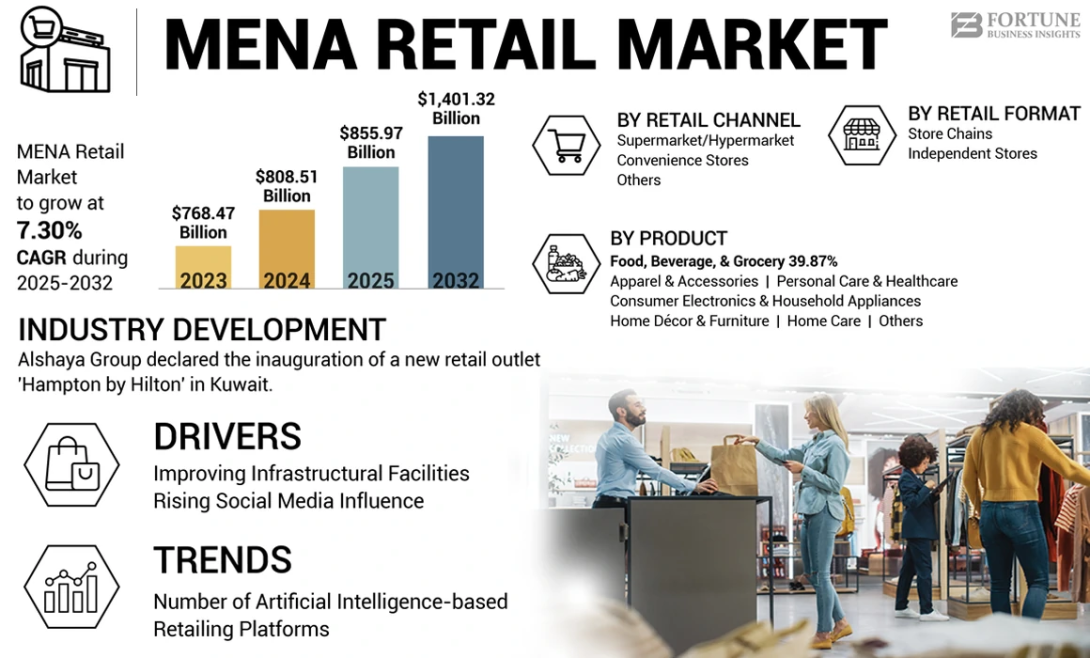
MENA Retail Market Overview Analysis By Fortune Business Insights
Market at a Glance
According to Fortune Business Insights: The Middle East and North Africa (MENA) retail market stood at USD 808.51 billion in 2024 and is forecast to climb from USD 855.97 billion in 2025 to USD 1,401.32 billion by 2032, reflecting a compound annual growth rate (CAGR) of 7.30% over the forecast period. This robust trajectory underscores the region's emergence as one of the world's most compelling retail frontiers, shaped by a confluence of demographic growth, technology adoption, and policy-driven investment.
Market Overview
The MENA retail industry is a diverse and dynamic sector influenced by cultural, economic, and technological factors. The region encompasses a broad spectrum of economies — from the high-income Gulf Cooperation Council (GCC) states such as the UAE and Saudi Arabia to developing markets like Egypt and Morocco. This economic diversity translates into varied consumer behaviors, retail formats, and investment landscapes, yet all are united by an accelerating pace of modernization and digitalization.
Government-backed initiatives and technological infrastructure investments are key enablers of this expansion. A notable example is Amazon Web Services' 2022 expansion in the UAE, which introduced advanced cloud infrastructure to serve local consumers and businesses with greater flexibility and lower latency — a development that signals the region's readiness to support sophisticated digital commerce ecosystems.
Get a Sample Research PDF: https://www.fortunebusinessinsights.com/enquiry/request-sample-pdf/109892
Key Growth Drivers
Improving Retail Infrastructure The rising number of grocery stores, specialty retailers, and large-format shopping destinations is a primary growth lever. Government financial support for infrastructure development is steadily increasing the number of retail outlets and enhancing consumer accessibility. Expanding home décor and furniture segments, driven by luxury product demand and replacement trends, further support market revenues. A prominent example is Apparel Group's opening of 19 new stores across India, UAE, Saudi Arabia, and Qatar in 2024.
Rise of AI-Powered and Digital Platforms AI-based shopping platforms are reshaping the retail experience across MENA. These platforms analyze consumer purchasing patterns to deliver personalized product recommendations, while virtual reality integrations create immersive shopping environments. Government partnerships are also fostering smart logistics, as evidenced by Saudi Arabia's Modon authority signing a public-private partnership in February 2023 to establish 14 smart warehouses in Jeddah — a move designed to optimize inventory management at a national scale.
Social Media Influence With 4.8 billion global social media users — representing 59.9% of the world's population — platforms such as Instagram, YouTube, and Facebook are powerful catalysts for consumer demand in MENA. Increasing social media penetration across the region is driving product discovery and purchase decisions, fueling retail growth throughout the forecast period.
Key Restraint
Supply Chain Costs and Geopolitical Risk Conflict, inadequate infrastructure, and limited transportation capacity in parts of North Africa and the Middle East continue to disrupt supply chains. These challenges push up the cost of raw materials and finished goods, compelling manufacturers and distributors to raise prices. Higher product prices, in turn, reduce consumer discretionary spending — a headwind that could temper market expansion, particularly in lower-income economies.
Segmentation Insights
By Product The food, beverage, and grocery segment dominated in 2023, driven by rapid population growth and rising consumer preference for organic, vegan, and sustainably produced foods. The consumer electronics and household appliances segment is on a high-growth trajectory, fueled by demand for smartphones, smartwatches, and laptops, alongside a growing product-replacement culture. Hisense International's 2023 expansion — opening two production facilities and three flagship stores across the GCC, Levant, and North Africa — exemplifies this momentum.
By Retail Channel Supermarkets and hypermarkets led the channel segment in 2023, anchored by high consumer demand and the growing trend of impulse buying and household stockpiling. Major players including Carrefour, LuLu Group International, and ShopRite dominate this space. E-commerce is the fastest-growing channel, as retailers invest heavily in digital platforms to offer broader product ranges and enhanced customer experiences.
By Retail Format Independent stores held the largest format share in 2023. In Saudi Arabia alone, the number of bakalas (independent neighborhood stores) reached approximately 40,000 by 2021. Store chains are also expanding rapidly, with Carrefour's launch of 50 new stores in 2023 and the continued regional push by global chains like Spar and 7-Eleven.
Connect with Our Expert for any Queries: https://www.fortunebusinessinsights.com/enquiry/speak-to-analyst/109892
Competitive Landscape
The MENA retail market is intensely competitive, with major players expanding both their physical and digital footprints. Leading companies include Alshaya Group (Kuwait), Al Futtaim Retail (UAE), LuLu Group International (UAE), Landmark Group (UAE), Chalhoub Group (UAE), BinDawood Stores (Saudi Arabia), Apparel Group (UAE), AZADEA Group (UAE), Alghanim Industries (Kuwait), and Al Tayer Group (UAE). These players are leveraging brand loyalty, digital commerce, and strategic store rollouts to maintain competitive advantage across the region.
Conclusion
The MENA retail market is on a sustained growth path, driven by infrastructure development, technology integration, a young and increasingly digital-savvy population, and strong government support. While supply chain vulnerabilities and geopolitical risks remain challenges, the overall outlook through 2032 is strongly positive. Retailers that invest in omnichannel strategies, localize their offerings, and embrace AI-driven personalization are best positioned to capture the region's expanding consumer base.