
Human Hair Extension Market Overview Analysis By Fortune Business Insights
Market Summary
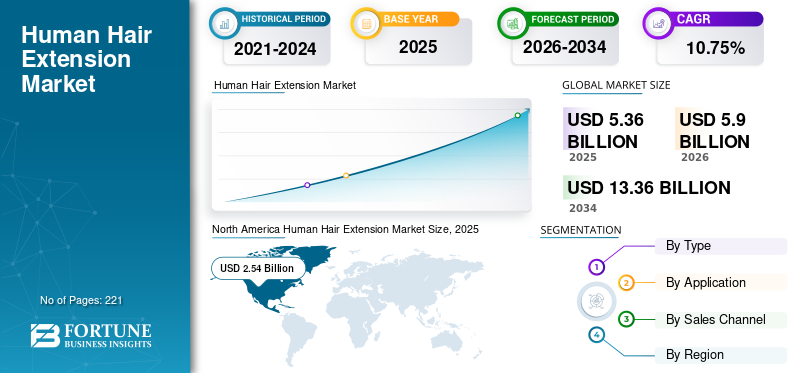
According to Fortune Business Insights: The global human hair extension market was valued at USD 5.36 billion in 2025 and is projected to grow from USD 5.90 billion in 2026 to USD 13.36 billion by 2034, exhibiting a CAGR of 10.75% during the forecast period. North America dominated the market with a 47.43% share in 2025, reflecting strong consumer demand for premium, natural hair products across the region.
Human hair extensions offer a distinct advantage over synthetic alternatives — they can be styled using heat tools, dyed, washed, and treated like natural hair. Synthetic extensions, by contrast, are sensitive to sunlight, difficult to blend with natural hair, and carry a shorter lifespan. Human hair extensions, if well maintained, can last a year or more, making them a preferred choice globally. The broader growth of the wigs and extensions market continues to reinforce human hair extension demand.
Get a Sample Research PDF: https://www.fortunebusinessinsights.com/enquiry/request-sample-pdf/106648
Key Market Drivers
Rising Hair Disorders and an Aging Population Hair loss is a widespread and growing concern. According to the American Hair Loss Association (AHLA), Male Pattern Baldness affects roughly 25% of men before the age of 21, and about two-thirds of men will have experienced some degree of hair loss by age 35. As global populations age — with the share of individuals aged 65 and older in the U.S. expected to rise from 15% in 2016 to approximately 25% by 2060 — demand for hair restoration solutions, including extensions, is anticipated to climb significantly. China, India, and the U.S. are home to the world's largest populations of older adults, making them critical markets for geographic expansion.
Growing Popularity of Remy Hair and Indian Exports Remy hair — widely regarded as the highest-quality commercially available human hair, owing to its intact cuticles — is a key growth driver. India is the world's largest exporter of human hair, with much of its Remy supply sourced from religious temples. The ethically sourced and often organically marketed nature of Indian Remy hair resonates strongly with environmentally conscious consumers. Companies such as Indique Hair distribute Indian-sourced extensions across the U.S., Canada, Africa, and Western Europe, underscoring India's pivotal role in the global supply chain.
Vietnamese Hair Gaining Traction in North America Vietnamese hair has surged in popularity across North American markets. Sourced primarily from young women in rural mountain villages who maintain natural haircare routines — using herbs, rice water, and locust-based products — Vietnamese hair is prized for its strength, texture, and minimal chemical exposure. This trend is opening new avenues for Asian raw material suppliers and attracting fresh entrants into the market.
Market Restraints
The primary challenge facing the market is competition from substitute products and procedures. Wigs represent the most significant substitute, with innovative new product launches intensifying competition. Hair restoration surgeries are also growing — the International Society of Hair Restoration Surgery (ISHRS) reported approximately 182,025 procedures in the U.S./Canada in 2019 alone. Additionally, caution from dermatology bodies, such as the American Academy of Dermatology's recommendation to use extensions only occasionally due to risks of traction alopecia, may temper consumer enthusiasm.
Biodegradable and sustainable braiding alternatives, such as banana fiber extensions launched by brands like ReGen Hair Fiber, further challenge traditional human hair extension demand, particularly among eco-conscious consumers.
Segmentation Analysis
By Type Clip-in hair extensions lead the market, projected to hold a 37.42% share in 2026. Their ease of use, removability, and affordability make them highly accessible across consumer groups. Tape-in extensions are gaining ground rapidly for their lightweight feel and natural appearance on the scalp. The concept of "non-commitment" — the consumer desire to change style or color frequently without a permanent commitment — is emerging as a key behavioral driver across both clip-in and tape-in categories.
By Application The female segment overwhelmingly dominates, accounting for an estimated 95.77% of the global market in 2026. Historically, brands have targeted female consumers, leaving the male segment largely untapped. However, given the high prevalence of hair loss among men, the male segment presents a compelling growth opportunity, particularly if products are marketed as stylish, scalp-protective solutions rather than cosmetic accessories.
By Sales Channel Offline channels — primarily professional salons and hairdressers — dominate with a 74.12% market share in 2026. Consumers prefer in-person consultations for personalized service and expert guidance. However, the online segment is growing at the fastest CAGR, driven by brand-owned e-commerce apps and digital platforms. SL Raw Virgin Hair's 2021 launch of a dedicated iOS and Android app exemplifies how brands are embracing digital-first distribution strategies.
Regional Insights
North America leads the global market, generating USD 1.69 billion in 2025 (30.66% share), with the U.S. market projected to reach USD 2.25 billion in 2026. Strong demand for premium Remy and Vietnamese hair, combined with a well-developed salon distribution network, underpins the region's leadership.
Asia Pacific contributed USD 1.88 billion in 2025 (34.09% share), with India serving as the dominant raw material supplier. Indian processors such as Shanmuga Hair Products export significant volumes to the U.S. and Europe, with hair extensions fetching up to USD 900 per kilogram in international markets.
Europe accounted for USD 1.33 billion in 2025 (24.83% share), with Germany and the U.K. as key markets. Brands like Balmain Hair Couture and Racoon International serve the region with a focus on ethically sourced, premium products.
Middle East & Africa and South America are smaller but promising markets, valued at USD 0.16 billion and USD 0.29 billion respectively in 2025. The UAE is a significant global importer of natural hair, and both regions are expected to attract increased investment from international players.
Connect with Our Expert for any Queries: https://www.fortunebusinessinsights.com/enquiry/speak-to-analyst/106648
Key Industry Players
Leading companies include Great Lengths (Italy), Balmain Hair Couture (France), Hairdreams Haarhandels GmbH (Austria), Beauty Industry Group Inc. (U.S.), Cinderella Hair Extension (U.S.), Hairlocs (U.S.), Klix Hair Inc. (U.S.), UltraTress (U.S.), and Racoon International (U.K.). Strategic partnerships with salons and hairstylists, as well as mergers and acquisitions — such as Beauty Industry Group's 2022 acquisition of Bellami Hair — are central to competitive growth strategies.
Outlook
The human hair extension market is on a strong and sustained growth trajectory through 2034. Driven by aging demographics, rising hair loss prevalence, the premiumization of beauty products, and growing e-commerce adoption, the market offers significant opportunities for both established players and new entrants. Innovation in product design, ethical sourcing, and digital distribution will be defining factors in shaping competitive dynamics over the coming decade.