
Fat Replacers Market Overview Analysis By Fortune Business Insights
Market at a Glance
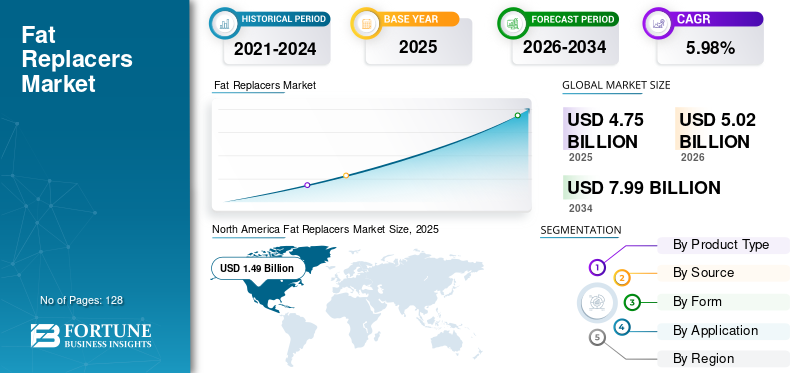
According to Fortune Business Insights: The global fat replacers market was valued at USD 4.75 billion in 2025 and is projected to grow from USD 5.02 billion in 2026 to USD 7.99 billion by 2034, at a steady CAGR of 5.98% over the forecast period. North America led all regions with a 31.36% market share in 2025, underpinned by robust demand for reduced-fat processed foods and large-scale food manufacturing infrastructure.
Fat replacers are functional food ingredients specifically engineered to mimic the sensory and functional properties of fats — including texture, mouthfeel, and creaminess — while substantially reducing calorie and fat content. They fall into three main categories: carbohydrate-based, protein-based, and fat-based systems. Their applications span a broad range of food categories, including bakery products, dairy items, meat products, sauces, and processed foods, where maintaining product quality while lowering saturated fat is a key formulation priority.
Get a Sample Research PDF: https://www.fortunebusinessinsights.com/enquiry/request-sample-pdf/100545
Key Market Drivers
The primary driver of market growth is the rising global demand for low-fat and calorie-reduced processed foods. Growing consumer awareness of the health risks linked to excessive fat consumption — including obesity, cardiovascular disease, and metabolic disorders — has encouraged food manufacturers to reformulate product portfolios using fat replacers. The scale of this challenge is significant: the WHO reported that more than one billion people were living with obesity in 2023, reflecting global obesity rates that have nearly tripled since 1975. In the U.S. alone, the USDA Economic Research Service notes that processed and ultra-processed foods account for over 55% of total caloric intake, reinforcing the urgency for ingredient-level reformulation.
This trend is amplified by the rapid expansion of functional and plant-based foods. Global retail sales of plant-based foods exceeded USD 29 billion in 2023, according to the Good Food Institute, creating strong and growing demand for fat replacers that can maintain texture and stability in dairy alternatives, plant-based beverages, and vegan desserts — categories where traditional emulsifiers often fall short.
Market Restraints and Challenges
Despite positive momentum, the market faces meaningful technical hurdles. Replicating the full sensory and functional profile of fat remains technically complex. Fat contributes to flavor release, lubrication, mouthfeel, and structural stability in food products, and substituting it often requires sophisticated multi-ingredient formulation strategies. Certain fat replacers may alter texture or demand additional stabilizers, increasing both formulation complexity and production costs for manufacturers. These sensory limitations continue to constrain adoption in premium food categories where taste and texture are non-negotiable.
Segmentation Highlights
By Product Type, carbohydrate-based fat replacers dominated the market at approximately USD 2.73 billion in 2025, owing to the widespread use of starches, cellulose derivatives, and gums in reduced-fat bakery, dairy, and sauce applications. These ingredients cost-effectively provide the viscosity, bulk, and mouthfeel associated with fat. The protein-based segment is the fastest-growing, forecast at a CAGR of 6.93%, driven by rising use of milk and soy proteins as fat mimetics in dairy products, meat substitutes, and functional foods.
By Source, the plant-based segment dominated with a valuation of approximately USD 3.60 billion in 2025, supported by the cost-effectiveness of plant-derived starches, fibers, and soy proteins and their compatibility with clean-label and vegan product formulations. The animal-based segment, relying primarily on dairy proteins and gelatin, is growing steadily at a CAGR of 6.30%, particularly in dairy and dessert applications.
By Form, the powder segment dominated at approximately USD 3.60 billion in 2025, valued for its transportation efficiency, longer shelf life, and compatibility with dry ingredient systems in bakery mixes and dairy powders. The liquid segment is the fastest-growing at a CAGR of 6.35%, increasingly adopted in beverage emulsions, sauces, and ready-to-drink formulations where easier dispersion is required.
By Application, bakery and confectionery led the market at approximately USD 1.47 billion in 2025, reflecting the extensive use of fat replacers in cakes, cookies, pastries, and chocolates to reduce fat content while preserving texture and shelf life. The beverages segment is the fastest-growing application, forecast at a CAGR of 7.50% from 2026 to 2034.
Regional Outlook
North America held the largest share at USD 1.49 billion in 2025, projected to reach USD 2.41 billion by 2034 (CAGR: 5.52%). The U.S. dominates the region at approximately USD 1.18 billion, supported by its large bakery, snack, and dairy industries and growing demand for healthier reformulations.
Europe reached USD 1.34 billion in 2025 (CAGR: 5.83%), driven by strong regulatory pressure to reduce saturated fat intake and a well-established food processing industry. Germany (USD 0.28 billion) and the U.K. (USD 0.27 billion) are the region's largest markets, anchored by their respective bakery, dairy, and packaged snack sectors.
Asia Pacific was valued at USD 1.21 billion in 2025 and is the fastest-growing region at a CAGR of 7.31%, projected to reach USD 2.28 billion by 2034. Rapid urbanization, expanding processed food industries, and rising health awareness are fueling demand. China leads the region at approximately USD 0.49 billion, supported by the rapid growth of packaged food manufacturing.
South America (USD 0.45 billion, CAGR: 4.97%) and the Middle East & Africa (USD 0.26 billion, CAGR: 4.36%) are smaller but growing markets, with Brazil and GCC nations as their respective regional anchors, driven by expanding bakery, snack, and processed food industries.
Connect with Our Expert for any Queries: https://www.fortunebusinessinsights.com/enquiry/speak-to-analyst/100545
Competitive Landscape
The global fat replacers market is moderately consolidated, with a handful of major food ingredient companies driving innovation in plant-derived, protein-based, and functional starch systems. The five leading players are Cargill Incorporated, Ingredion Incorporated, Tate & Lyle PLC, Kerry Group Plc, and Archer Daniels Midland Company. Other significant participants include DSM-Firmenich, Corbion, Ashland Global Holdings, Fiberstar, and CP Kelco.
Recent innovation highlights the growing momentum of clean-label and plant-based fat replacement technologies. In December 2024, Gavan Technologies raised USD 8 million in a Series A round to commercialize FaTrix — a pea protein-based fat ingredient that reduces saturated fat by 80% compared to butter. In October 2024, U.K.-based MicroLub secured USD 4.44 million to advance its plant-based fat replacement technology for reduced-calorie foods. These developments signal robust investor confidence and continued product innovation at the ingredient frontier.