
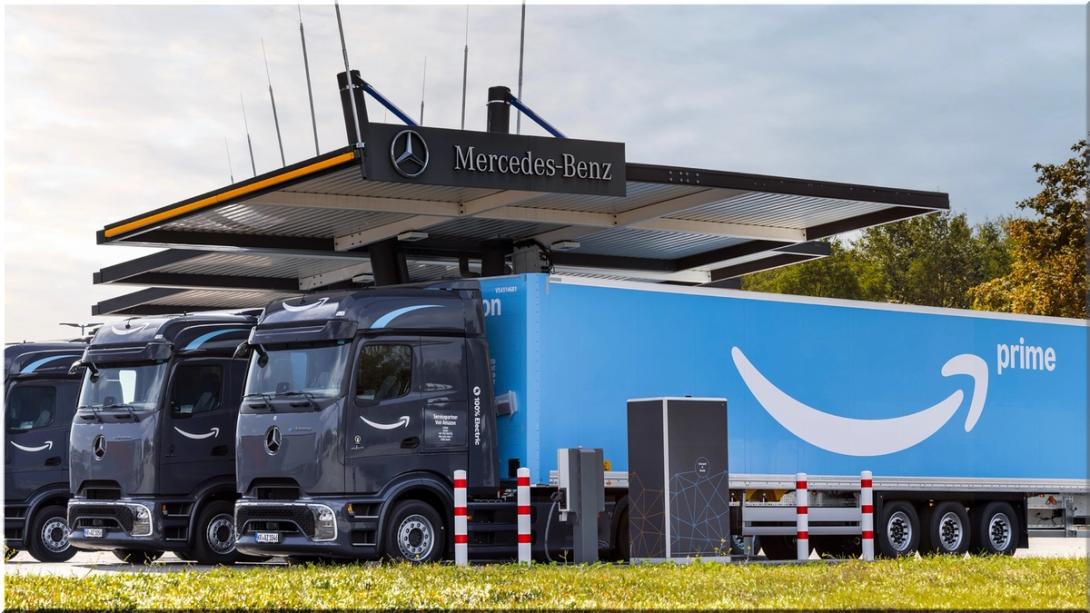
Amazon has decided to expand its German freight fleet with more than 50 Mercedes‑Benz eActros 600 electric trucks. This is not a symbolic gesture involving two trucks and a press photographer. This is a large‑scale deployment of long‑haul battery‑electric tractors into daily middle‑mile operations. The eActros 600 arrives with a 621‑kWh battery pack, up to 500 km of range, and an e‑axle that delivers up to 600 kW of peak power. It also arrives with the quiet satisfaction of knowing diesel budgets will shrink while charging bills appear neatly itemized.
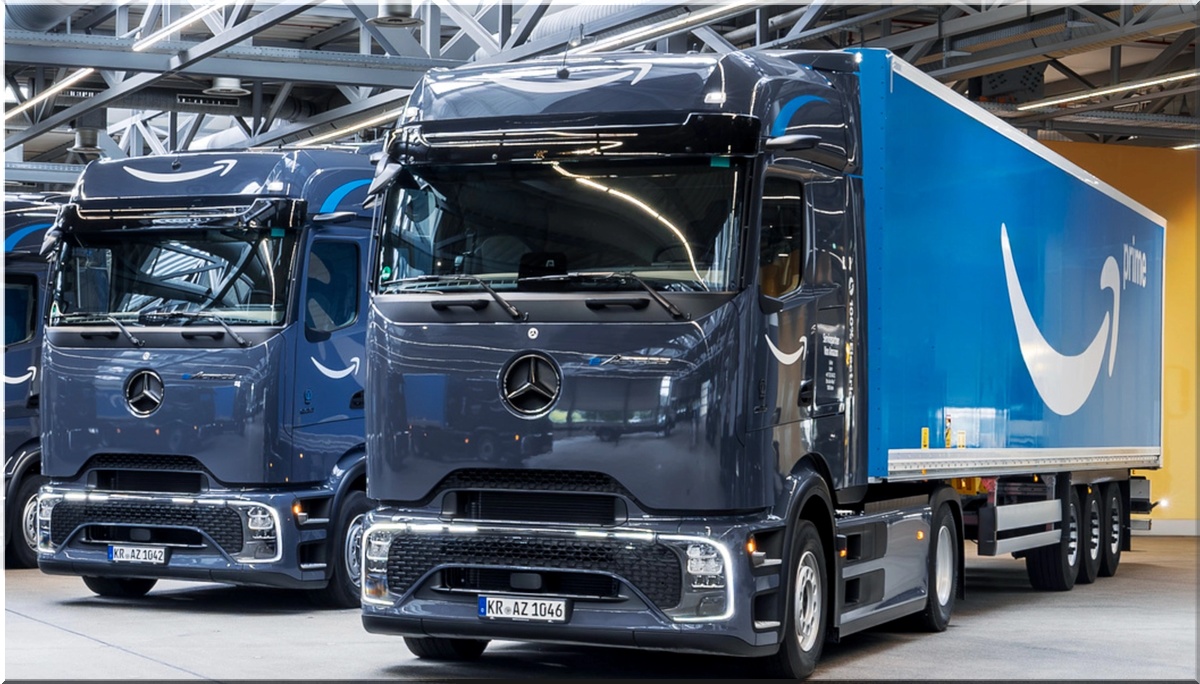
Why Amazon Wants the eActros 600 in Germany
Amazon’s German freight network thrives on predictable routes between fulfillment centers, sortation hubs, and regional depots. These routes typically fall between 150 and 300 km, which is the sweet spot where electric trucks stop being experimental and start being financially attractive.
Amazon’s motivations include:
- Route compatibility: The truck’s up to 500 km range covers typical German long‑haul segments with enough margin for traffic, gradients, and drivers who enjoy acceleration more than they should.
- Energy predictability: Three LFP battery packs with roughly 621 kWh usable capacity deliver stable consumption curves, making planning easier than forecasting diesel prices.
- Payload preservation: With a gross vehicle weight of 44 tons, the eActros 600 keeps trailers full instead of sacrificing pallets to battery mass.
- Charging strategy flexibility: Depot charging at night combined with future megawatt charging allows Amazon to scale without redesigning its entire network.
From an expert perspective, Amazon is not chasing maximum range. It is chasing repeatable daily cycles with minimal operational drama.
Technical Overview: What the eActros 600 Actually Delivers
Mercedes‑Benz built the eActros 600 on a dedicated electric architecture. This includes an e‑axle, a ProCabin cab, and three LFP battery packs arranged along the frame.
Core specifications include:
- Battery capacity: Around 621 kWh across three LFP packs
- Range: Up to 500 km per charge
- Continuous power: 400 kW
- Peak power: 600 kW
- Torque at axle: Up to 10,000 Nm
- GVW: 44 tons
- Charging capability: Up to 400 kW DC, with megawatt charging prepared
- Projected service life: Around 1.2 million km over ten years
Mercedes‑Benz designed the truck to reduce aerodynamic drag through a reshaped cab, tapered roofline, and optimized side surfaces. The result is lower energy consumption at motorway speeds and fewer excuses for drivers who blame wind resistance for late arrivals.
Battery Architecture: Three LFP Packs and Predictable Behavior
The eActros 600 uses three lithium‑iron‑phosphate battery packs mounted along the frame. LFP chemistry trades energy density for stability and long cycle life, which is ideal for freight operations that value consistency over bragging rights.
Advantages of the battery design include:
- Stable thermal behavior: LFP chemistry runs cooler and more predictable, reducing the odds of starring in an unwanted viral video.
- Long cycle life: The projected 1.2 million km lifespan means the batteries should outlast several generations of depot coffee machines.
- Predictable degradation: Frequent fast charging does not cause dramatic performance swings, simplifying long‑term cost planning.
- Balanced weight distribution: Battery placement along the frame keeps handling predictable under varying loads.
Fleet managers appreciate that the truck covers typical European long‑haul stages without forcing them to redraw every route map.
Charging Logic: From Depot AC to Megawatt Power
The eActros 600 supports conventional DC fast charging up to 400 kW and prepares for megawatt charging once infrastructure catches up. This lets Amazon begin with realistic depot setups and expand into high‑power corridors later.
Charging tiers include:
- Depot AC charging: Around 22 kW, suitable for overnight replenishment.
- High‑power DC charging: Up to 400 kW, ideal for regional hubs and longer layovers.
- Megawatt charging (MCS‑ready): Targeting 20–80% in roughly 30 minutes, turning driver rest periods into range extensions instead of extended coffee breaks.
Megawatt charging is the real unlock for long‑haul electrification. It sharply reduces standstill time and allows trucks to run multiple high‑distance legs per day without swapping vehicles or drivers.
Drivetrain Mechanics: The e‑Axle and Four‑Speed Gearbox
Under the ProCabin sits an e‑axle with an integrated four‑speed transmission. This setup delivers continuous high torque for 44‑ton combinations while maintaining efficiency at motorway speeds.
Drivetrain characteristics include:
- Integrated e‑axle: Motors sit close to the wheels, reducing mechanical losses and freeing space for batteries.
- Four‑speed gearbox: Ratios support low‑speed maneuvering, gradients, and highway cruising without the gear‑hunting drama of diesel transmissions.
- Regenerative braking: Energy recovery during deceleration and downhill segments reduces net consumption and brake wear.
- Predictive powertrain control: Software manages speed and energy use based on topography and route data, which is more patient than most human drivers.
The eActros 600 removes many classic failure points: no turbochargers, no exhaust after‑treatment, and no multi‑stage diesel injection systems. Fewer moving parts mean fewer reasons for a truck to spend its day on a lift instead of a highway.
Cab Design: ProCabin Comfort with Aerodynamic Discipline
The ProCabin focuses on long‑distance comfort and drag reduction. Mercedes‑Benz reshaped the cab to cut air resistance, then filled it with digital controls that look modern but still allow drivers to adjust temperature without navigating a maze of menus.
Cab and interior details include:
- Aerodynamic profile: Optimized roofline, side surfaces, and front fascia reduce drag and energy use.
- Digital instrument cluster: Wide screens display speed, energy use, range, and assistance systems.
- Central display: Controls navigation, media, and vehicle settings with large rotary knobs retained for key functions.
- Noise levels: Electric drive removes combustion noise, leaving drivers with a quiet cabin and their own thoughts.
Diesel trucks send vibration and engine pulses through the cab, which some drivers call character and others call fatigue. The eActros 600 trades that for smooth, linear acceleration and a more relaxed acoustic environment.
Diesel vs eActros 600: Key Differences in Plain Language
Instead of a table, here is a clear comparison in paragraph form:
The eActros 600 delivers up to 600 kW of peak power, while a typical diesel Actros offers around 395 kW. Torque at the axle reaches 10,000 Nm, compared to roughly 2,600 Nm of engine torque in the diesel. The electric truck uses three LFP battery packs totaling about 621 kWh, whereas the diesel relies on a 12.8‑liter engine. Range differs significantly: the eActros covers up to 500 km, while the diesel can reach around 1,500 km on a full tank. Charging from 20 to 80 percent can take about 30 minutes with megawatt charging, while diesel refueling takes roughly 10 to 15 minutes. The electric drivetrain removes many mechanical components, reducing maintenance needs and eliminating tailpipe emissions.
Charging Benchmarks Explained Without a Table
Depot AC charging at around 22 kW handles overnight replenishment for trucks that return to base daily. High‑power DC charging up to 400 kW suits regional hubs and longer layovers, typically restoring a significant portion of the battery in about an hour. Megawatt charging, once fully deployed, aims to deliver a 20–80 percent charge in roughly 30 minutes, making it ideal for long‑haul corridors where trucks stop for mandatory driver rest periods.
Amazon’s Operational Gains: What Changes on the Ground
Deploying more than 50 eActros 600 units gives Amazon enough volume to treat electric long‑haul as a core tool rather than a side experiment.
Operational advantages include:
- Lower energy cost per km: Electricity pricing under long‑term contracts often beats diesel volatility.
- Reduced maintenance: Fewer mechanical components and no exhaust after‑treatment reduce workshop hours.
- Depot integration: Charging becomes part of yard management instead of relying on fuel pumps.
- Driver comfort: Lower noise and smoother acceleration improve long‑distance experience.
- Emissions reduction: Battery‑electric operation cuts local emissions on key freight corridors.
The real gain is predictability. Energy use, maintenance intervals, and route performance become data‑driven instead of dependent on fuel markets and engine quirks.
Pro‑Tips for Fleet Managers Considering Heavy‑Duty EVs
- Plan grid capacity early: Coordinate with utilities before trucks arrive to avoid charging bottlenecks.
- Use detailed telematics: Match truck range with real‑world loads, gradients, and stop patterns.
- Train drivers on regenerative braking: Proper technique improves efficiency and reduces brake wear.
- Schedule charging during rest periods: This keeps trucks productive and avoids peak‑tariff surprises.
- Monitor battery health: OEM tools help plan pack replacement and avoid unexpected capacity drops.
These steps turn heavy‑duty EVs from interesting hardware into reliable assets.
Actionable Question: How Should Fleets Prepare for Megawatt Charging?
Fleets planning to adopt megawatt‑capable trucks should treat infrastructure design as an industrial project. The key is to map future charging hubs, coordinate with utilities on peak loads, integrate energy storage to buffer demand spikes, and standardize connectors and procedures so drivers treat megawatt charging as routine.
Handled this way, megawatt charging becomes a predictable part of long‑haul operations instead of a bottleneck.
What Amazon’s Move Signals for Freight Transport
Amazon’s decision to deploy more than 50 Mercedes‑Benz eActros 600 trucks in Germany shows that long‑haul battery‑electric platforms have moved from concept stage to operational reality. The combination of 621‑kWh LFP batteries, up to 500 km range, and megawatt‑ready hardware gives fleets a credible alternative to diesel on many European routes.
Other logistics operators will run the same calculations: route length, depot locations, grid capacity, and total cost of ownership. The numbers will not flatter every route, but for middle‑mile and many long‑haul corridors, the math starts to favor trucks that hum instead of roar.
Amazon’s order does not end diesel freight in Germany. It does something more practical: it proves that long‑haul electric trucks like the eActros 600 can carry real cargo, on real schedules, for real companies—without turning the operation into a science project.