
Air Compressor Market Overview Analysis By Fortune Business Insights
Market at a Glance
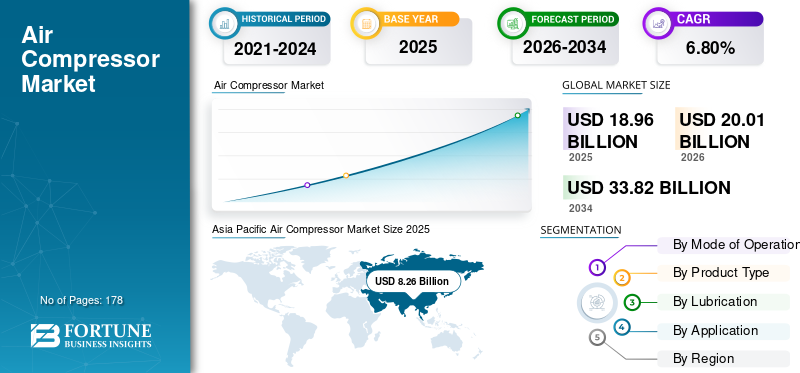
According to Fortune Business Insights: The global air compressor market was valued at USD 18.96 billion in 2025 and is projected to grow from USD 20.01 billion in 2026 to USD 33.82 billion by 2034, at a compound annual growth rate (CAGR) of 6.80% over the forecast period. Asia Pacific dominated the global market with a 43.60% share in 2025, reflecting the region's rapid industrialization and strong manufacturing base. The U.S. market alone is expected to reach USD 5.36 billion by 2032, propelled by the growing adoption of Industry 4.0 technologies aimed at enhancing operational efficiency.
Market Overview
Air compressors operate through three principal modes — rotary, centrifugal, and reciprocating — and serve a broad spectrum of applications across manufacturing, oil & gas, energy and power, healthcare, electronics, food and beverages, and aerospace industries. Rotary compressors, which use twin-screw mechanisms to generate compressed air, dominate the industry owing to their efficiency, lower maintenance requirements, and suitability for continuous heavy-duty operations.
The market is further distinguished by product type — stationary and portable — and lubrication method — oil filled and oil free. Stationary compressors are the preferred choice for large-scale industrial and commercial environments, while oil-filled variants remain dominant due to their reliability in heavy-duty applications.
The COVID-19 pandemic initially dampened market growth through supply chain disruptions and reduced industrial activity. However, demand rebounded sharply in 2021, led by the medical sector's urgent need for compressed air-driven equipment such as ventilators. The pandemic also accelerated the adoption of automation and remote monitoring within the compressor industry, a trend that continues to reshape the competitive landscape.
Get a Sample Research PDF: https://www.fortunebusinessinsights.com/enquiry/request-sample-pdf/101672
Key Growth Driver
Technological Upgradation for Air System Control and Management A central force driving market growth is the integration of advanced technologies into compressor systems. Companies are developing centralized control solutions that allow comprehensive monitoring and management of airflow across entire compressor networks. Kaeser, for example, offers the Sigma Air Manager (SAM) system — a loaded compressor setup with PC-based controls providing real-time analog and digital input/output signals, historical data analysis, and predictive maintenance capabilities. The latest SAM2 iteration improves upon these features with greater efficiency and reliability.
The broader integration of Industrial Internet of Things (IIoT) technology is transforming conventional compressors into smart, connected devices. These systems enable real-time tracking of operational parameters including pressure, temperature, and energy consumption. Machine learning algorithms analyze operational data trends to predict potential failures before they occur, minimizing unplanned downtime and extending equipment lifespan. Variable frequency drives (VFDs) further optimize energy use by adjusting compressor speed dynamically to match real-time demand, reducing both energy costs and carbon emissions.
Key Restraint
Air Leaks and Rising Component Costs A persistent challenge for the market is economic loss arising from air leaks within compressor systems. When manufacturing facilities lose compressed air through partially opened or faulty valves, the financial consequences can be substantial. Compressors naturally draw in atmospheric contaminants and water vapor alongside air, making efficient drainage essential. The costs associated with managing these inefficiencies — compounded by rising prices for replacement parts — create ongoing operational burdens for end-users and moderate overall market expansion.
Segmentation Insights
By Mode of Operation The rotary segment is projected to lead the market with a 62.07% share in 2026, driven by its widespread adoption in manufacturing, construction, and industrial applications. Its efficiency and capacity for continuous operation make it the preferred configuration globally. Centrifugal compressors are increasingly used in manufacturing processes involving air-based activities, while reciprocating compressors remain relevant for applications requiring precise pressure control through piston-driven displacement.
By Product Type Stationary compressors are expected to account for 87.31% of the market in 2026, reflecting their dominance in fixed industrial installations. The portable segment is growing as a complementary category, offering flexibility across diverse job sites through both electric-powered and gas-powered configurations.
By Lubrication Oil-filled compressors hold a dominant share of 72.76% in 2026, underpinned by heavy commercial and industrial demand. Oil-free variants are gaining traction in hygiene-sensitive sectors such as hospitality, healthcare, and oxygen plant operations, where contamination-free air is a non-negotiable requirement.
By Application The energy and power segment leads in growth rate, driven by the use of compressors in power generation facilities, control systems, pneumatic actuators, and wind turbine operations. The manufacturing segment holds the largest share at 35.38% in 2026, with compressors powering pneumatic tools, automated assembly lines, and production processes including sandblasting, cleaning, and air blowing.
Regional Insights
Asia Pacific is the largest and fastest-growing region, valued at USD 8.26 billion in 2025, with China projected to reach USD 5.47 billion by 2026. Growth is fueled by industrial automation, semiconductor manufacturing, and expanding construction and automotive sectors. North America generated USD 4.52 billion in 2025, supported by oil & gas, aerospace, and energy sectors. Europe contributed USD 4.38 billion in 2025, with Germany and the UK as key markets. The Middle East & Africa and Latin America are growing steadily, supported by energy infrastructure investment and mining activities.
Connect with Our Expert for any Queries: https://www.fortunebusinessinsights.com/enquiry/speak-to-analyst/101672
Competitive Landscape
The global air compressor market is moderately fragmented, with major players holding approximately 20–25% of the total market share. Leading companies include Atlas Copco AB (Sweden), Ingersoll Rand (U.S.), ELGi Equipments Limited (India), Sulzer Ltd. (Switzerland), Hitachi Ltd. (Japan), Mitsubishi Heavy Industries (Japan), Siemens AG (Germany), Campbell Hausfeld (U.S.), Doosan Infracore Portable Power (South Korea), and EBARA Corporation (Japan). Key strategies include new product launches, acquisitions, and facility expansions to broaden geographic reach and technology capabilities.
Conclusion
The global air compressor market is on a sustained growth trajectory through 2034, driven by industrial automation, smart technology integration, and expanding applications across energy, manufacturing, healthcare, and semiconductor sectors. Despite challenges from air leakage losses and component costs, the ongoing evolution toward IIoT-enabled, energy-efficient compressor systems presents significant opportunity for both established players and new entrants across all major regions.