

The Hidden Financial Leak in Manufacturing
In the modern manufacturing landscape, the engineering department is often scrutinized solely through the lens of innovation and product performance. However, operational leaders and CFOs know that the proper financial health of a project is usually determined long before metal is cut or plastic is molded. It is determined on the digital drawing board.
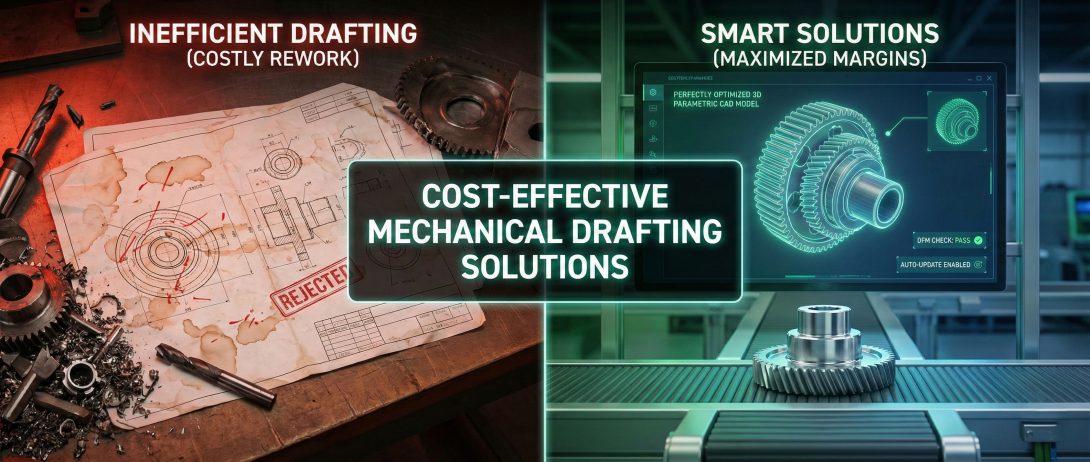
Mechanical drafting is the language of manufacturing. It is the precise set of instructions that translates a concept into physical reality. When this language is spoken clearly and efficiently, production hums. When it is cluttered, inaccurate, or inefficient, it becomes a silent financial leak that drains profitability through scrap, rework, and delayed time-to-market.
Many organizations mistakenly equate "cost-effective drafting" with simply hiring cheaper labor or buying less expensive software. This is a fundamental error. True cost-effectiveness in mechanical drafting is not about paying less for hours worked; it is about maximizing the value of every hour spent. It is about implementing robust workflows, leveraging parametric technologies, and making strategic sourcing decisions that reduce the "Total Cost of Quality."
This guide explores the structural and procedural shifts that forward-thinking manufacturing firms are adopting to optimize their drafting operations, reduce overhead, and protect their margins in 2026.
1. The Economics of Precision: Understanding the Cost of Errors
To understand why high-quality drafting is a cost-saving mechanism, we must first look at the "1-10-100 Rule" of quality costs.
- Prevention ($1): Catching a geometric interference or a tolerance error during the drafting phase costs a nominal amount, perhaps 30 minutes of a drafter's time.
- Correction ($10): If that error slips through to the prototyping phase, it costs significantly more to fix. You have wasted material, machine time, and setup labor for a one-off part.
- Failure ($100+): If the error reaches the production floor, the costs explode. You are now dealing with scrapped tooling, line stoppages, emergency shipping of replacement materials, and potentially penalties for late delivery.
The Strategy: Front-Loading Quality Control Cost-effective drafting begins with a "Check Twice, Cut Once" digital philosophy. Implementing a rigorous checking process where a senior designer reviews the drawings of a junior drafter might seem like an extra expense upfront. However, data consistently shows that this layer of redundancy saves thousands of dollars in downstream rework.
Furthermore, utilizing Model-Based Definition (MBD) can reduce errors. Instead of manually creating 2D drawings that might become desynchronized from the 3D model, MBD embeds product manufacturing information (PMI) directly into the 3D file. This ensures that the machinist is always looking at the single source of truth, eliminating the ambiguity that leads to expensive scrap.
2. Parametric Modeling: The Engine of Efficiency
In the days of manual board drafting or simple 2D CAD, a design change was a logistical nightmare. If a client requested a machine shaft be lengthened by 50mm, a drafter had to erase and redraw the shaft in the assembly view, the part view, and the section view, and then manually update the Bill of Materials (BOM).
This manual replication is where human error thrives. It is also prolonged.
The Strategy: Mastering Parametric Associativity. Modern mechanical drafting relies on Parametric Modeling. In this workflow, dimensions are not just static numbers; they are driven by logic and constraints.
When a drafter updates the length of a shaft in the 3D part file, the software automatically propagates that change to every associated file—the assembly model updates to show the new position. The 2D fabrication drawing updates the dimension line. The BOM updates the mass and cut length.
To maximize cost-effectiveness, engineering managers must ensure their teams are not treating modern 3D software like a 2D digital drawing board. They must build "smart models" with defined relationships (e.g., guaranteeing a bolt hole always stays centered on a flange, regardless of the flange's width). This "design intent" means that future revisions, which are inevitable, take minutes instead of days.
3. Strategic Outsourcing: The Hybrid Workforce Model
One of the most significant challenges in managing an engineering budget is the "Feast or Famine" workflow cycle.
During a new product launch, your internal drafting team is overwhelmed, leading to overtime costs and burnout. During quiet periods between projects, those same high-salaried engineers may be underutilized. Maintaining a staff size large enough to handle the peaks but small enough to remain profitable during the valleys is a delicate balancing act.
The Strategy: The Hybrid Sourcing Model. Cost-effective organizations represent a shift away from the "all or nothing" outsourcing mentality. Instead, they adopt a hybrid model.
- Core Internal Team: Retain a lean team of senior engineers and lead designers in-house. Their role is to manage Intellectual Property (IP), define design intent, and handle high-level R&D tasks that require deep tribal knowledge of the company's products.
- External Drafting Partners: Partner with a specialized mechanical drafting service to handle the volume-heavy, repetitive tasks. This includes converting legacy paper drawings to CAD, creating detailed fabrication prints from solid models, or updating entire libraries of parts to new standards.
This approach converts fixed overhead costs (salaries, benefits, software seats) into variable project costs. You only pay for the extra drafting capacity when you need it. Furthermore, it prevents your expensive R&D engineers from getting bogged down in routine detailing work, keeping them focused on innovation that drives revenue.
4. Design for Manufacturing (DFM) & Standardization
A drawing can be geometrically perfect but financially disastrous. This happens when a drafter creates a part without considering how it will be made.
Common examples of "expensive drafting" include:
- Specifying a non-standard hole size (e.g., 10.23mm) that requires a custom drill bit, when a standard 10.5mm hole would suffice.
- Designing internal square corners that a rotating cutter cannot mill.
- Applying tight tolerances (e.g., ±0.01mm) to surfaces that don't touch anything.
The Strategy: Standardization Libraries & DFM Guidelines. To reduce manufacturing costs, drafting teams should implement strict standardization libraries.
Instead of modeling a new bracket or fastener for every project, the team should draw from a central repository of pre-approved, standard components. This reduces the number of unique part numbers the procurement team needs to manage and allows the company to buy standard parts in bulk.
Additionally, Geometric Dimensioning and Tolerancing (GD&T) should be used strategically. A common misconception is that GD&T complicates drawings. In reality, when used correctly, it allows for looser tolerances where they don't matter, and tighter control only where necessary. A drawing that clearly communicates "this surface acts as a datum" allows the machinist to set up the part once and machine it efficiently, reducing cycle time.
5. Legacy Data Migration: Digitizing for the Future
Many established manufacturing firms still sit on a treasure trove of physical blueprints or static 2D PDFs. While these documents contain valuable IP, they are "dead data." They cannot be easily modified, they cannot be fed into a CNC machine, and they degrade over time.
Searching for a physical drawing in a filing cabinet costs time. Redrawing a part from scratch because the original file is lost costs even more.
The Strategy: Systematic Conversion Investing in converting legacy drawings to modern 3D CAD formats is a capital expense that pays long-term dividends.
- Digital Inventory: Once a part is modeled in 3D, it can be printed on demand or machined directly from the file, reducing the need to warehouse physical spare parts.
- Simulation Ready: Old designs can be subjected to modern Finite Element Analysis (FEA) to find weight-saving opportunities, reducing material costs on parts that have been over-engineered for decades simply because "that's how we always made them."
Efficiency is a Choice
Cost-effective mechanical drafting is not about cutting corners. It is about sharpening your process.
It involves a cultural shift from viewing drafting as a clerical task to viewing it as a strategic manufacturing tool. By leveraging the parametric power of modern software, adopting a flexible hybrid staffing model, and rigorously enforcing DFM standards, manufacturers can dramatically reduce their overhead.
In a market where material costs and labor rates are constantly rising, the efficiency of your engineering workflow is one of the few variables you can fully control. The companies that master this control will be the ones that remain profitable and competitive in the years to come.