

Introduction
In today’s highly competitive transportation and supply chain industry, acquiring new customers requires more than traditional networking and cold outreach. As digital transformation accelerates, companies must adopt smarter marketing strategies to remain visible and relevant. Consequently, logistics lead generation has become a critical growth driver for freight brokers, carriers, and logistics service providers alike.
Moreover, modern buyers conduct extensive research before engaging with service providers. Therefore, businesses that invest in strategic digital visibility are far more likely to attract qualified prospects.
Why Logistics Lead Generation Matters More Than Ever
Over the past decade, customer behavior has shifted significantly. For instance, procurement managers now compare multiple providers online before making decisions. Because of this shift, companies that rely solely on referrals may struggle to maintain consistent pipeline growth.
In addition, the logistics market has become increasingly crowded. Consequently, standing out requires a structured approach to logistics lead generation that combines branding, digital presence, and relationship-building.
Furthermore, consistent lead acquisition ensures revenue predictability. Therefore, organizations that build strong marketing systems are better positioned to scale sustainably.
Understanding Modern Logistics Lead Generation
At its core, logistics lead generation involves attracting, nurturing, and converting potential customers who require transportation, warehousing, or supply chain services. Traditionally, this process relied heavily on trade shows and direct sales outreach. However, digital channels now play a dominant role.
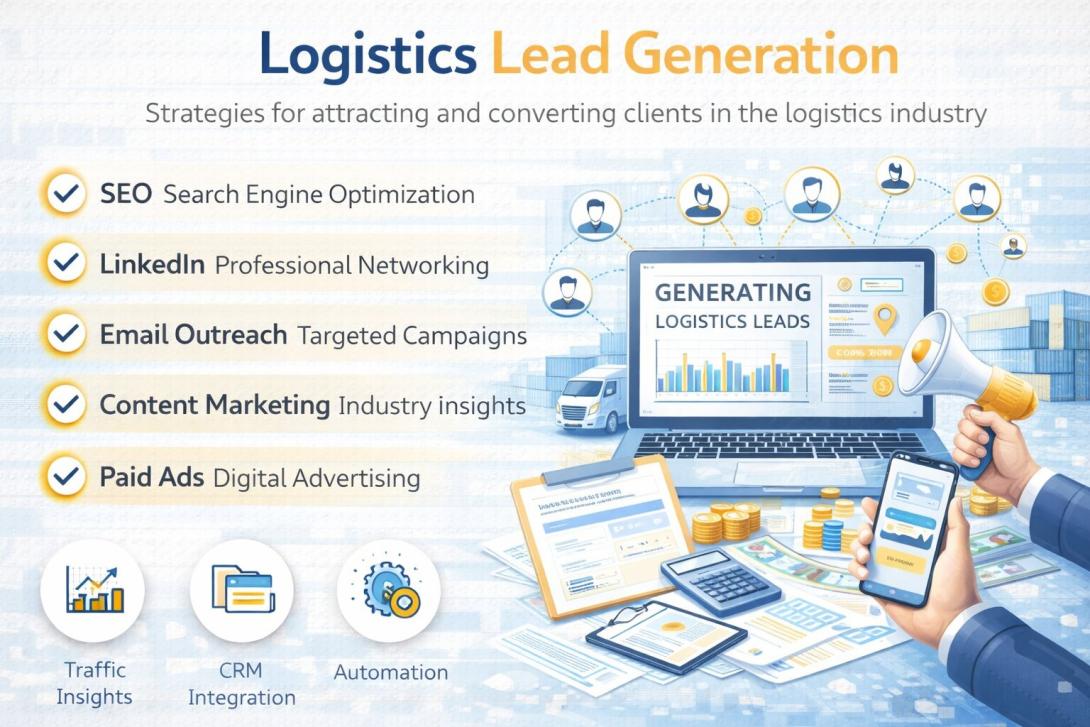
Today, successful lead strategies often integrate:
- Search engine visibility
- Content marketing
- Email outreach campaigns
- Social media engagement
- Paid advertising
- Industry partnerships
As a result, businesses can create multiple touchpoints throughout the buyer journey.
The Role of Content in Lead Attraction
Notably, content marketing has become one of the most effective components of logistics lead generation. By publishing educational articles, case studies, and industry insights, companies establish credibility and authority.
For example, informative blogs addressing freight cost optimization or supply chain risk management can attract decision-makers searching for solutions. Consequently, well-crafted content not only increases visibility but also builds trust.
Moreover, consistent content helps businesses rank for relevant industry queries. Therefore, organic traffic becomes a sustainable source of inbound leads.
Digital Channels Driving Lead Growth
Search Engine Optimization (SEO)
First and foremost, SEO ensures that potential clients discover your services during online research. Because logistics buyers frequently search for service providers and industry solutions, visibility on search engines is essential.
LinkedIn and Professional Networking
In addition, platforms like LinkedIn provide direct access to procurement managers and supply chain leaders. By sharing thought leadership content, companies can enhance logistics lead generation efforts organically.
Email Marketing
Equally important, personalized email campaigns allow businesses to nurture prospects over time. Since logistics decisions often involve long sales cycles, consistent communication is critical.
Paid Advertising
Meanwhile, targeted advertising campaigns can accelerate lead acquisition. However, these efforts are most effective when combined with high-quality landing pages and clear value propositions.
Aligning Sales and Marketing for Better Results
However, generating leads alone is not enough. To maximize results, organizations must align marketing efforts with sales follow-up processes. For instance, when marketing teams qualify prospects effectively, sales representatives can focus on high-intent leads.
Furthermore, clear communication between departments ensures faster response times. Consequently, conversion rates improve significantly.
Therefore, integrated workflows are essential for sustainable logistics lead generation performance.
Common Challenges in Logistics Lead Generation
Despite its importance, many logistics companies encounter obstacles such as:
- Inconsistent brand positioning
- Weak online presence
- Limited content strategy
- Poor tracking of lead sources
- Lack of performance analytics
Because of these gaps, marketing investments may not deliver measurable results. Therefore, structured tracking and optimization are critical.
Measuring Lead Generation Success
To evaluate performance accurately, businesses should monitor key metrics, including:
- Website traffic growth
- Lead conversion rates
- Cost per acquisition
- Sales cycle length
- Customer lifetime value
By analyzing these indicators regularly, companies can refine their logistics lead generation strategies over time.
The Importance of Trust and Credibility
Notably, logistics services often involve high-value contracts and operational risk. Therefore, decision-makers prioritize reliability and proven performance. As a result, testimonials, case studies, and transparent communication play a significant role in attracting qualified leads.
Moreover, demonstrating operational expertise through thought leadership content strengthens brand perception. Consequently, prospects are more likely to initiate conversations.
The Future of Logistics Lead Generation
Looking ahead, technology will continue to reshape how companies attract and convert customers. In particular, artificial intelligence and predictive analytics will help identify high-value prospects more efficiently.
Furthermore, automation tools will streamline follow-ups and personalize communication at scale. Therefore, businesses that invest in digital maturity today will gain a competitive advantage in tomorrow’s market.
Final Thoughts
In an increasingly digital and competitive landscape, logistics lead generation is no longer optional, it is foundational to business growth. By combining strong digital visibility, valuable content, and aligned sales processes, companies can build a consistent pipeline of qualified prospects.
Ultimately, organizations that approach lead generation strategically rather than reactively will achieve sustainable expansion and long-term market relevance.