
Prior authorization automation is quickly becoming the difference between a healthcare practice that drowns in paperwork and one that gets patients treated on time.
Manual PA processes eat staff hours, delay care, and generate denials that could have been avoided. AI prior authorization software fixes this by handling repetitive verification and submission work while keeping clinicians in control of clinical decisions.
Why Prior Authorization Needs Intelligent Automation
Prior authorization automation exists because the manual process is broken. Staff spend hours each week calling payers, faxing clinical notes, and re-entering the same patient data across systems. This administrative load is a major reason the healthcare automation market keeps expanding, since providers are actively looking for ways to cut non-clinical work without adding headcount.
AI does not replace the person approving treatment, it removes the busywork around that decision. The software checks eligibility, pulls clinical documentation, and pre-fills forms automatically, then flags anything unusual for staff review. Human judgment stays in the loop for complex or borderline cases, while routine, well-documented requests move through the system without manual touch.
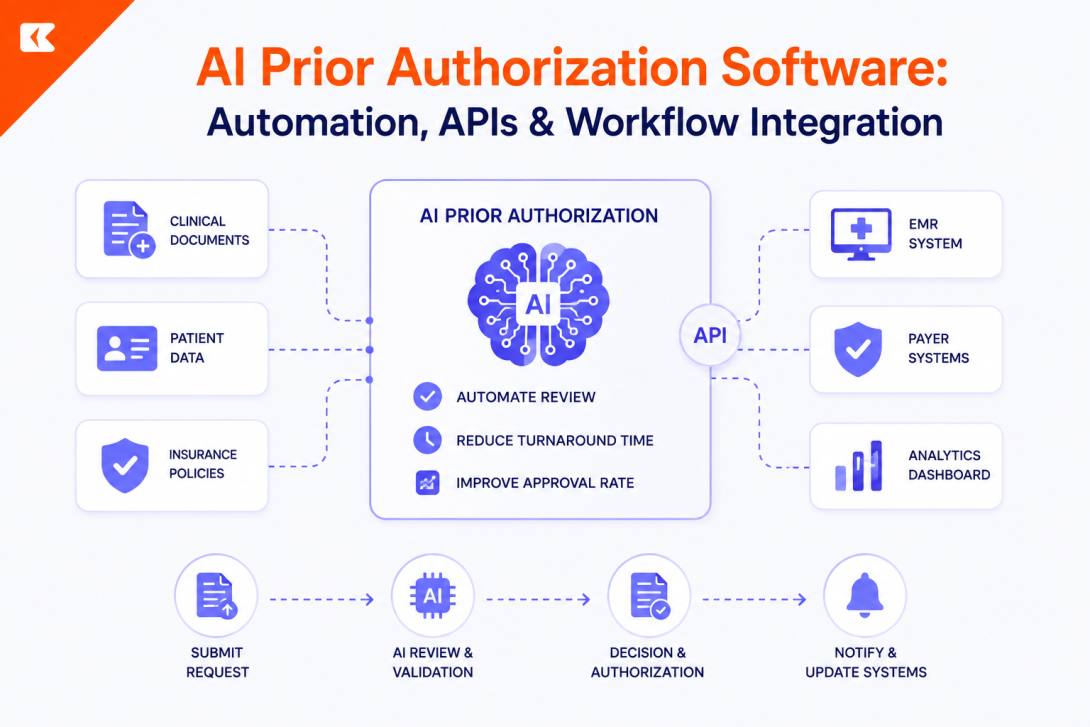
To fit into a real clinic or hospital, AI prior authorization software has to talk to what is already in place. That means it needs to plug into the EHR, connect with payer systems through APIs, and exchange data with clearinghouses and pharmacy platforms, not sit as a separate tool staff have to log into on the side.
What Is AI Prior Authorization Software?
AI prior authorization software is a system that uses machine learning and rules-based logic to automate the steps involved in getting payer approval for a treatment, test, or procedure. Its core purpose is to cut turnaround time and reduce denials by handling data collection, form completion, and submission with far less manual effort from staff.
Traditional prior authorization software is mostly a digital filing cabinet. It stores forms and tracks status, but still needs a person to read documentation, decide what applies, and fill everything in by hand. AI-powered solutions read the clinical notes themselves, match them against payer rules, and complete most of the submission before a human ever opens the case.
How AI Supports the Prior Authorization Process
- Patient and insurance verification: confirms the patient's coverage and plan details automatically before any treatment is scheduled.
- Clinical documentation review: scans notes, labs, and imaging reports to pull out the details a payer will ask for.
- Coverage and eligibility checks: cross-references the requested service against the patient's active plan in real time.
- Authorization submission: fills out and files payer-specific forms using the extracted clinical data.
- Status tracking: monitors where each request sits in the payer's queue without staff having to call and check.
- Denial identification: flags requests likely to be denied before submission, so staff can fix gaps early.
How AI Automates the Prior Authorization Workflow
The process generally follows one continuous line: patient appointment, eligibility check, PA requirement detection, clinical data collection, AI review, payer submission, status tracking, and finally approval or denial. Each step used to require someone to manually move the case forward. Automation software connects these steps so information flows on its own from one to the next.
Key AI Automation Capabilities
- Extracting information from clinical documents pulls relevant details out of notes, scans, and PDFs instead of requiring manual re-typing.
- Identifying missing information flags gaps in documentation before a request goes out, cutting down on avoidable denials.
- Matching patient data with payer requirements checks the clinical picture against each payer's specific approval criteria.
- Automating authorization form completion fills payer forms directly from verified patient and clinical data.
- Predicting potential denials uses historical patterns to flag requests that are likely to get rejected.
- Generating follow-up tasks creates reminders and to-dos for staff when a case needs a human touch.
- Routing complex cases to staff for review sends anything outside standard criteria straight to a person instead of guessing.
APIs That Power AI Prior Authorization Software
None of this automation works without the right integrations behind it. Healthcare API integration is what lets AI prior authorization software actually read patient records, check payer rules, and submit requests, instead of operating as a disconnected tool that still needs manual data entry on both ends.
Healthcare Data APIs
- EHR/EMR APIs: give the AI system direct access to patient charts, orders, and treatment history.
- FHIR APIs: provide a standardized format for exchanging clinical data between the EHR and the PA software.
- HL7 interfaces: support older systems that still rely on HL7 messaging rather than modern FHIR standards.
- Patient and clinical data exchange: keeps information synced across systems so nothing has to be entered twice.
Providers running legacy systems often lean on dedicated EHR integration services to bridge HL7 and FHIR without a full platform rebuild.
Payer APIs
- Eligibility and benefits verification: checks a patient's active coverage directly with the payer in real time.
- Prior authorization requests: submits the actual PA request through the payer's system rather than a portal or fax.
- Authorization status: pulls live status updates instead of requiring a phone call to the payer.
- Coverage and payer policy information: retrieves the specific rules a payer applies to a given service or code.
Supporting Integrations
- Clearinghouses: route claims and authorization data between providers and multiple payers through one connection.
- Claims systems: keep authorization and billing data aligned so approved services translate cleanly into claims.
- Pharmacy systems: handle medication-specific prior authorizations, which often follow different rules than medical procedures.
- Document management platforms: store and retrieve the clinical attachments a payer requires alongside the request.
The point of all these APIs is simple: they let authorization workflows exchange data directly between providers, payers, and internal systems instead of relying on manual data entry. A practice with strong healthcare claim management software in place typically sees fewer denials, because information stays consistent from the first eligibility check through final approval.
Workflow Integration: How AI Fits Into Existing Healthcare Operations
- Integrating with EHR/EMR workflows: connects directly to the system staff already use, instead of adding another login.
- Triggering authorization automatically when an order requires PA: starts the process the moment a qualifying order is placed.
- Sending incomplete cases to staff: routes anything missing documentation back to a human instead of stalling silently.
- Returning authorization status to the provider's system: updates the EHR directly so staff never have to check a separate portal.
- Creating alerts for pending or denied requests: notifies the right person the moment a case needs attention.
- Maintaining a centralized authorization dashboard: gives staff one place to see every request and its current stage.
This kind of integration is a big part of why AI in EHR systems has moved from pilot projects to standard practice at larger provider groups. When authorization logic lives inside the EHR workflow, staff do not have to change how they work, they just see fewer manual steps along the way.
Core Features to Look for in AI Prior Authorization Software
- AI-powered clinical document extraction: reads notes and reports instead of requiring manual data entry.
- Payer policy and rules engine: keeps up with each payer's specific authorization criteria.
- Automated PA submission: files requests directly with payers without staff re-entering data.
- FHIR/HL7/API integration: connects cleanly with the EHR and payer systems already in use.
- Authorization status tracking: shows exactly where each request stands without a phone call.
- Denial prediction and management: flags high-risk requests before they go out the door.
- Human-in-the-loop review: keeps clinical decision-making with qualified staff, not the algorithm.
- Audit trails: records every action taken on a request for compliance and dispute resolution.
- Role-based access: limits who can view or act on sensitive patient data.
- Analytics and reporting: shows turnaround times, denial rates, and staff workload over time.
Security & Compliance Requirements
Any AI prior authorization system worth deploying needs to be built on HIPAA-ready application development practices from day one, not bolted on afterward.
- HIPAA-compliant data handling: keeps patient information protected at every step of the authorization process.
- Encryption and secure API communication: protects data as it moves between the EHR, the AI system, and payers.
- Role-based access control: makes sure staff only see the patient data relevant to their role.
- Audit logs: track who accessed or changed a request and when.
- PHI protection: limits exposure of protected health information to only what each system actually needs.
- Data minimization: collects and shares only the information required for a specific authorization request.
- Secure integration with EHRs and payer systems: keeps every connection point encrypted and access-controlled.
Automating prior authorization does not remove the need for compliance controls, it just moves where they have to be applied. Every API connection, every document the AI reads, and every decision it makes has to hold up against HIPAA requirements. Reviewing your setup against a HIPAA compliance checklist before launch catches most of these gaps early.
How to Implement AI Prior Authorization Software
1. Map the Existing PA Workflow
Start by mapping out exactly how PA requests move today, from order to approval. Note where staff spend the most time and which authorization types come up most often. This baseline is what you will measure automation against later.
2. Identify Integration Requirements
List every EHR, payer, clearinghouse, and healthcare API the new system needs to connect with. Skipping this step is the most common reason PA automation projects stall mid-build, since integration work usually takes longer than the AI logic itself.
3. Define AI Automation Opportunities
Prioritize the repetitive, well-documented tasks like eligibility checks and form completion. Keep complex or ambiguous clinical decisions under human review rather than trying to automate everything on day one.
4. Build and Test the Workflow
Test API integrations, authorization rules, AI outputs, security controls, and exception handling before rolling anything out to staff. Run the system in parallel with the manual process for a stretch to catch gaps before they affect patients.
5. Monitor and Optimize
Track automation rates, turnaround time, denial rates, exception volume, and staff workload after launch. These numbers tell you where to tune the rules engine and where staff still need to step in.
How Much Does AI Prior Authorization Software Development Cost?
There is no honest flat number for this, because cost depends entirely on scope. What drives the price is the number of EHR and payer integrations required, how much AI capability is built in versus off-the-shelf, overall workflow complexity, and compliance requirements.
A custom platform built around your specific payer mix costs more upfront than a configurable one, and cloud infrastructure, security hardening, and ongoing model maintenance all add to the total. Rather than anchor on a generic range, it is worth scoping your specific integrations and automation goals first, then pricing against that.
How to Choose an AI Prior Authorization Software Development Partner
- Healthcare software development experience: has actually shipped systems that handle PHI and clinical workflows, not just general software.
- EHR/FHIR/HL7 integration expertise: can connect to major EHR platforms without a lengthy custom build every time.
- Payer API integration experience: understands how different payers structure their eligibility and authorization endpoints.
- AI/ML implementation capabilities: can build models for document extraction and denial prediction, not just basic automation scripts.
- HIPAA-compliant architecture: designs security and access control from the start, not as an afterthought.
- Healthcare workflow understanding: knows how PA actually happens in a clinic or hospital, not just in theory.
- Experience with scalable cloud infrastructure: can support growing request volume without rebuilding the system later.
- Post-launch support and optimization: stays involved after go-live to tune rules and fix integration issues as they come up.
Conclusion: Build AI Prior Authorization Around the Existing Workflow
Prior authorization automation only works when it is built around the workflow you already have, not the other way around.
The right AI prior authorization software connects to your EHR, talks to payer APIs, and keeps staff in control of the decisions that matter.
If you are ready to reduce manual PA work without adding risk, that is exactly the kind of system worth building next.