

Imagine a consumer accessing their phone late at night, remembering a birthday present, finding what they need, paying with a few taps, and getting an order confirmation before setting the phone down. The customer feels that the process is straightforward. However, e-commerce software, payment systems, product management, security, inventory, and fulfillment procedures all operate together behind it.
For businesses, the challenge is not simply finding an e-commerce platform. It is choosing a solution that fits the way they sell today and can support future growth.
Whether you choose a ready-made platform or ecommerce software development service, this guide examines 10 commonly used e-commerce software solutions, what each is best suited for, how e-commerce differs from traditional business, and what to consider before planning.
What Do E-commerce Platforms Offer?
E-commerce platforms give businesses everything they need to run an online store, from showcasing products and processing payments to managing orders and tracking inventory.
Many platforms go further, offering built-in marketing tools, insightful analytics, customer management features, and seamless connections to other services. Some solutions let you launch quickly with ready-made features, while others offer deep customisation to match your unique business vision.
Top 10 E-commerce Software and Platform Solutions
There is no single best platform for every business. Some solutions focus on simplicity and fast deployment, while others offer greater flexibility for complex catalogues, integrations, and enterprise operations.
1. Shopify
This hosted platform, which combines themes, apps, payment methods, and integrations in one location, was designed to simplify the process of establishing and managing an online store. Because of this combination, opening a store is comparatively easy and quick.
Best for: New and growing businesses that prioritise ease of management and a faster route to market.
2. WooCommerce
This solution, which is open source and designed for WordPress, provides companies with a great deal of control over the appearance and functionality of a store. They can customise both features and design through a vast collection of extensions and themes.
Best for: WordPress-based businesses looking for flexibility and customisation.
3. Adobe Commerce (Magneto)
This platform, formerly known as Magento, is designed for companies with more complicated, demanding e-commerce needs.
Best for: Larger retailers with complex operations and technical requirements.
4. BigCommerce
A hosted commerce platform that combines built-in features with ways to customize the store and incorporate additional tools.
Best for: Growing and established businesses seeking a scalable hosted solution.
5. Salesforce Commerce Cloud
This platform's core features are enterprise-grade commerce capabilities that integrate with the broader Salesforce ecosystem.
Best for: Larger organisations requiring enterprise-level commerce and Salesforce integration.
6. PrestaShop
This open-source platform's primary selling point is its flexibility, since it offers modules, themes, and custom programming. Support for many languages and currencies can also benefit companies that sell in various areas.
Best for: Small and mid-sized businesses seeking an adaptable open-source solution.
7. Shopware
This adaptable platform, which places a strong emphasis on digital customer experiences, works well with content-rich storefronts, diverse customer journeys, and more specialised commerce requirements.
Best for: Growing brands that value customisation and customer experience.
8. OpenCart
This approach is open source, lightweight, and adds functionality via extensions. This simple method works well for companies that don't need the complexity of an enterprise platform.
Best for: Small businesses with straightforward store requirements.
9. Wix eCommerce
Here, e-commerce and website development are combined via a drag-and-drop visual interface. This lowers the technical barrier for companies that want to handle much of their storefront management.
Best for: Small businesses and entrepreneurs prioritising simplicity and design flexibility.
10. Squarespace
This website and e-commerce builder centres on powerful visual design. Businesses where brand appearance is crucial to the customer experience may find its templates and integrated tools useful.
Best for: Creatives, boutiques, makers, and smaller design-led brands.
E-commerce vs. Traditional Business: What Changes?
Traditional firms and e-commerce connect with consumers, handle transactions, and grow differently.
The following table lists the main distinctions:
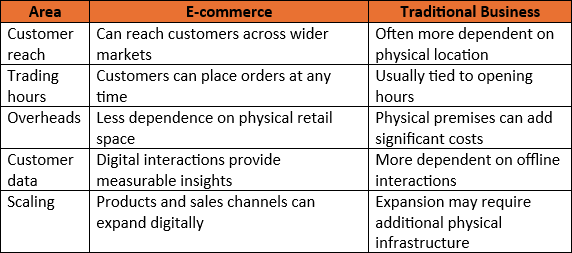
However, e-commerce does not remove operational complexity. Businesses still need inventory management, fulfilment, customer support, payment processing, security, and reliable technology.
Which E-commerce Business Model Fits Your Goals?
The business model should influence the technology behind the store.
- B2C: Consumer retailers often prioritise easy navigation, promotions, payments, and a smooth checkout.
- B2B: Wholesalers may need account-based pricing, bulk ordering, approval workflows, and business-system integrations.
- D2C: Direct-to-consumer brands often focus heavily on branding, customer experience, marketing integrations, and retention.
- Marketplaces: Multi-vendor businesses need functionality for sellers, commissions, listings, payments, and order management.
- Subscriptions and digital products: These models may require recurring billing, customer accounts, or controlled access to digital content.
Understanding the business model early can prevent businesses from selecting software that becomes restrictive as requirements evolve.
How to Choose the Right E-commerce Solution
Once the business model is clear, compare platforms against practical requirements rather than popularity alone. Consider:
- Business and product complexity: Look at product variations, pricing rules, catalogue size, and inventory requirements.
- Budget and total cost: Consider development, hosting, licences, extensions, maintenance, and support.
- Scalability: Assess whether the solution can handle future customers, products, traffic, and markets.
- Integrations: Check compatibility with ERP, CRM, accounting, inventory, payment, and shipping systems.
- Customisation: Determine whether built-in functionality meets your requirements or custom features will be needed.
- Security: Consider payment security, access controls, data protection, and ongoing updates.
- Technical resources: Make sure the platform matches the capabilities of the internal team.
- Ongoing support: Consider who will maintain, improve, and troubleshoot the store after launch.
These factors are equally important when evaluating ecommerce website development services because the platform is only one part of the overall solution.
When Should You Consider Custom E-commerce Development?
Custom ecommerce website development becomes more relevant when standard functionality cannot accommodate the way a business operates.
Examples include complex pricing structures, unusual product configurations, specialised workflows, multiple third-party integrations, several sales channels, or highly customised customer experiences.
An ecommerce development agency can help businesses assess these requirements and build functionality around their actual processes. However, custom does not automatically mean better. If an established platform meets the requirements effectively, it may offer a faster, more economical path forward.
Final Thoughts: Choose for Your Business, Not Just for Launch
The final decision should come down to business model, complexity, budget, integrations, scalability, and customisation needs. When a business requires a more tailored solution, working with an experienced ecommerce website development company can help turn those requirements into a practical technology strategy.
Investing in the right e-commerce web design services and technical foundation can create an online experience that is easier to manage, improve, and scale.
For businesses looking to build or enhance their online store, contact the Vrinsoft team or call +61 480 027 297 to discuss your requirements and explore the right E-commerce website development solution for your business.
E-commerce Development FAQs
How much does e-commerce website development cost?
A basic template-driven storefront costs $1,000, while a highly customized enterprise platform can cost over $100,000.
Which e-commerce platform is best for a small business?
Shopify, Wix, or Squarespace may suit businesses prioritising simplicity, while WooCommerce or other flexible platforms may be better when greater customisation is required.
Is custom e-commerce development better than a ready-made platform?
Custom development makes sense when standard platforms cannot support important business processes or customer requirements. Otherwise, a ready-made solution may be more efficient.
How long does it take to develop an e-commerce website?
An established platform can be developed faster than a custom solution. The timeline depends on design, functionality, integrations, catalogue complexity, testing, and the project's overall scope.
What should businesses prioritise when developing an online store?
Usability, mobile responsiveness, secure payments, performance, integrations, scalability, and a straightforward checkout should be considered alongside the specific requirements of the business model.