

Buy Now: https://www.eastwestoffroad.com/product/ewo-chevy-10-bolt-knuckle-and-arm-kit
Every lifted Squarebody owner knows the white-knuckle feeling. You hit a pothole, a frost heave, or a washboard section of trail, and suddenly your truck darts sideways like it has a mind of its own. This isn't a worn steering box, and it isn't loose tie rod ends—it's bump steer. A permanent Square Body Bump Steer Fix requires abandoning the factory push-pull steering geometry that becomes geometrically compromised the moment you install a lift kit. The solution lies in a properly engineered crossover high steer conversion that re-synchronizes your drag link and track bar arcs, delivering the stable, predictable handling that makes driving enjoyable again.
For decades, Squarebody enthusiasts have chased this problem with band-aid fixes: dual steering stabilizers, dropped pitman arms, and offset tie rod ends. None of these address the fundamental geometric conflict between a lifted suspension and the stock inverted-Y or push-pull steering linkage. This comprehensive guide unpacks why bump steer occurs, how crossover steering eliminates it entirely, and why the East West Offroad machined knuckle and arm kit provides the most robust, ready-to-install solution on the market for K10, K20, and K5 Blazer owners who are done compromising.
Understanding the Root Cause of Squarebody Bump Steer
Bump steer in a lifted Squarebody is not a mystery—it's pure geometry. The factory steering system was designed for a specific static ride height where the drag link and track bar operate on nearly parallel planes. When you install lift springs, the axle drops away from the frame, the drag link angle steepens dramatically, and its arc of motion diverges from the track bar's arc. Every suspension cycle now induces a toe change that yanks the steering wheel, forces the truck to wander, and accelerates tire wear. This is the mechanical reality behind the vague, wandering steering that plagues lifted GM trucks.
The Push-Pull System's Fatal Design Flaw
The stock push-pull steering configuration routes the steering force from the driver-side frame rail through a bell crank, then across to the passenger-side knuckle via a long drag link. This bell crank is the system's Achilles' heel. It introduces a pivot point that multiplies bushing deflection, frame flex, and linkage slop. On a lifted truck, the steepened drag link angle introduces a powerful vertical force vector that tries to rotate the axle housing every time the steering wheel is turned. This feedback loop—steering input causing axle rotation, axle rotation causing unintended steering output—is what drivers perceive as bump steer and wandering.
Why Lift Kits Inevitably Create Lifted Chevy Steering Geometry Problems
Lifted Chevy Steering Geometry is fundamentally altered the moment the ride height changes. The track bar and drag link, which once shared similar angles and lengths, now operate on completely different planes. The track bar's arc pushes the axle laterally as the suspension cycles, while the drag link's steeper arc pulls the steering linkage in a conflicting direction. This tug-of-war manifests as the steering wheel jerking in the driver's hands over bumps. No alignment shop can adjust this away because the problem isn't an adjustment—it's a design incompatibility between the factory steering layout and the lifted suspension height.
The Definitive Mechanical Solution: Crossover High Steer
The only permanent fix is to completely reconfigure the steering layout from push-pull to crossover, and critically, to raise the steering linkage attachment points via high steer arms on top of the knuckles. This achieves two essential corrections simultaneously. First, the drag link now runs directly from the pitman arm to the passenger-side knuckle, eliminating the bell crank and its associated slop. Second, the elevated attachment points flatten both the drag link and tie rod angles, restoring the parallel relationship with the track bar that neutralizes bump steer.
Crossover Steering vs Push Pull: The Night-and-Day Difference
When comparing Crossover Steering vs Push Pull, the driving experience difference is transformative. A push-pull system feels disconnected, with a large dead zone on-center and constant micro-corrections required to keep the truck in its lane. Crossover steering creates a direct, mechanical connection from the steering box to the knuckle. The steering response becomes linear and predictable. Highway wander disappears because the wheels no longer toe-change independently of driver input. Off-road, the improvement is even more dramatic—the steering wheel stays steady in technical terrain, reducing driver fatigue and increasing vehicle control.
The Role of a K5 Blazer High Steer Conversion
The K5 Blazer High Steer Conversion is particularly impactful due to the Blazer's shorter wheelbase. Shorter-wheelbase vehicles amplify the directional instability caused by bump steer because there's less polar moment of inertia resisting the unwanted yaw inputs. When a K5's suspension cycles, the bump steer-induced toe change has a more immediate and aggressive effect on the vehicle's heading. The high steer conversion tames this nervousness completely, turning the short-wheelbase Blazer from a handful on rough roads into a planted, confidence-inspiring rig that tracks true regardless of terrain.
The Foundation: Upgrading to a Dana 44 Flat Top Knuckle Passenger Side
Crossover steering cannot exist without the proper mounting foundation on the passenger side of the axle. The factory passenger side knuckle has no provision for attaching a high steer arm—its top surface is rough and sloped. The solution is a flat top knuckle: a knuckle casting with a machined-flat upper surface featuring threaded holes specifically designed to accept a bolt-on high steer arm. For decades, builders scavenged these rare knuckles from pre-1976 Dana 44 axles, but new, aftermarket solutions now eliminate the junkyard hunt entirely.
Why a Machined Flat Top Surface Is Mission-Critical
The interface between the knuckle and the high steer arm must be absolutely flat and perpendicular to the kingpin axis. Any angular deviation concentrates stress on the edges of the arm, creating a wedging action that cycles the mounting studs in bending rather than pure tension. This bending fatigue is the primary cause of stud failures and arm separations that can lead to complete steering loss. A precision-machined flat top surface ensures full-face contact between the arm and knuckle, eliminating the stress concentrations that doom makeshift conversions.
The Dana 44 4-Stud Knuckle Upgrade Advantage
The Dana 44 4-Stud Knuckle Upgrade configuration is the recognized standard for steering strength in the off-road industry. Earlier Dana 44 axles used a three-stud mounting pattern with smaller-diameter fasteners that proved inadequate for tires larger than 33 inches. The four-stud layout, using 9/16-inch diameter studs on a wider bolt circle, distributes clamping force more evenly and provides redundant load paths. Even if one stud were to lose preload—an unlikely scenario with proper torque and conical washers—three additional studs maintain arm retention and steering control.
Building Strength Throughout the Entire System
Bump steer correction is only half the battle. A lifted truck running oversized tires and tackling challenging terrain needs steering components built for the abuse. The factory tie rod and drag link are undersized for aggressive off-road use, and their thin walls are susceptible to bending on rock impacts. Integrating one-ton-rated steering linkages and a massively overbuilt high steer arm ensures the system not only steers correctly but also survives the trail damage that strands lesser setups.
Integrating a GM 1 Ton Tie Rod Conversion
A GM 1 Ton Tie Rod Conversion replaces the anemic half-ton linkage with thick-walled DOM tubing, massive one-ton-style threaded adjuster sleeves, and heavy-duty tie rod ends with significantly larger shank diameters. These components resist bending forces that would fold a stock tie rod like a pretzel. When paired with a crossover high steer arm, the one-ton linkage connects directly to the elevated attachment points on the knuckles, keeping the entire steering assembly tucked safely above the axle centerline and away from rock impacts.
The Chevy 10 Bolt Passenger Arm 1.25 Thick Difference
Arm thickness isn't just a number on a spec sheet—it's the difference between precision steering and unpredictable flex. The Chevy 10 bolt passenger arm 1.25 thick design provides nearly double the bending stiffness of common 1-inch arms. Under high steering loads—like when you're bound up in rocks with a locked front differential and applying heavy throttle—thinner arms flex elastically, effectively changing your toe setting in real time. The 1.25-inch thick arm remains rigid, preserving the alignment settings you established and delivering consistent, predictable steering response under all conditions.
The EWO Complete Steering Solution
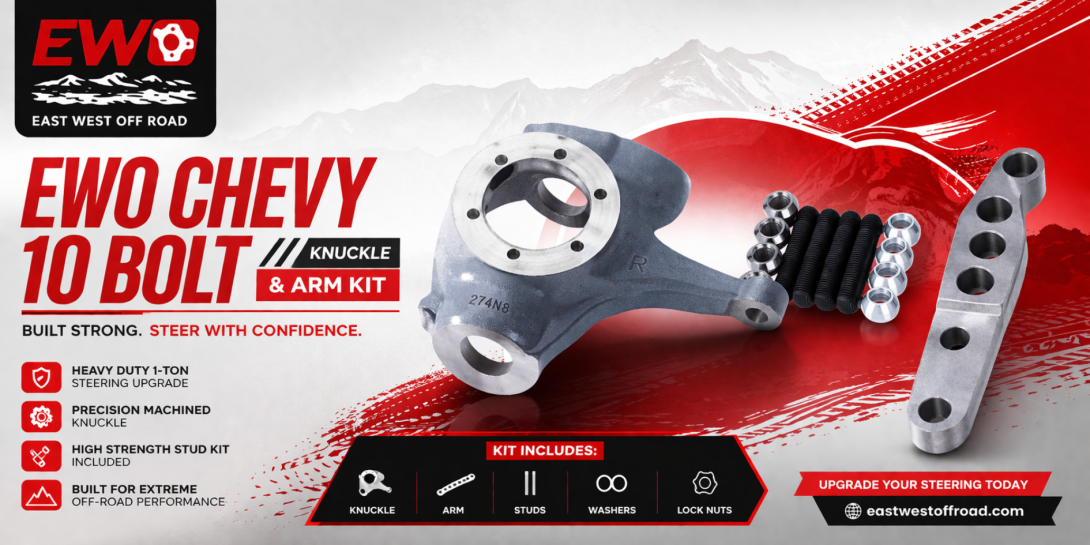
A true Square Body Bump Steer Fix demands a comprehensive, engineered solution rather than a patchwork of mismatched components. The complete Chevy 10 Bolt Crossover Steering Kit from East West Offroad bundles every component needed for the passenger-side conversion into a single, cohesive package. The star of the show is the precision-machined flat top knuckle—a brand-new casting, not a remanufactured core—paired with the massive 1.25-inch thick high steer arm and all necessary mounting hardware.
Inside the HD Crossover Steering Kit Components
An hd crossover steering kit must include more than just the large, obvious components. The EWO kit includes four high-strength 9/16-18 studs, each engineered for the specific metallurgical demands of steering arm retention. Heavy-duty conical washers seat into precision-machined counterbores in the arm, maintaining clamping force as the steel arm and cast iron knuckle expand at different rates under thermal cycling. Lock nuts with prevailing torque features ensure nothing vibrates loose after thousands of miles of rough-road driving.
The Engineering Behind East West Offroad Knuckle and Arm Kit
The East West Offroad knuckle and arm kit represents a systems-engineering approach to steering component design. The flat top surface of the knuckle is machined in the same setup as the kingpin bores, guaranteeing perpendicularity. The bottom of the high steer arm is surface-ground for flatness. The stud holes are precision-reamed to exact diameters. These manufacturing tolerances ensure that when the assembly is torqued, the load distributes evenly across the entire interface. There are no high spots to crush, no low spots to allow movement, and no tolerance stacks to compromise the assembly's long-term reliability.
Fastener Integrity: 9/16-18 High Strength Studs Dana 44
The 9/16-18 high strength studs Dana 44 hardware is the unsung hero of the entire system. Studs are far superior to bolts for this application because they're installed finger-tight into the knuckle, subjecting the cast iron threads to pure tensile preload rather than the combined tension-and-torsion stress of a bolt installation. The fine-thread 18-pitch upper end provides superior vibration resistance and allows precise torque application. This dual-thread design, combined with proper conical washers, creates a joint that maintains its clamp force indefinitely under the harshest off-road conditions.
Configuration Flexibility for Custom Builds
One of the most frustrating aspects of traditional high steer conversions is the permanence of the taper direction. Most machined knuckles commit you to either a top-down or bottom-up tie rod orientation, and changing that decision later requires irreversible machine work. The EWO kit solves this with an innovative tapered insert system that allows the end user to configure or reconfigure the steering orientation as their build evolves.
The Dana 44 Bottom Up Tapered Knuckle Standard
The knuckle arrives from EWO configured with a Dana 44 bottom up tapered knuckle orientation. In this configuration, the tie rod end installs from underneath the steering arm with its threaded shank pointing upward. This setup provides maximum ground clearance underneath the knuckle and works perfectly with the majority of leaf-sprung, spring-over-axle Squarebody configurations. The tie rod and drag link are elevated above the axle centerline, well-protected from trail obstacles and maintaining the flat angles essential for bump steer elimination.
Reversing Orientation with the Slit Tapered Insert Bottom Down
For builders running hydraulic assist rams, custom sway bar configurations, or specific linkage geometries that require top-down tie rod routing, the slit tapered insert bottom down provides a reversible solution. This precision-ground steel insert features a calibrated slit that allows it to compress during press-in installation, creating a permanent radial preload that locks it into the existing bore. Once installed, the insert provides a fresh, unworn tapered seat oriented in the opposite direction. The conversion is clean, mechanically robust, and reversible with proper tools—no welding, no machining, no irreversible modifications.
The HD Passenger Arm Dana 44: Overbuilt for a Reason
The HD passenger arm Dana 44 supplied in the EWO kit is machined from solid steel plate rather than being cast or forged. This manufacturing choice eliminates the internal porosity, inclusions, and grain-boundary weaknesses that can plague cast or forged arms subjected to high-cycle fatigue. The solid-plate construction provides isotropic material properties—meaning the strength is consistent in all directions—so there's no hidden weak orientation that could fail under an unexpected impact load.
Material Selection and Load Distribution
The arm's 1.25-inch thickness isn't just about brute bending resistance. The additional material depth provides sufficient thread engagement length for the tie rod end shank, preventing the pull-out failures that occur when tapered studs are installed in arms that are too thin. The arm also features multiple potential tie rod mounting positions, allowing builders to fine-tune their steering ratio. Moving the tie rod attachment closer to the kingpin centerline speeds up the steering response; moving it outward increases leverage and reduces steering effort with larger tires.
A Complete Chevy 10 Bolt Crossover Steering Kit for the Long Haul
When you commit to solving your Squarebody's bump steer permanently, you need a system that's as durable as the truck it's installed on. The complete Chevy 10 Bolt Crossover Steering Kit provides every component in one box, eliminating the guesswork of mixing and matching parts from different manufacturers. The knuckle is fresh-machined, the arm is purpose-built, the hardware is application-specific, and the tapered insert system provides flexibility for future modifications. This integrated approach ensures that every component works in harmony, from initial installation through years of off-road service.
Installation Best Practices for Long-Term Reliability
Proper installation is essential for extracting maximum performance and longevity from the system. The studs should be installed into the knuckle using high-strength thread locker and torqued to approximately 25-30 ft-lbs. The arm slides over the studs, the conical washers seat into their counterbores, and the lock nuts are tightened in a cross pattern to 90-100 ft-lbs. After the first heat cycle—usually after the first extended drive—all fasteners must be rechecked. This re-torque compensates for any initial settling in the assembly and ensures the clamping force remains consistent for the life of the installation.
The Essential Dana 44 Flat Top Knuckle Passenger Side Core
The entire conversion revolves around the passenger-side knuckle. Without a properly machined Dana 44 Flat Top Knuckle Passenger Side, the crossover system has no rigid foundation. The EWO knuckle provides this foundation with a factory-fresh casting machined to exacting specifications. The kingpin bores are honed for perfect bearing fit. The spindle mounting face is parallel to the kingpin axis. The flat top surface is perpendicular to both. Every geometric relationship in this knuckle is controlled to tolerances that ensure your alignment settings remain consistent and your steering remains predictable mile after mile.
Achieving the Ultimate Square Body Bump Steer Fix
The goal from day one has been to transform your truck's handling from a liability into an asset. A genuine Square Body Bump Steer Fix does more than just stop the steering wheel from jerking—it fundamentally changes the character of the vehicle. The truck tracks straight on the highway without constant correction. It holds its line through rough corners. It absorbs potholes and washboard without transmitting panic to the driver's hands. This transformation requires the right components, installed correctly, working together as an engineered system rather than a collection of parts.
The Dana 44 1-Ton Crossover High Steer Arm in Action
The Dana 44 1-ton crossover high steer arm is the final link in the chain, connecting the precision-machined knuckle to the heavy-duty tie rod linkage. Its massive cross-section resists the bending loads that flex lesser arms. Its multiple tie rod positions allow fine-tuning of the steering ratio. Its material quality ensures it survives impacts that would crack a cast arm. When you're miles from pavement, navigating terrain that demands absolute trust in your equipment, the overbuilt nature of this arm provides the confidence to commit to the line and drive with precision.
A Chevy 10 Bolt Steering Knuckle Machined for Modern Demands
The Chevy 10 bolt steering knuckle machined by EWO brings modern CNC precision to a classic platform. Unlike junkyard knuckles with unknown fatigue histories and worn bores, this fresh casting starts life as a blank destined specifically for high steer duty. The machining process ensures every surface is within specification, every threaded hole is perfectly located, and the flat top surface provides an ideal mating interface for the high steer arm. This is the foundation that makes everything else possible—a steering knuckle purpose-built for the demands of lifted, locked, and heavily-tired Squarebody trucks.
Frequently Asked Questions (FAQs)
What exactly causes bump steer in my lifted Squarebody?
Bump steer occurs because the factory drag link and track bar operate on different arcs once the suspension is lifted. The drag link's steeper angle pulls the steering linkage in a different direction than the track bar pushes the axle, creating a toe change every time the suspension cycles. This toe change tugs on the steering wheel, making the truck feel unstable.
Can I fix bump steer without a crossover steering conversion?
Band-aid fixes like dropped pitman arms or dual steering stabilizers can mask symptoms but cannot cure the underlying geometric problem. The only permanent fix is to reconfigure the steering layout to crossover with high steer arms, which raises the attachment points and restores proper linkage angles.
Is a flat top knuckle absolutely necessary for crossover steering?
Yes. The passenger-side knuckle must have a machined-flat top surface to properly mount the high steer arm. Attempting to bolt an arm to a rough, as-cast knuckle surface creates dangerous stress concentrations that will eventually cause stud failure and potential steering loss.
Will this conversion work on both the K10 and K20?
Absolutely. The GM 10 Bolt and Dana 44 front axles used in K10 and K20 trucks share the same knuckle dimensions and kingpin geometry. The EWO kit is compatible with both axle types across the Squarebody platform.
How does the slit tapered insert allow me to change tie rod orientation?
The slit insert presses into the existing taper bore and provides a new tapered seat oriented in the opposite direction. The slit compresses during installation, locking the insert in place. This allows you to reverse the tie rod orientation from bottom-up to top-down without any permanent modifications to the knuckle.