

Solid axle swap steering should be planned while the axle and suspension are being positioned—not after the swap is nearly complete.
The steering box is attached to the chassis.
The steering arm is attached to the moving axle.
Everything between those two points has to clear suspension components while maintaining suitable steering motion.
That makes steering one of the fundamental design constraints of an SAS build.
Establish Axle Position First
Before designing the drag link, determine:
- Axle centerline
- Wheelbase
- Spring location
- Suspension travel
- Tire size
- Full-lock tire position
Moving the axle later in the project changes steering geometry.
Establish Steering-Box Position
The chassis-side steering point is equally important.
The steering-box location determines where the pitman arm operates.
For the EWO conventional crossover configuration, a compatible 2WD Saginaw-style steering box is required.
The factory GM 4WD steering box is not suitable for that arrangement.
A custom SAS vehicle may need specific chassis work to position the correct box.
Select the Knuckle and Steering Arm
The axle-side connection needs an appropriate knuckle.
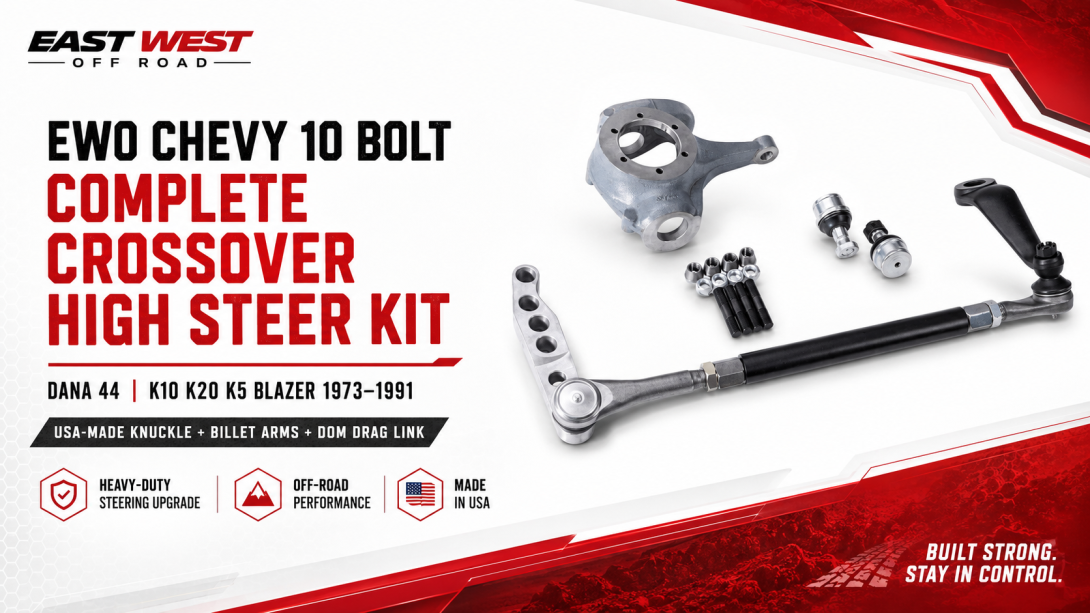
The EWO system uses a USA-made passenger-side steering knuckle with a 1.25-inch billet steering arm.
The arm is mounted using four 9/16-inch studs with conical washers and lock nuts.
The knuckle has a bottom-up taper and can accept an alternative bottom-down orientation using the supplied slit tapered insert when appropriate.
Mock Up the Drag Link
Once the steering-box and axle-side points are established, mock up the drag link.
The EWO D.O.M. tube provides 43 inches of material with 1.50-inch outside diameter and 0.250-inch wall.
Final dimensions depend on the completed vehicle.
Do not cut based on a forum measurement.
Check Suspension and Steering Together
Cycle:
- Full compression
- Full droop
- Driver-side articulation
- Passenger-side articulation
- Full left lock
- Full right lock
During each position, inspect:
- Joint angle
- Tire clearance
- Spring clearance
- Frame clearance
- Shock clearance
- Crossmember clearance
This is one reason steering must be considered before permanent fabrication.
Think About Serviceability
An SAS vehicle is already highly customized.
Avoid creating a steering arrangement that requires dismantling major suspension components for ordinary maintenance.
Consider access to:
- Jam nuts
- Steering-end nuts
- Arm fasteners
- Ball joints
- Steering box
- Pitman arm
Good design is serviceable design.
Steering Geometry vs. Suspension Geometry
The suspension determines how the axle moves.
The steering system must accommodate that motion without unwanted steering input or binding.
If the drag-link path and suspension movement are poorly coordinated, the vehicle can develop undesirable steering behavior.
Crossover/high steer can be useful because it allows the steering path to be designed around the solid axle rather than retained from an incompatible previous arrangement.
SAS Planning Checklist
Before final welding:
- Axle centered and located
- Ride height established
- Steering box installed or accurately mocked
- Pitman arm positioned
- Passenger knuckle installed
- High-steer arm installed
- Drag link mocked
- Full-lock clearance verified
- Full compression verified
- Full droop verified
- Joint articulation verified
- Alignment strategy confirmed
Conclusion
Good solid axle swap steering is engineered into the build from the beginning.
Axle position, steering-box placement, knuckle geometry, drag-link routing, suspension travel, and tire clearance are interconnected.
For compatible Dana 44 or GM 10 Bolt axle projects, the EWO crossover steering kit for solid axle swaps can provide several of the key axle-side and linkage components.
CTA
If your SAS brackets are not permanently welded yet, mock up the steering now. Discovering an interference problem before final welding is far easier than redesigning the front suspension afterward.
FAQs
When should steering be planned during an SAS?
As early as possible. Steering-box position, axle location, suspension travel, and drag-link routing can affect one another.
Can I use measurements from somebody else’s swap?
Use them only as reference information. Final dimensions must come from your own chassis, axle, steering box, suspension, and wheel/tire combination.
Is crossover steering common on solid axle swaps?
Yes, crossover-style geometry is commonly considered because the builder needs a steering path suited to the solid axle and custom suspension.
Does an SAS always require high steer?
No. The appropriate steering design depends on axle, suspension, clearance, steering box, and intended use.