

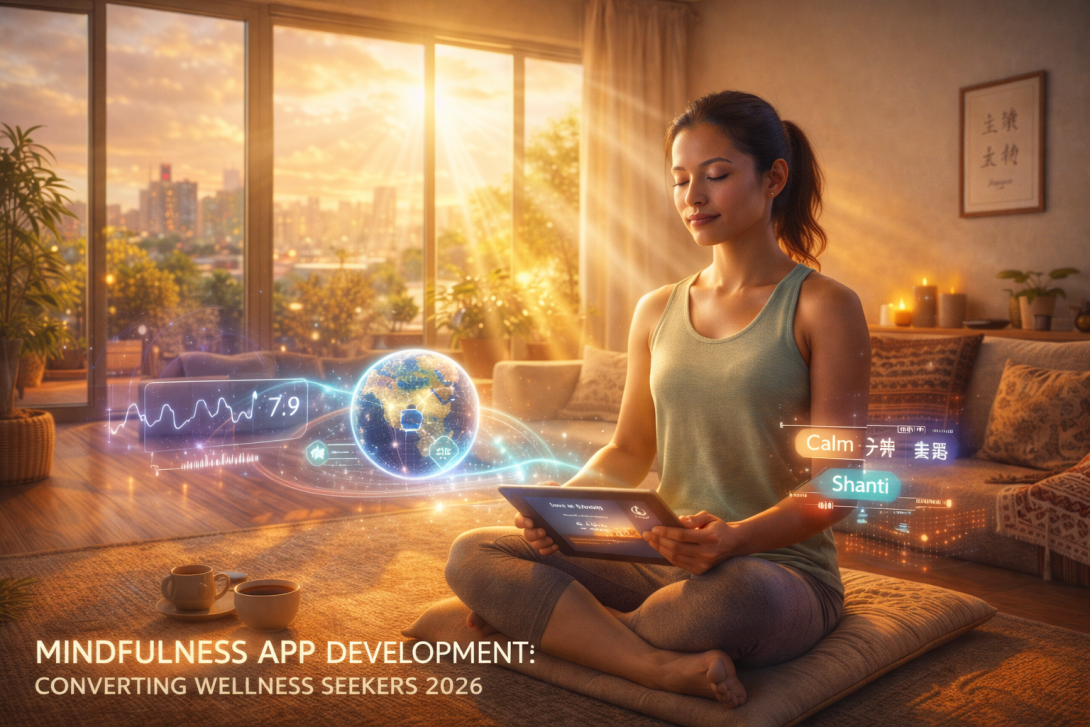
Mindfulness app development has shifted from a "content-library" model to a "proactive-intervention" model as we move through 2026. The days of simply offering a list of audio tracks are over. Today’s wellness seekers demand hyper-personalization, measurable biological outcomes, and seamless integration into their daily digital lives. For founders and product owners, the challenge isn't just building an app; it’s building a habit-forming engine that survives the "churn-heavy" nature of the mental health industry.
Disclaimer: This information is for educational purposes only and does not constitute medical or professional health advice. Consult a qualified clinical professional for guidance specific to mental health regulations and diagnostic software requirements.
The State of Mindfulness App Development in 2026
The wellness market has matured. In 2026, users are no longer satisfied with generic "ocean sounds" or basic breathing timers. According to industry analysis of app store trends in early 2026, the highest-performing mental health apps have moved toward precision wellness. This involves using real-time data to suggest interventions exactly when a user’s stress levels spike.
The competitive landscape is now dominated by apps that leverage Wearable 2.0 sensors. These devices provide continuous streams of cortisol proxies, such as skin temperature and heart rate variability (HRV). If your development roadmap doesn't include sensor integration, you are competing with 2022 technology in a 2026 market.
Moving from Awareness to Implementation (MOFU)
As you evaluate your development partner, geographic expertise becomes a competitive advantage. For instance, teams specializing in Mobile App Development in Georgia are increasingly focused on cost-efficient, high-security builds that comply with both US and European data privacy standards. This regional focus allows for specialized talent pools that understand the nuances of HIPAA and GDPR—critical for any app handling sensitive mental health data.
Successful implementation requires a three-pillar framework:
- Biometric Synchronization: Connecting to Apple HealthKit, Google Health Connect, and specialized wearable APIs.
- Contextual Awareness: Using AI to understand if a user is at work, commuting, or at home to suggest appropriate content.
- Community Loops: Moving beyond solo meditation to group "live-sync" sessions that increase accountability.
Strategic Framework: Converting Wellness Seekers
Conversion in the mindfulness space is not a single event; it is a series of micro-commitments.
Phase 1: The Bio-Validation Hook
In early 2026, the most effective onboarding flows use a "Bio-Check." Instead of asking a user what they want, the app reads their current physiological state via their smartwatch and tells them what they need. This immediate value-add proves the app’s utility before the user even hits a paywall.
Phase 2: Generative Content Engines
Static libraries are expensive to maintain. Modern mindfulness app development utilizes generative AI to create personalized guided meditations. By analyzing a user's specific stressors—extracted from integrated calendars or manual mood logs—the app can generate a 5-minute script voiced by a high-fidelity synthetic coach tailored to that specific moment.
Phase 3: The "Small Wins" Retention Loop
Wellness seekers often quit because they don't "feel" different immediately. To combat this, successful apps in 2026 use Progress Visualization.
"Retention in mental health apps is directly proportional to the user’s perception of progress, not the actual hours spent meditating." — Journal of Digital Health & Clinical Psychology (2025 Study)
AI Tools and Resources
MindfulFlow API — A specialized LLM endpoint for generating clinical-grade meditation scripts.
- Best for: Automating the creation of personalized audio content.
- Why it matters: Eliminates the need for constant studio recording sessions.
- Who should skip it: Apps focused exclusively on celebrity-led content.
- 2026 status: Fully operational with support for 40+ languages.
Sentio SDK — Real-time emotional state detection via front-facing camera/biometrics.
- Best for: Adjusting app difficulty or content based on visible user frustration or calm.
- Why it matters: Creates a truly "responsive" app environment.
- Who should skip it: Privacy-first apps that avoid camera permissions.
- 2026 status: V3 release with edge-processing to ensure data privacy.
Vocal Media Blueprint — Reference framework for technical architecture in fitness AI.
- Best for: Understanding how to structure high-performance AI wellness backends.
- Why it matters: Provides a developer blueprint for scaling real-time processing.
- Who should skip it: Non-technical founders looking for "no-code" solutions.
- 2026 status: Updated for 2026 hardware standards.
Risks, Trade-offs, and Limitations
Building in the mental health space involves significant risks that generic app development often overlooks.
When Personalization Fails: The "Feedback Loop" Scenario If an app incorrectly identifies a user's high heart rate during exercise as a "panic attack" and triggers a heavy intervention, it disrupts the user experience and erodes trust.
- Warning signs: High "dismiss" rates on proactive notifications.
- Why it happens: Over-reliance on a single data point (e.g., HR) without checking activity sensors.
- Alternative approach: Implement "Multi-Modal Validation" where the app asks a quick confirmation question before escalating an intervention.
Hidden Costs of Compliance Many founders underestimate the cost of maintaining "Cyber-Resilience." In 2026, regulatory bodies have increased the frequency of mandatory security audits for wellness apps that store biometric data. Skipping a quarterly penetration test can lead to platform-wide de-listing from major app stores.
Practical Application: 2026 Development Roadmap
If you are starting your project today, follow this 90-day sprint logic:
- Day 1-30: Foundation & Compliance. Secure your data architecture and finalize your HIPAA/GDPR compliance layer. Define your "Unique Biometric Angle."
- Day 31-60: The Generative Core. Integrate your AI engines for content and biometric analysis. Focus on the latency of your "Live-Sync" features.
- Day 61-90: Community & Feedback. Build out the social accountability layers and begin closed-beta testing with 2026-specific "Wellness Influencer" groups to seed the community.
Key Takeaways
- Biometrics are Mandatory: A mindfulness app without wearable integration is obsolete by 2026 standards.
- Hyper-Personalization: Use generative AI to create content that addresses the user's current, specific stressors.
- Trust is the Currency: Transparent data handling and bio-validation (proving the app works via data) are the only ways to ensure long-term retention.
- Regional Expertise: Leveraging specialized hubs for Mobile App Development in Georgia or similar tech corridors can provide the necessary compliance and technical depth at a sustainable price point.