

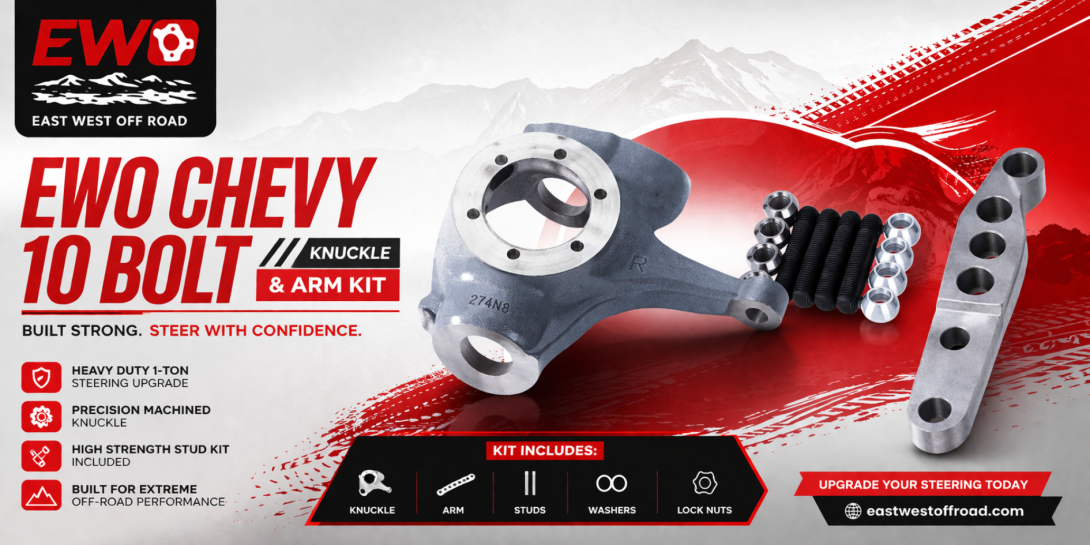
Buy Now: https://www.eastwestoffroad.com/product/ewo-chevy-10-bolt-knuckle-and-arm-kit
There is a moment in every lifted Squarebody build when excitement turns to dread. The suspension is installed, the tires are mounted, the stance is perfect—and then you drive it. The truck wanders like a shopping cart. The steering wheel jerks violently over every bump. Highway speeds become a white-knuckle exercise in constant correction. This is not a failed alignment or a worn steering box. This is Lifted Chevy Steering Geometry collapsing under the weight of angles it was never designed to handle. The factory push-pull steering layout operates correctly at exactly one ride height: stock. Change that height, and you break a carefully balanced equation of arcs, angles, and pivot points that no amount of toe adjustment can fix.
The good news is that this geometry is not a mystery. It is governed by measurable, predictable physical relationships that can be understood, diagnosed, and permanently corrected. This article dissects the angles, explains the arcs, and maps the path from a truck that fights its driver to one that tracks straight and steers with precision.
The Fundamental Geometry of a Solid Axle Steering System
Before you can understand why lifting breaks everything, you must understand what the factory geometry looks like and how it functions at stock ride height. A solid-axle, leaf-sprung GM truck relies on four key components to control front-end kinematics, and their relationships to one another determine whether the truck handles predictably or dangerously.
The Track Bar: Axle Location and Lateral Movement
The track bar—also called a panhard bar—is a fixed-length link that connects the driver-side frame rail to the passenger-side axle housing. Its job is simple: locate the axle laterally under the vehicle, preventing it from shifting side to side as cornering and road forces act on the suspension. But because the track bar pivots at both ends, it does not constrain the axle to perfectly vertical movement. The axle actually sweeps through a slight side-to-side arc as the suspension compresses and extends. At stock ride height, this lateral movement is minimal—typically less than half an inch through the full suspension travel—and it occurs symmetrically around the static position. The factory steering geometry was designed with this specific track bar arc in mind.
The Drag Link: Steering Force Transmission
In the factory push-pull system, the drag link runs from the bell crank on the driver-side frame rail to the passenger-side knuckle. When the steering wheel turns, the drag link pushes or pulls on the passenger knuckle, steering both wheels through the tie rod. The critical geometric requirement is that the drag link must pivot on an arc that is parallel to the track bar's arc. When these two arcs are synchronized, the lateral movement of the axle caused by the track bar is exactly matched by the lateral movement of the drag link. The tie rod sees no unintended force, and toe remains constant regardless of suspension position.
The Tie Rod: Connecting the Knuckles
The tie rod is the fixed-length link connecting the driver-side knuckle to the passenger-side knuckle. Its job is to ensure both wheels steer together. When the drag link pushes or pulls the passenger knuckle, the tie rod transfers that motion to the driver-side knuckle. If the drag link and track bar arcs are synchronized, the tie rod experiences only the intended steering forces. If those arcs diverge—which happens after lifting—the tie rod experiences conflicting forces that change the toe setting dynamically.
What Happens to the Angles When You Lift
Installing lift springs drops the entire front axle several inches relative to the frame. This single change cascades through every geometric relationship in the steering system.
The Track Bar Angle After Lift
When the axle drops, the fixed-length track bar tilts downward at a steeper angle from its frame mount to its axle mount. A steeper track bar angle means the axle's lateral movement per inch of suspension travel increases. The arc becomes more aggressive. Where the axle might have moved a quarter-inch laterally through the suspension travel at stock height, it now moves half an inch or more. This increased lateral movement is unavoidable with a track bar design—the only ways to correct it are to raise the axle-end mount, lower the frame-end mount, or lengthen the bar, all of which require significant fabrication.
The Drag Link Angle After Lift
The drag link in the push-pull system also tilts to a steeper angle after lifting. But because the drag link's pivot points are different from the track bar's—the bell crank on the frame versus the track bar's frame mount, the passenger knuckle versus the track bar's axle mount—the angles change at different rates. The drag link length is also different from the track bar length, which means the arcs have different radii. What was once an approximately synchronized pair of arcs is now a geometric mismatch. Every inch of suspension travel produces a conflict between where the track bar positions the axle and where the drag link tries to position the knuckle.
The Toe Change That Defines Bump Steer
This conflict manifests as a dynamic toe change. On compression, the track bar pushes the axle slightly to the passenger side. But the drag link, sweeping through its own steeper and now-mismatched arc, pulls the passenger knuckle in a slightly different direction. The knuckle rotates around the kingpin. The tie rod transfers this rotation to the driver-side knuckle. The wheels steer—toe-in on compression, toe-out on extension—without any driver input. The driver feels this toe change as a tug on the steering wheel, and the truck darts in response to the unintended steering angle. This is bump steer in its mechanical essence, and it is the direct consequence of lifting without correcting the steering geometry.
The Vertical Force Vector Problem
A steep drag link angle introduces a secondary problem that is often overlooked. When a link operates at a steep angle, a significant portion of the force traveling through it acts vertically rather than horizontally. The steering box pushes on a steep drag link, and some of that force tries to compress the suspension rather than steer the wheels. This vertical force component fights the leaf springs, making the steering feel heavy and inconsistent. It also feeds back into the steering wheel—when the suspension compresses and the drag link angle momentarily changes, the vertical force component changes, and the driver feels a corresponding pulse. This is the secondary mechanism of bump steer, compounding the toe-change effect.
The Crossover Steering Solution: Correcting the Angles
Crossover steering addresses both the arc mismatch and the force-vector problem by fundamentally changing how the drag link connects to the axle. Understanding how it corrects the geometry explains why it is the only permanent solution.
Raising the Drag Link Attachment Point
Crossover steering eliminates the bell crank and runs the drag link directly from the pitman arm to a high steer arm bolted to the top of the passenger-side knuckle. This high steer arm raises the axle-end attachment point of the drag link by several inches. Raising this attachment point flattens the drag link angle, bringing it back into parallel alignment with the track bar. When the drag link and track bar are parallel, their arcs synchronize. The lateral axle movement is matched by the drag link's sweep. Toe remains constant. Bump steer is eliminated at its geometric source.
Flattening the Force Vector
A flatter drag link angle also minimizes the vertical force component that makes steep-angled push-pull steering feel heavy and inconsistent. More of the steering force now acts horizontally, where it actually steers the wheels. The steering effort becomes lighter and more linear. The feedback through the wheel becomes predictable rather than pulsing. The driver experiences a direct, connected steering feel.
The Crossover Steering vs Push Pull Distinction
The difference between Crossover Steering vs Push Pull is the difference between correcting geometry and living with it. Push-pull cannot be fixed with band-aids because its fundamental architecture—the bell crank, the mismatched arcs, the steep angles—is incompatible with suspension lift. Crossover steering replaces that architecture with one that works correctly at the new ride height.
The Foundation: Dana 44 Flat Top Knuckle Passenger Side
Crossover steering requires a flat top knuckle on the passenger side to mount the high steer arm. The Dana 44 Flat Top Knuckle Passenger Side from EWO is a brand-new, CNC-machined casting that provides the geometrically accurate foundation for the entire system. The flat top surface is milled perpendicular to the kingpin bores. The Dana 44 4-Stud Knuckle Upgrade pattern secures the arm with four 9/16-18 high strength studs Dana 44 and conical washers. The Chevy 10 bolt steering knuckle machined from a fresh casting eliminates the variables of junkyard cores.
The High Steer Arm and Linkage
The Dana 44 1-ton crossover high steer arm provides the elevated attachment point that corrects the drag link angle. The Chevy 10 bolt passenger arm 1.25 thick resists bending under load, preserving the corrected geometry. The HD passenger arm Dana 44 specification ensures the arm stays rigid. The Dana 44 bottom up tapered knuckle orientation positions the tie rod for maximum ground clearance, and the slit tapered insert bottom down provides orientation flexibility for custom builds.
The Complete Chevy 10 Bolt Crossover Steering Kit Solution
A Chevy 10 Bolt Crossover Steering Kit bundles every component needed to correct lifted steering geometry. The EWO Chevy 10 bolt knuckle kit provides the flat top foundation. The East West Offroad knuckle and arm kit integrates the knuckle, arm, and hardware into a system-engineered package. The GM 1 Ton Tie Rod Conversion adds the strength to maintain the corrected geometry under load. The hd crossover steering kit standard ensures every component is overbuilt for the abuse of off-road use. Together, these components deliver a Square Body Bump Steer Fix that transforms the driving experience for K5 Blazer High Steer Conversion and Chevy K10/K20 Steering Upgrade builds alike.
Frequently Asked Questions (FAQs)
Why does lifting my Chevy truck destroy the steering feel?
Lifting changes the angles of the drag link and track bar. These two links must operate on parallel arcs to prevent bump steer. After a lift, the angles change at different rates, the arcs diverge, and every suspension cycle creates a toe change that tugs the steering wheel and makes the truck wander.
Can an alignment fix lifted steering geometry?
No. An alignment sets static toe, but it cannot correct the dynamic toe change that occurs when the suspension cycles. The problem is geometric—the drag link and track bar are operating on conflicting arcs—and no alignment adjustment can fix that mismatch.
At what lift height do steering geometry problems become serious?
Bump steer becomes noticeable at around 2 inches of lift and severe by 4 inches. The factory geometry has very little tolerance for ride height change. Even a mild lift degrades the drag link-to-track bar relationship enough to affect handling.
Why is a flat top knuckle required to fix the geometry?
The flat top knuckle provides the mounting surface for the high steer arm, which raises the drag link attachment point to flatten the angle and restore parallel operation with the track bar. The factory knuckle cannot accept a high steer arm.
Will a dropped pitman arm fix my steering geometry?
A dropped pitman arm changes the drag link angle at the frame end but does not address the fundamental mismatch between the drag link and track bar arcs. In a push-pull system, it often introduces additional bump steer through the bell crank mechanism. Crossover high steer is the only permanent correction.