

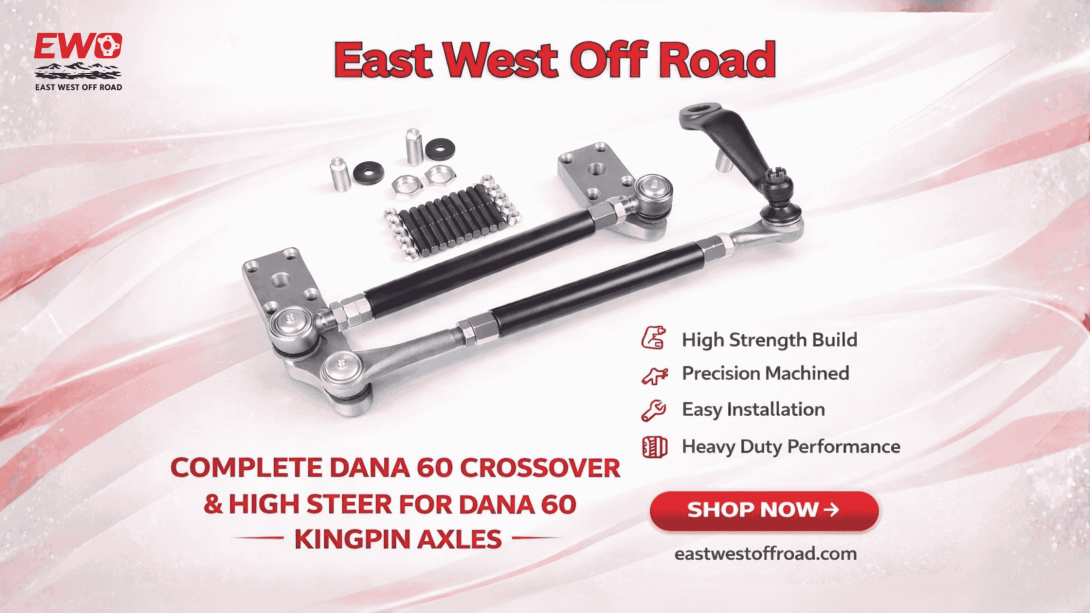
The kingpin Dana 60 is the gold standard of off-road front axles, but its factory steering system was designed for farm trucks on narrow bias-ply tires. Bolt a set of 40-inch radials onto a lifted rig and point it at a trail, and the factory push-pull or inverted-Y linkage becomes the weak link that holds the entire build back. A properly executed Kingpin Dana 60 Steering Upgrade replaces every compromised factory component with parts engineered for the actual loads that off-road driving generates. Billet high steer arms with a five-stud pattern lock to the knuckles with clamping force that eliminates the stud failures plaguing factory three-bolt arms. Thick-wall DOM tubing replaces the bend-prone factory tie rod and drag link. GM 1-ton rod ends provide the taper strength and articulation range that smaller ends cannot match. This guide covers every aspect of the upgrade, from knuckle preparation to final alignment, and explains why a complete USA-made kit is the only way to guarantee a steering system that survives the trail.
Why the Factory Kingpin Steering System Falls Short
The kingpin Dana 60 axle itself is nearly bulletproof. The steering components attached to it were never intended to handle what today's builds demand from them.
The Three-Stud Arm Problem
Factory kingpin Dana 60 knuckles use a three-stud steering arm mounting pattern. Three fasteners concentrated the entire steering load onto a small number of stress points. When a truck on large tires wedges against a rock and the driver cranks the wheel, the force at each stud can exceed its yield strength. The stud stretches, the arm lifts slightly from the knuckle face, and the remaining studs shear in rapid succession. Even if catastrophic failure is avoided, the micro-movement between the arm and knuckle wallows out the mounting holes, a permanent condition that requires knuckle replacement or expensive machining to correct.
The solution is Dana 60 High Steer Arms 5 Stud that spread the steering load across five fasteners. The 5 hole pattern Dana 60 steering arms reduce the stress on each individual stud by approximately 40 percent, keeping operating loads well within the safe range of the stud material. This five-stud pattern is the foundation of any legitimate kingpin steering upgrade, and it addresses the most common failure point in the entire system.
Bump Steer and Geometry Problems
Factory steering geometry was optimized for stock ride height. Adding suspension lift angles the drag link and track bar in different directions, creating divergent arcs when the suspension cycles. The result is bump steer, where the axle steers itself without driver input and the steering wheel jerks violently with every bump. Off Road Crossover Steering geometry fixes this by running the drag link from the steering box directly to a high steer arm on the passenger-side knuckle. When the drag link and track bar are parallel and of equal length, they swing through identical arcs, and bump steer disappears completely.
Low-Hanging Steering Linkage
The factory tie rod hangs well below the axle centerline, making it the lowest vulnerable component under the front of the truck. One solid rock strike bends the tie rod, and the truck loses toe alignment or steering control entirely. High steer arms relocate the tie rod and drag link mounting points above the axle centerline, tucking the linkage behind the differential housing where it is protected from direct rock impacts.
Components of a Complete Kingpin Steering Upgrade
A legitimate Kingpin Dana 60 Steering Upgrade addresses every component from the knuckle face to the pitman arm.
Billet High Steer Arms
The steering arms are machined from 1.25 inch thick Dana 60 billet arms steel. Billet material is a solid block of American steel with uniform grain structure and zero internal voids. This eliminates the porosity that creates stress risers in cast arms. The 1.25-inch thickness provides a massive cross-section that resists bending, keeping the tie rod end mounting holes perfectly aligned under load. The arms are CNC-machined with precise taper angles for GM 1 Ton Tie Rod Ends and incorporate correct Ackermann angle geometry so the inside tire tracks a tighter radius without scrubbing.
DOM Tubing for Drag Link and Tie Rod
The linkage is fabricated from Dana 60 crossover steering with DOM tubing using 1.50 OD .250 wall DOM tubing. DOM manufacturing creates seamless tubing with uniform wall thickness and no internal weld seam. The .250-inch wall resists denting when the linkage contacts rocks. The 1.50-inch outside diameter provides the column stiffness to resist buckling under compression. The Dana 60 Drag Link Kit includes pre-cut lengths ready for final fabrication.
GM 1-Ton Rod Ends and Hardware
GM 1 Ton Tie Rod Ends are the standard for heavy-duty steering because of their oversized taper stud. The ES2026R ES2027L drag link ends handle the drag link with opposing right-hand and left-hand threads for easy length adjustment. The ES2234L ES2234R tie rod ends provide the same construction for the tie rod. All four ends are greaseable. They thread into 7/8-18 weld bungs and jam nuts machined from solid hex stock and fully welded into the DOM tubing.
High-Strength Mounting Studs
The arms are secured with Dana 60 high strength studs 180000 PSI, a dramatic upgrade from the factory 120,000 PSI hardware. When torqued with the included tapered conical nuts, these studs create a friction bond that effectively welds the arm to the knuckle.
The Complete Kit Advantage
Sourcing individual Dana 60 Kingpin Parts from multiple manufacturers creates compatibility risks that compromise steering precision and safety.
Tolerance Stacking Problems
Taper mismatch between rod ends and arms is the most common issue with mixed-brand systems. The GM 1-ton taper is a specific angle, and even minor manufacturing variations prevent full stud seating. A partially seated rod end concentrates its load on a small contact patch, wallowing out the taper over time. Thread pitch mismatches between rod ends and bungs create similar problems.
The East West Offroad Solution
The East West Offroad Dana 60 kit delivers a complete, pre-engineered system in a single box. The complete Dana 60 kingpin steering kit includes driver and passenger side billet high steer arms, pre-cut DOM tubing for both links, all four GM 1-ton rod ends with hardware, ten 180,000 PSI studs with tapered nuts, weld-in bungs with matching jam nuts, grease fittings, and installation hardware. Every taper matches. Every thread pitch is correct. Every component is verified compatible before the kit ships. This is the Dana 60 High Steer Kit approach that guarantees professional results.
The EWO kingpin high steer kit is machined in the United States from domestically sourced billet steel and DOM tubing. Full material traceability verifies published strength specifications. American manufacturing provides direct engineering support from the people who designed and machined the components.
Step-by-Step Installation Overview
Installing a kingpin steering upgrade involves mechanical assembly, welding, and precise alignment.
Knuckle Preparation
Remove the factory steering arms. Wire-wheel the knuckle mounting surfaces to bare steel and wipe with solvent. Chase all threaded holes with a bottoming tap. Any debris between the arm and knuckle reduces clamping friction and accelerates stud fatigue.
Arm Installation
Apply high-strength red thread locker to the knuckle-side threads of the Dana 60 high strength studs 180000 PSI. Bottom the studs by hand, install the arms, and torque the conical nuts in a star pattern to the manufacturer's specification. The arms must sit perfectly flat with zero visible gap.
Bung Welding
Slide the 7/8-18 weld bungs and jam nuts into the DOM tubing ends with a small root gap for weld penetration. Tack each bung in four quadrants, verify rod end fitment, and weld in short alternating passes with compressed air cooling to prevent bung distortion. Overheating the bung ruins the internal threads.
Alignment
Assemble the drag link and tie rod. Install on the vehicle with full suspension weight. Set toe to 1/16 to 1/8 inch of toe-in. Tighten all jam nuts. Grease all four rod ends through their zerk fittings. Re-torque all fasteners after the first 500 miles of driving and after the first serious trail run.
Steering Box and Track Bar
Crossover steering requires a steering box that swings side to side. Factory push-pull boxes are not compatible. A two-wheel-drive steering box or aftermarket crossover box is required, along with frame reinforcement. The track bar must be parallel with the drag link. An adjustable track bar or drop bracket may be needed on lifted trucks.
Performance Results After the Upgrade
Drivers completing the Kingpin Dana 60 Steering Upgrade notice immediate improvements across all driving conditions.
Trail Performance
The tie rod now lives above the axle centerline, protected by the differential housing. Steering feedback is direct with no dead zone on-center. When tires wedge against obstacles, the crossover system delivers clean steering assist without the leverage multiplication that bends factory linkage.
Highway Stability
Parallel drag link and track bar geometry eliminates bump steer over expansion joints and potholes. The steering wheel stays calm and straight, reducing driver fatigue on long highway transits to the trailhead.
Hydraulic Assist Readiness
The billet high steer arms include provisions for hydraulic ram mounting. The five-stud pattern and 180,000 PSI studs provide the clamping overhead needed to survive hydro assist pressures without shearing fasteners.
Conclusion
The Kingpin Dana 60 Steering Upgrade is the single most impactful modification for any lifted solid-axle truck. Billet high steer arms with a five-stud pattern eliminate the stud failures that plague factory three-bolt arms. DOM tubing with a quarter-inch wall replaces bend-prone factory linkage. GM 1-ton rod ends provide the taper strength for off-road steering loads. Crossover geometry eliminates bump steer and makes the truck predictable to drive on any terrain. A complete USA-made kit from East West Offroad ensures every component works together without compatibility problems. Build your steering once, build it right, and enjoy the confidence that comes from a system engineered for the abuse that kingpin Dana 60 axles are famous for surviving. The complete system is available as a Dana 60 Crossover Steering solution ready to transform how your truck handles.
Frequently Asked Questions (FAQs)
How do I know if my Dana 60 is a kingpin axle?
Look for a large threaded hex cap on top of the upper knuckle. This cap houses the kingpin spring and bushing. Ball joint Dana 60 axles have a smooth upper knuckle surface. The kingpin cap is visible without disassembly and is the definitive identifying feature.
What is included in the complete steering upgrade kit?
The complete Dana 60 kingpin steering kit includes driver and passenger side billet high steer arms, pre-cut DOM tubing for the drag link and tie rod, all four GM 1-ton rod ends with hardware, ten 180,000 PSI studs with tapered nuts, weld-in bungs with matching jam nuts, grease fittings, and installation hardware.
Do I need to change my steering box?
Yes. Crossover steering requires a steering box that swings side to side across the chassis. Factory push-pull boxes that swing fore and aft are not compatible. A two-wheel-drive steering box or aftermarket crossover box is required with frame reinforcement.
Is welding required?
The high steer arms bolt to the knuckles without welding. However, the drag link and tie rod require welding the threaded bungs into the DOM tubing. This welding should be performed by someone with fabrication experience.
Will this upgrade fix my death wobble?
Crossover steering corrects the geometry issues that contribute to death wobble by synchronizing drag link and track bar arcs. However, death wobble can also be caused by worn kingpin bushings, bad wheel bearings, unbalanced tires, and loose track bar mounts. A properly installed upgrade eliminates steering geometry as a contributing factor, making it easier to diagnose remaining issues.