

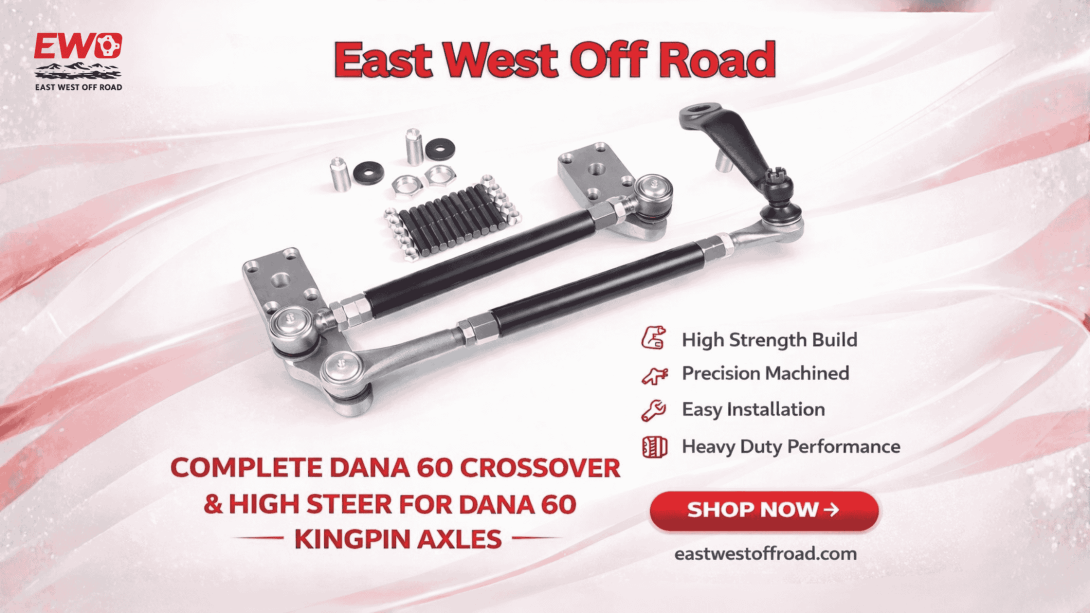
The kingpin Dana 60 front axle is legendary for its strength, but the factory steering system was never engineered to handle the demands of modern off-road driving. Lifted suspensions, oversized tires, and aggressive trail use expose every weakness in the stock push-pull or inverted-Y linkage. A properly executed Kingpin Dana 60 Steering Upgrade replaces the entire compromised system with a crossover high steer arrangement that places the tie rod and drag link above the axle centerline where they belong. This article examines why the kingpin knuckle design demands a specific steering solution, how billet arms and DOM tubing transform handling, and what separates a complete USA-engineered kit from pieced-together alternatives. When you are ready to build a steering system that matches the brute strength of your kingpin axle, the comprehensive solution is available as a Kingpin Dana 60 Steering Upgrade from East West Offroad.
Why the Kingpin Dana 60 Deserves a Dedicated Steering System
The kingpin Dana 60 is not the same axle as the ball joint version found under later Ford Super Duty trucks. The knuckle design, mounting pattern, and load paths are fundamentally different, and the steering upgrade must account for these unique characteristics.
The Kingpin Advantage and Its Steering Demands
Kingpin knuckles use a massive tapered pin rotating inside a bronze bushing housed in the steering knuckle. This design handles side-load impacts that destroy ball joints, making it the preferred axle for rock bouncers, monster trucks, and heavy overland rigs. However, the factory steering arms were engineered when 33-inch tires were considered massive. Bolt on a set of 40-inch sticky compound tires and the loads skyrocket beyond what the factory three-bolt arm pattern can withstand. The studs stretch, the arm walks on the knuckle face, and the bolt holes elongate. A legitimate kingpin steering upgrade addresses this at the mounting interface before even considering the linkage.
Geometry Correction for Lifted Applications
Lifting a truck with a kingpin Dana 60 pushes the factory drag link and track bar into divergent arcs. At ride height, the angles might look acceptable, but cycle the suspension and the toe change becomes dramatic. This dynamic toe change is what drivers feel as bump steer, where the steering wheel jerks violently when one tire hits a rut or rock. Crossover steering fixes this by attaching the drag link to the passenger knuckle and aligning it parallel with the track bar. The two components move in synchronized arcs, eliminating the toe change that makes a lifted truck exhausting to drive on uneven terrain. This is the core benefit of a complete Dana 60 Crossover Steering conversion.
Components That Define a True Heavy-Duty Upgrade
Not all steering kits labeled as heavy-duty actually deliver the strength required for hardcore wheeling. The difference lies in material specifications, machining precision, and hardware quality.
Billet High Steer Arms: The 5-Stud Revolution
Cast steel arms are the weak link in most budget steering kits. Casting inherently introduces porosity, tiny air bubbles trapped in the steel that act as stress risers. Under repeated impact loading from rock crawling, these voids propagate into cracks that eventually cause catastrophic arm failure. The solution is 1.25 inch thick Dana 60 billet arms machined from a solid block of American steel. Billet material has a uniform grain structure with no internal voids, meaning the arm's strength is predictable and consistent throughout.
The 5 hole pattern Dana 60 steering arms further enhance durability by distributing clamping load across five fasteners instead of three. This reduces the load on each stud by nearly half, keeping the arms locked to the knuckle face even under hydraulic ram assist pressures. The arms are machined with precision for the correct Ackermann angle, ensuring the inside tire follows a tighter turning radius than the outside tire without scrubbing rubber off the tread blocks.
Studs That Hold Under Extreme Load
The best billet arms in the world are worthless if the studs snap. This kit includes Dana 60 high strength studs 180000 PSI rated hardware, a massive upgrade from the factory studs that typically fall in the 120,000 PSI range. These studs are fine-thread for maximum thread engagement and utilize tapered conical nuts that self-center in the arm's counterbores. When torqued to specification in a star pattern, the studs stretch slightly in tension, creating a clamping force so high that the arm and knuckle effectively fuse into a single unit. This friction bond prevents the micro-movement that wallows out knuckle mounting holes, a common failure that requires knuckle replacement.
DOM Tubing and the Drag Link Assembly
The drag link and tie rod are the backbone of the steering linkage. Cheap kits use standard ERW pipe with a visible internal weld seam that creates a stress riser along the entire length. The Dana 60 crossover steering with DOM tubing specification calls for Drawn Over Mandrel tubing, which is formed by drawing a solid billet over a mandrel to create a seamless, uniform wall thickness. The 1.50 OD .250 wall DOM tubing used in this kit provides a .250-inch wall that resists denting when the tie rod inevitably contacts a rock ledge. The 1.50-inch outside diameter provides the stiffness needed to prevent flex under load without the unnecessary weight of solid bar stock.
GM 1 Ton Tie Rod Ends and Weld Bungs
The rod ends connect the steering linkage to the knuckles and steering box. GM 1 Ton Tie Rod Ends are the industry standard for crossover steering because of their massive taper stud and full-range misalignment capability. The ES2026R ES2027L drag link ends feature a greaseable design with heavy-duty rubber boots that keep contamination out of the joint. The ES2234L ES2234R tie rod ends use the same robust construction for the tie rod assembly. These ends thread into 7/8-18 weld bungs and jam nuts that are machined from solid steel hex stock. The hex profile allows for easy wrench adjustments during alignment, a practical detail that pays off on the trail when tweaks are needed.
The Complete East West Offroad Kit: What Makes It Different
Scavenging junkyards and parts stores for steering components creates a system with mismatched tapers, unknown thread pitches, and questionable metallurgy. The East West Offroad Dana 60 kit arrives as a unified system where every component is pre-selected for compatibility and strength.
Everything in One Box
The complete Dana 60 kingpin steering kit includes driver and passenger side billet high steer arms, two lengths of DOM tubing pre-cut to 54 inches and 43 inches respectively, all four required GM 1-ton tie rod ends with hardware, ten high-strength studs with tapered nuts, grease fittings, spacers, jam nuts, and the weld-in inserts. There is no cross-referencing part numbers across different websites or discovering mid-installation that a rod end taper doesn't match the pitman arm. The EWO kingpin high steer kit is designed as a complete system from the knuckle out.
USA Manufacturing and Material Traceability
East West Offroad machines these components in the United States from domestically sourced billet steel. This provides full material traceability back to the mill, verifying that the steel meets published strength specifications. Imported kits frequently use steel alloys that look correct but fail to meet tensile strength ratings, a dangerous compromise in a steering component where failure means complete loss of vehicle control. American manufacturing also means direct engineering support, if a fitment question arises, you can talk to the people who machined the parts.
Ideal Applications for This Upgrade
The kit serves a broad range of off-road applications. Rock crawlers benefit from the ground clearance provided by high steer geometry. Lifted truck owners eliminate the bump steer that makes highway driving fatiguing. Custom Jeep builders get a steering system strong enough to handle Dana 60 axle swaps and 40-inch tires. Off-road race vehicles rely on the billet arm strength to survive high-speed desert impacts. Overlanding rigs gain the reliability needed for remote expeditions where a steering failure means a very long walk home.
Step-by-Step Installation Walkthrough
Installing a kingpin steering upgrade is a fabrication project that requires welding, precise measurement, and attention to detail. Rushing the installation results in poor alignment and compromised strength.
Knuckle Preparation and Stud Torque Procedure
Begin by removing the factory steering arms and inspecting the knuckle mounting surface. Any rust scale, old gasket material, or paint must be removed down to bare steel. A flat, clean mounting surface is critical for the friction bond that keeps the billet arms locked in place. Chase all threaded holes with a bottoming tap to ensure the new studs engage fully. Apply high-strength red thread locker to the knuckle-side threads and install the Dana 60 high strength studs 180000 PSI by hand until they bottom out. Do not use a wrench to seat them initially, bottoming by hand ensures the stud is fully engaged without cross-threading. Torque the studs to the manufacturer's specification in a star pattern, then install the arms and torque the conical nuts incrementally in the same pattern.
Welding the Bungs: Technique and Heat Control
Slide the 7/8-18 weld bungs and jam nuts into the DOM tubing ends. Leave approximately a 1/16-inch gap between the tube end and the bung shoulder. This root gap is critical, it allows the weld bead to penetrate through to the inside diameter, creating a full-penetration weld rather than a surface fillet that can crack. Tack the bung in four evenly spaced locations, then check that the rod end threads in freely without binding. If the bung shifted during tacking, break the tacks and reposition. Weld in short 1-inch beads, alternating sides and allowing the tube to cool between passes. Overheating the bung distorts the internal threads, and once those threads are damaged, the bung is scrap. Compressed air cooling between passes keeps the temperature under control.
Setting Toe and Drag Link Length
Assemble the drag link and tie rod with the rod ends threaded into the welded bungs. Install both assemblies on the vehicle with the full weight on the suspension. Set the toe using a tape measure across the tire tread blocks at the front and rear of the tires. Target 1/16 to 1/8 inch of toe-in to account for the slight deflection that occurs under load. Tighten all jam nuts firmly, then cycle the steering lock to lock while watching for any binding in the rod ends at full articulation. Grease all four rod ends through their zerk fittings until fresh grease purges from the boots. Recheck toe and jam nut torque after the first 500 miles of driving, as everything will settle into its final position.
Chevy-Specific Kingpin Dana 60 Considerations
Many kingpin Dana 60 axles found in the wild originated under square-body Chevy and GMC one-ton trucks from 1977 to 1991. These axles have specific characteristics that affect steering upgrade choices.
Factory Chevy Steering Box Compatibility
The Chevy Dana 60 Crossover Steering conversion typically requires replacing the factory push-pull steering box with a crossover steering box or a two-wheel-drive box that swings side to side. The factory four-wheel-drive box pushes forward and backward, which works for the inverted-Y linkage but cannot operate a crossover drag link. The steering box must be mounted to the inside of the frame rail with reinforcement to prevent frame cracking. Chevrolet frames are notoriously prone to cracking at the steering box mounting ears, so a weld-in frame reinforcement plate is strongly recommended before bolting up the new steering system.
Pitman Arm Selection for Chevy Applications
The pitman arm connects the steering box sector shaft to the drag link. Selecting the correct length and drop is essential for achieving parallel geometry with the track bar. On lifted Chevy trucks, the factory pitman arm often has too much drop, angling the drag link downward while the track bar angles upward. This mismatch creates bump steer even with a crossover steering system. A flat or minimally dropped pitman arm with the correct GM taper for the ES2026R ES2027L drag link ends restores the parallel relationship. East West Offroad offers an optional pitman arm matched to the kit's rod end tapers.
Off-Road Performance: What Changes After the Upgrade
Drivers who complete the Off Road Crossover Steering conversion notice immediate improvements in several areas, both on the trail and on pavement.
Trail Handling and Ground Clearance
The tie rod now lives above the axle centerline, protected by the differential housing and leaf springs. Ledges that previously used the tie rod as a slider now pass harmlessly underneath. The steering feedback is direct and predictable, with no dead zone on-center and no wandering that requires constant correction. When the front tires wedge against an obstacle, the crossover system delivers clean steering assist without the leverage multiplication that bends factory tie rods into pretzels.
Highway Stability and Daily Driving
A properly aligned crossover steering system is perfectly stable at highway speeds. The synchronized drag link and track bar geometry eliminates the bump steer that causes the truck to dart when hitting expansion joints or potholes. The steering wheel stays straight and calm, reducing driver fatigue on long highway stints. This is not a trail-only modification, it is a genuine handling upgrade for any lifted truck that sees street miles.
Hydraulic Assist Compatibility
For rigs running tires over 40 inches or competing in extreme rock crawling events, hydraulic ram assist is the next logical step. The billet high steer arms include provisions for mounting a hydraulic ram to the tie rod. The Dana 60 Drag Link Kit components are engineered to handle the additional force of a ram pushing and pulling on the steering linkage. The five-stud arm pattern and 180,000 PSI studs provide the overhead needed to survive hydro assist pressures without shearing fasteners or cracking arms.
Conclusion
The kingpin Dana 60 is a legendary axle that deserves a steering system engineered to the same standard. Factory steering components were designed for an era of bias-ply tires and farm trucks, not for rock crawling on 40-inch radials with hydraulic assist. A complete kingpin steering upgrade replaces every weak link in the chain, from the knuckle arms and studs to the drag link tubing and rod ends. Billet steel arms with a five-stud pattern distribute load across the knuckle face, DOM tubing with a quarter-inch wall resists rock damage, and GM 1-ton ends provide the articulation and strength that off-road driving demands. Choosing a USA-made kit ensures material traceability, precise machining, and engineering support from people who understand the abuse these components will endure. Build your steering system once, build it right, and never think about it again. Start your upgrade with the Dana 60 High Steer Kit that serious wheelers trust.
Frequently Asked Questions (FAQs)
What is the difference between a kingpin Dana 60 and a ball joint Dana 60 for steering upgrades?
Kingpin knuckles have a flat, five-stud mounting surface that accepts billet high steer arms directly. Ball joint knuckles use an angled, tapered mount that is completely different. Steering kits are not interchangeable between the two axle types. Verify your axle has kingpin caps on top of the upper knuckle before ordering.
Do I need to remove the axle from the truck to install a high steer kit?
No. The knuckle arms can be replaced with the axle fully assembled and under the truck. Removing the wheels and brake components provides access, but the differential, axle shafts, and kingpin assemblies remain in place. The installation is primarily an external bolt-on and weld-on process.
Can I run this steering kit with my factory Dana 60 tie rod ends?
No. The billet high steer arms are machined for the taper of GM 1-ton tie rod ends, which are larger than the factory Dana 60 ends. The kit includes the correct ES2026R ES2027L drag link ends and ES2234L ES2234R tie rod ends that match the arm tapers precisely.
How do I know if my track bar needs to be changed with crossover steering?
Measure the angle of your track bar at ride height. The drag link must sit at the same angle when the steering is centered. If the angles differ by more than a few degrees, you need an adjustable track bar or a drop bracket to bring them into parallel alignment. Parallel track bar and drag link geometry is essential for eliminating bump steer.
Is the DOM tubing included in the kit threaded?
No. The DOM tubing comes cut to length with square ends. The 7/8-18 weld bungs and jam nuts are separate components that must be welded into the tube ends. This weld-in design is stronger than a clamp-style adapter and allows for final adjustment of tie rod end clocking during assembly.