

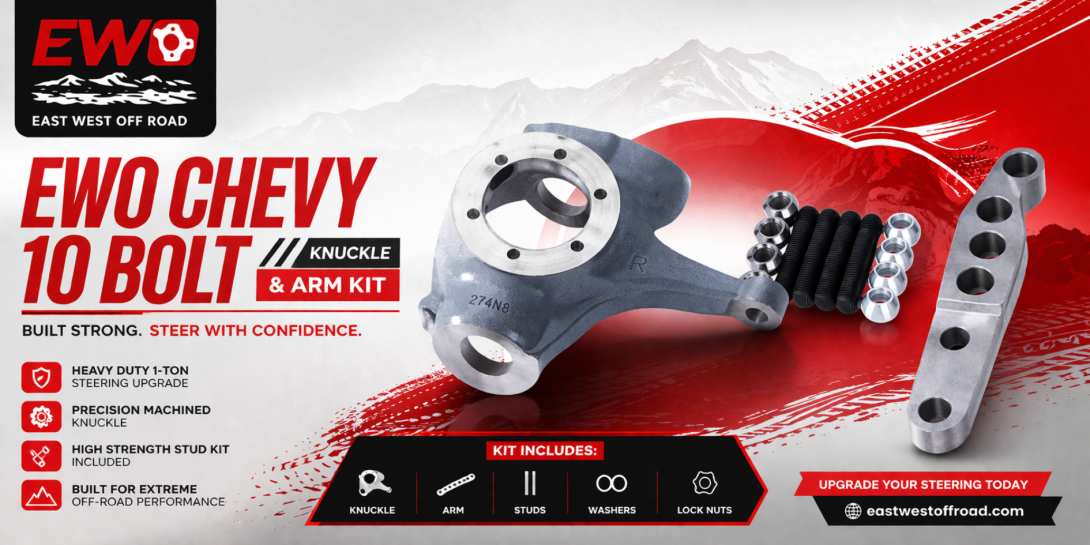
Buy Now: https://www.eastwestoffroad.com/product/ewo-chevy-10-bolt-knuckle-and-arm-kit
The factory tie rod on your Squarebody GM truck was engineered for a half-ton payload, stock-height suspension, and modest 235/75R15 highway tires. The moment you bolt on 35s, 37s, or larger rubber and point the nose toward a rock garden, that pencil-thin factory linkage becomes the weakest link in your entire steering system. A GM 1 Ton Tie Rod Conversion swaps those inadequate half-ton components for massive, thick-wall DOM tubing, one-ton-rated tie rod ends, and robust threaded adjuster sleeves that can absorb impacts that would instantly fold a stock tie rod into a horseshoe. This is the strength upgrade that keeps you steering when the trail gets serious.
Bending a tie rod on the trail isn't just an inconvenience—it's a safety crisis. A severely bent tie rod can create enough toe-in to lock your front tires against each other, immobilizing the vehicle. Even a minor bend alters your alignment enough to make the truck dangerous to drive at highway speeds on the return trip home. The one-ton conversion eliminates this failure mode by increasing the bending strength of the linkage by an order of magnitude, using materials and dimensions originally designed for trucks with gross vehicle weight ratings nearly double that of a K5 Blazer or K10 pickup.
Why the Factory Tie Rod Fails on Lifted Trucks
Understanding the forces that destroy factory tie rods explains why the one-ton conversion is not just an upgrade—it's a necessity for any Squarebody that sees off-pavement use with oversized tires. The factory tie rod is a hollow tube with a relatively thin wall thickness and a small outside diameter. This cross-section is adequate for the bending loads generated by stock tires on paved roads, but it has virtually no safety margin for the amplified forces created by larger, heavier tire and wheel assemblies striking obstacles at speed or binding against rocks at low speed with a locked differential.
The Mechanics of Tie Rod Buckling and Bending
When your driver-side tire jams against an immovable rock while the passenger-side tire has traction, the force required to drag the stuck tire across the obstacle travels directly through the tie rod as a compressive axial load. A long, slender column loaded in compression—and that's exactly what a tie rod is—will buckle once the compressive force exceeds its critical load. The factory tie rod's small cross-section and thin wall make its critical buckling load dangerously low for off-road use. A one-ton conversion increases both the outside diameter and the wall thickness, dramatically raising the critical buckling load and preventing the sudden, catastrophic collapse that strands trucks on the trail.
Impact Loading and Shock Forces
Even when the tie rod doesn't buckle under pure compression, it can bend from impact loading. Striking a rock, stump, or ledge with the tie rod itself—common when the linkage is positioned below the axle centerline in the factory configuration—delivers a shock load that can locally yield the tube material. Once a bend initiates, the tube's effective column strength drops precipitously, and additional bending occurs with progressively less force. One-ton conversion components resist this damage through thicker material sections and, when paired with a high steer conversion, by relocating the tie rod above the axle centerline where it is far less likely to contact obstacles in the first place.
The Components of a Proper GM 1 Ton Tie Rod Conversion
Not all one-ton conversions are created equal. The term "one-ton" refers to the use of tie rod ends sourced from or dimensionally equivalent to those used on one-ton-rated GM trucks, but the quality of the tubing, the design of the adjuster sleeves, and the compatibility with your specific knuckle taper all determine whether the conversion delivers its promised strength and reliability.
DOM Tubing: The Backbone of the System
Drawn Over Mandrel (DOM) tubing is the only acceptable material for a one-ton tie rod conversion. Unlike cheaper electric-resistance-welded (ERW) tubing, DOM tubing is cold-drawn through a die and over a mandrel after welding, which work-hardens the material, normalizes the weld zone, and produces exceptionally consistent wall thickness and dimensional accuracy. The result is a tube with uniform mechanical properties throughout its cross-section and length, eliminating the weak points that can cause ERW tubing to split along the weld seam under cyclical loading. The increased yield strength of DOM tubing directly translates to higher buckling resistance and impact toughness.
One-Ton Tie Rod Ends: Taper and Thread Specifications
Genuine one-ton tie rod ends feature a significantly larger taper shank diameter than their half-ton counterparts. This larger shank provides greater shear strength at the point where the tie rod end connects to the steering arm or knuckle, and it distributes the bending load across a larger cross-sectional area at the base of the taper. The threaded shank that engages the DOM tubing adjuster sleeve is also larger, providing deeper thread engagement and greater pull-out resistance. When selecting tie rod ends for a conversion, the taper angle must match the taper machined into your knuckles and high steer arms. The EWO kit's Dana 44 bottom up tapered knuckle and accompanying high steer arm are machined with the correct taper for standard one-ton tie rod ends, ensuring full contact area and eliminating the slop that develops with mismatched taper angles.
Adjuster Sleeves and Thread Engagement
The adjuster sleeve connects the tie rod end to the DOM tubing and provides the length adjustment necessary for setting toe alignment. High-quality one-ton conversion kits use massive, thick-wall adjuster sleeves with substantial thread engagement length. The sleeve should be machined from solid bar stock or heavy-wall DOM, not thin-wall tubing with a few threads tapped into each end. The threaded section should engage at least 1.5 times the diameter of the tie rod end shank to ensure the threads are not the weak point in the assembly. Jam nuts on each end of the sleeve lock the adjustment in place and prevent the tie rod end from rotating under vibration.
Integrating the One-Ton Conversion with Crossover High Steer
A one-ton tie rod conversion delivers its full potential when integrated with a crossover high steer system. The elevated linkage position of a high steer setup protects the investment you've made in heavy-duty steering components, while the corrected steering geometry eliminates the bump steer that can cause the driver to make abrupt, load-spiking steering corrections.
How a Chevy 10 Bolt Crossover Steering Kit Completes the System
A complete Chevy 10 Bolt Crossover Steering Kit bundles the one-ton tie rod with the flat top knuckle, high steer arm, and drag link components needed for a full steering overhaul. The kit approach ensures that every component—from the knuckle taper to the tie rod end shank to the high steer arm thickness—is dimensionally compatible and engineered to work as a system. This eliminates the frustrating process of sourcing components from multiple manufacturers and discovering on installation day that a tie rod end taper doesn't match the knuckle bore, or that the adjuster sleeve thread pitch is incompatible with the tie rod end.
The Role of the HD Crossover Steering Kit in Linkage Protection
An hd crossover steering kit positions the entire steering linkage above the axle centerline, tucking the one-ton tie rod into a protected zone behind the axle tube where rocks and obstacles cannot reach it. This elevated position is made possible by the high steer arms bolted to the flat top knuckles, which raise the tie rod attachment points several inches above their factory locations. The combination of one-ton strength and elevated positioning creates a steering linkage that is both geometrically correct and physically protected from trail damage.
Installation and Alignment: Getting It Right
Installing a GM 1 ton tie rod conversion is mechanically straightforward, but attention to detail during assembly and alignment determines whether the system performs reliably for years or develops problems within months.
Thread Preparation and Anti-Seize Application
The threads on the tie rod ends and the inside of the adjuster sleeves should be thoroughly cleaned with brake cleaner before assembly to remove any machining oils or protective coatings. A high-quality anti-seize compound should be applied to the threads to prevent galling and to ensure that future alignment adjustments can be made without excessive force. Do not use thread locker on the adjuster sleeve threads; the jam nuts provide the locking function, and thread locker can make future toe adjustments unnecessarily difficult.
Setting Toe Alignment Correctly
With the one-ton conversion installed, toe alignment should be set with the vehicle's full weight on the suspension at normal ride height. For most lifted Squarebody trucks running 35-inch or larger tires, a target of 1/8-inch to 3/16-inch toe-in measured at the tire tread centerline provides stable highway tracking. The one-ton adjuster sleeves allow precise toe settings because their fine threads provide greater adjustment resolution than the coarse threads on factory half-ton components. Once the toe is set, the jam nuts should be tightened securely against the adjuster sleeve ends to lock the adjustment.
Common Mistakes to Avoid with One-Ton Conversions
Several predictable pitfalls catch builders who are new to one-ton tie rod conversions. Awareness of these issues before you start the installation saves time, money, and frustration.
Mismatched Taper Angles
The most common and most dangerous mistake is forcing a tie rod end with one taper angle into a knuckle or high steer arm machined with a different taper angle. The two common GM taper angles are 1.5 inches per foot (7.125 degrees included angle) and 2 inches per foot (10 degrees included angle). Mismatched tapers will not seat properly, leaving a gap that allows the tie rod end to rock in its bore under load. This movement will eventually elongate the taper bore, ruin the knuckle or arm, and can cause the tie rod end to separate from the steering system entirely. Always verify taper compatibility before assembly.
Insufficient Thread Engagement
The tie rod end shank must engage the adjuster sleeve threads by a minimum of 1.5 times the shank diameter. Less engagement than this concentrates the axial load on too few threads, risking thread stripping under high compressive or tensile loads. If the adjuster sleeve does not provide adequate engagement length with your chosen tie rod ends, a longer sleeve or a different tie rod end must be selected. This is not a dimension where compromise is acceptable.
Neglecting Post-Installation Inspection
After the first significant off-road use, the entire one-ton conversion should be inspected. Check the jam nuts for tightness, examine the tie rod ends for any sign of movement in their taper bores, and visually inspect the DOM tubing for any signs of impact damage or bending. Catching a loose jam nut or a slightly bent tube early prevents the progressive damage that turns a minor issue into a major component failure.
The Synergy Between One-Ton Strength and Corrected Geometry
The one-ton tie rod conversion addresses the strength deficit of the factory linkage, but it does not, by itself, fix the bump steer problems that plague lifted Squarebody trucks. True steering transformation requires both strength and correct geometry.
Pairing One-Ton Linkage with Lifted Chevy Steering Geometry Correction
Lifted Chevy Steering Geometry correction through a crossover high steer conversion addresses the root cause of bump steer, while the one-ton tie rod ensures the corrected geometry is maintained by components strong enough to resist deflection under load. A thin factory tie rod flexes under steering loads, effectively changing the toe setting dynamically as cornering or obstacle forces increase. The one-ton DOM tubing is stiff enough to maintain its shape, preserving the alignment settings that eliminate bump steer. This synergy between geometry correction and component stiffness is what makes a complete steering overhaul so transformative to the driving experience.
Why a K5 Blazer High Steer Conversion Demands One-Ton Strength
The K5 Blazer High Steer Conversion benefits disproportionately from one-ton tie rod strength because the Blazer's shorter wheelbase and lighter overall weight encourage more aggressive driving lines. Blazer owners tend to point their trucks at obstacles that heavier, longer-wheelbase trucks avoid, and the resulting shock loads on the steering linkage are correspondingly higher. A one-ton tie rod on a K5 Blazer is not overkill—it's appropriate insurance against the kind of trail damage that turns a weekend adventure into a recovery operation.
Making the Case for a Complete Dana 44 Flat Top Knuckle Passenger Side Foundation
The one-ton tie rod connects to the steering system at the knuckles, and the quality of that connection point determines whether the one-ton strength can be fully utilized. A properly machined Dana 44 Flat Top Knuckle Passenger Side provides the rigid mounting point that anchors the entire steering linkage.
The Square Body Bump Steer Fix and Linkage Strength Working Together
A true Square Body Bump Steer Fix addresses the geometric cause of instability, while the one-ton tie rod conversion addresses the structural weakness that makes the factory linkage a liability. Together, they create a steering system that tracks straight on the highway, responds predictably to driver inputs, and survives impacts that would destroy lesser components. This is the combination that transforms a lifted Squarebody from a white-knuckle handful into a vehicle that drives with the precision and confidence of a modern truck, while retaining the solid-axle capability that makes these trucks legendary.
Long-Term Maintenance of Your One-Ton Tie Rod System
The one-ton conversion is designed for durability, but it is not maintenance-free. Regular inspection and occasional service keep the system performing at its peak and catch developing issues before they become trail failures.
Inspection Intervals and What to Look For
Every oil change is a good opportunity to slide under the truck and inspect the steering linkage. Grab the tie rod and attempt to rotate it by hand—it should not move independently of the tie rod ends. Check the jam nuts with a wrench to confirm they remain tight. Look for any sign of rust staining around the taper bores, which can indicate movement between the tie rod end shank and the knuckle or arm taper. Inspect the DOM tubing for any dents, gouges, or bends. A straightedge laid along the tube will quickly reveal any deformation that might not be visible to the naked eye.
Tie Rod End Replacement and Service Life
One-ton tie rod ends are wear items with a finite service life, though that life is typically significantly longer than half-ton ends due to the larger bearing surfaces and greater grease capacity. When a tie rod end develops play—detectable as vertical or horizontal movement when the linkage is manipulated with a pry bar—it should be replaced immediately. A worn tie rod end introduces slop into the steering system and can initiate the death wobble oscillations that are difficult to diagnose and dangerous to experience.
Frequently Asked Questions (FAQs)
What exactly is a GM 1 ton tie rod conversion?
A GM 1 ton tie rod conversion replaces the factory half-ton tie rod with thick-wall DOM tubing, one-ton-rated tie rod ends with larger shank diameters, and heavy-duty threaded adjuster sleeves. This dramatically increases bending strength and buckling resistance for lifted trucks running oversized tires.
Do I need a high steer conversion to run a one-ton tie rod?
The one-ton tie rod can be installed on factory steering configurations, but the full benefits are realized when paired with a crossover high steer system. High steer positions the linkage above the axle centerline, protecting it from impacts and correcting the steering geometry that causes bump steer.
Will a one-ton tie rod fit my factory knuckles?
One-ton tie rod ends have larger taper shanks than half-ton ends. Factory knuckles are typically machined with half-ton tapers. To run one-ton tie rod ends, you need knuckles or high steer arms machined with the correct one-ton taper. The EWO flat top knuckle and high steer arm are machined with the appropriate taper for one-ton tie rod ends.
How do I adjust toe with a one-ton tie rod conversion?
The adjuster sleeve between the tie rod end and the DOM tubing allows length adjustment. Loosen the jam nuts, rotate the sleeve to extend or retract the tie rod end, set the desired toe measurement, and re-tighten the jam nuts. Always set toe with the vehicle's full weight on the suspension at normal ride height.
Can I use the one-ton conversion with my stock steering stabilizer?
Most one-ton tie rod conversions require a different steering stabilizer mounting configuration than the factory setup. The larger diameter DOM tubing typically does not accept the stock U-bolt stabilizer bracket. Aftermarket clamp-on stabilizer brackets sized for the one-ton tube diameter are readily available.