

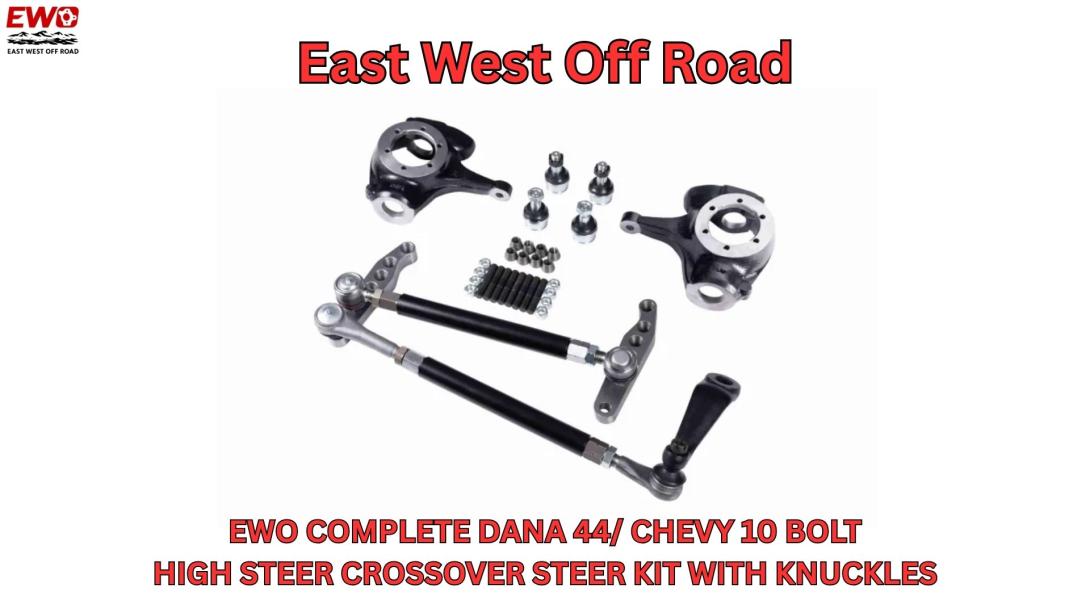
The journey to building a capable off-road vehicle inevitably leads to a critical crossroads where appearance meets engineering. While suspension lifts and oversized tires provide the visual statement of capability, they simultaneously introduce a fundamental engineering challenge: compromised steering geometry. For owners of Chevy K5 Blazers, Square Body trucks, and Jeep Wranglers, this reality demands more than temporary fixes—it requires a complete system re-engineering through a professionally designed Dana 44 Flat Top Knuckle Conversion that transforms steering from a liability into a precision asset.
The Physics of Failure: Why Lifted Vehicles Lose Steering Integrity
When you elevate your GM 4x4 with a suspension lift, you're engaging in a fundamental alteration of vehicle dynamics that factory engineers never intended. The original inverted Y-link steering design functions within precise geometric parameters at stock height but becomes mathematically compromised when lift kits change the critical relationships between steering components. This mismatch creates dangerous bump steer—a condition where suspension movement generates unpredictable steering inputs that compromise vehicle control during critical moments.
This challenge extends beyond theoretical physics into practical reliability concerns. The factory configuration positions the tie rod as the lowest and most vulnerable component in your undercarriage, making it susceptible to catastrophic trail damage. For those seeking to Fix Bump Steer Lifted Chevy K5 vehicles, the solution requires addressing both the mathematical geometry flaws and the physical vulnerability through comprehensive system re-engineering rather than partial adjustments.
The Engineering Solution: Crossover Steering Fundamentals
Crossover steering, frequently termed high steer in technical discussions, represents a complete re-engineering of front steering architecture. This systematic approach transforms problematic factory designs into robust, parallel linkage systems through two methodical modifications:
- Foundation Reformation: The process initiates with replacing production knuckles with precision-machined units featuring geometrically-correct mounting surfaces that establish the proper foundation for steering physics—a critical step in any Dana 44 Flat Top Knuckle Conversion.
- Structural Elevation: High-strength steering arms mount directly to these engineered knuckles, elevating the entire steering linkage assembly. This strategic repositioning aligns components in parallel formation with the axle housing, creating the mechanical basis for a transformative Square Body Chevy High Steer Upgrade.
The engineered outcome delivers measurable improvements: virtual elimination of bump steer, calculated gains in component clearance, and exponential enhancements in system durability and driver predictability across all driving conditions.
Manufacturing Precision: The Bolt-On Advantage
Historical steering modifications involved taper reaming—an imprecise process that compromised material integrity while introducing dimensional variance. Contemporary manufacturing eliminates these compromises. A genuine Bolt-On High Steer Kit GM 10 Bolt arrives with every interface precision-machined to exact specifications, establishing new benchmarks for installation accuracy and component compatibility.
This defines current expectations for the K10 Crossover Steering Kit No Reaming experience. In professionally engineered systems, knuckles and arms feature pre-machined tapers that precisely match included heavy-duty ends, eliminating installation variables while ensuring consistently secure fits that deliver professional-grade results with every installation.
Material Integrity: Engineering for Longevity
Exceptional steering systems transcend mere component relocation—they fundamentally reinforce every structural element. The engineering hallmark of premium systems is integration of a complete GM 1 Ton Tie Rod Conversion Kit, utilizing specifically engineered 7/8”-18 threaded interfaces paired with 1.5” .250-wall DOM tubing for assemblies with mathematically superior strength over factory components.
Material origin proves equally critical for long-term performance. USA Made Dana 44 Steering Arms and knuckles manufactured from certified domestic billet aluminum represent the durability benchmark. Unlike cast alternatives with potential internal inconsistencies, billet material provides uniform molecular structure and superior impact resistance—essential characteristics for systems responsible for vehicle control in demanding environments.
Application Versatility: Universal Platform Compatibility
A common consideration involves Dana 44 vs 10 Bolt Crossover Steering compatibility. Technical analysis confirms these GM axle platforms share virtually identical external dimensions and knuckle geometries for steering applications. Consequently, a properly engineered Chevy 10 Bolt Crossover Steering Kit accommodates both GM Corporate 10-bolt and Dana 44 applications without modification, simplifying specification while maintaining technical integrity across platforms.
Complete System Integration
Partial solutions often create compatibility challenges and performance compromises. A Complete Dana 44 Crossover Steering System provides all necessary components for integrated implementation within a single package. From knuckles and arms through precision tie rod ends, drag link ends, DOM tubing, threaded inserts, jam nuts, and new ball joints, comprehensive systems ensure harmonious component interaction and optimized performance from initial installation through extended service life.
Installation Requirements and Performance Transformation
While complete systems streamline implementation, this remains a significant undertaking requiring proper preparation. The process involves knuckle replacement, ball joint installation, and complete steering linkage assembly. Essential resources include proper press tools and welding capability for structural attachment of threaded inserts to DOM tubing. A prerequisite requirement involves conversion to a 2WD steering gearbox, as 4WD box pitman arm orientation proves geometrically incompatible with crossover system requirements.
Post-installation transformation delivers immediately noticeable improvements. The vague, wandering highway feel characteristic of lifted vehicles is replaced with linear, predictable response that enhances driver confidence during all operating conditions. Off-road, steering inputs translate directly to precise wheel placement without unsettling geometry-induced corrections. The resulting confidence comes from knowing your steering represents a protected, robust system specifically engineered for modified 4x4 requirements and demanding use.
Frequently Asked Questions (FAQ)
What differentiates crossover steering from traditional steering upgrades?
Crossover steering fundamentally re-engineers steering geometry by relocating all connection points above the knuckles, creating parallel linkage that eliminates bump steer at its source. Traditional upgrades typically strengthen existing components without correcting underlying geometric flaws that cause handling issues.
Can this system handle the demands of oversized tires (37"+)?
Absolutely. Crossover steering systems are specifically engineered to handle the increased stresses of larger tires. The 1-ton tie rod ends, DOM tubing, and billet arms provide the necessary strength, while the improved geometry reduces feedback and stress transmitted to the steering box, making them ideal for vehicles with oversized tires.
What's the installation time frame for professional shops?
Professional installation typically requires 6-8 hours for experienced technicians. This includes complete knuckle replacement, ball joint installation, steering linkage assembly, welding of tube adapters, and initial setup. Additional time may be needed for vehicles with seized or damaged original components.
How does this upgrade affect towing and payload capabilities?
Properly installed crossover systems typically improve towing stability by eliminating bump steer and creating more predictable steering response. The increased strength of 1-ton components enhances durability when hauling heavy loads or towing trailers, making your vehicle more capable across all usage scenarios.
Can I use my existing steering stabilizer with this system?
Yes, most steering stabilizers can be adapted to work with crossover steering systems. Many kits include mounting provisions, or universal brackets are readily available. A properly functioning stabilizer remains recommended, especially with larger tires or vehicles used in high-speed off-road conditions.
What maintenance protocols ensure optimal system longevity?
For normal use: monthly visual inspections, quarterly torque checks on all mounting hardware, and bi-annual greasing of all zerks with high-quality lubricant. For extreme use: pre- and post-trip inspections, more frequent torque verification, and annual complete disassembly for thorough inspection of all components.
How does this system perform in extreme weather conditions?
Premium crossover systems excel in extreme conditions due to their robust construction. The sealed or greaseable joints handle temperature extremes well, while the corrosion-resistant materials and coatings maintain integrity in wet, salty, or chemically challenging environments with proper maintenance.