

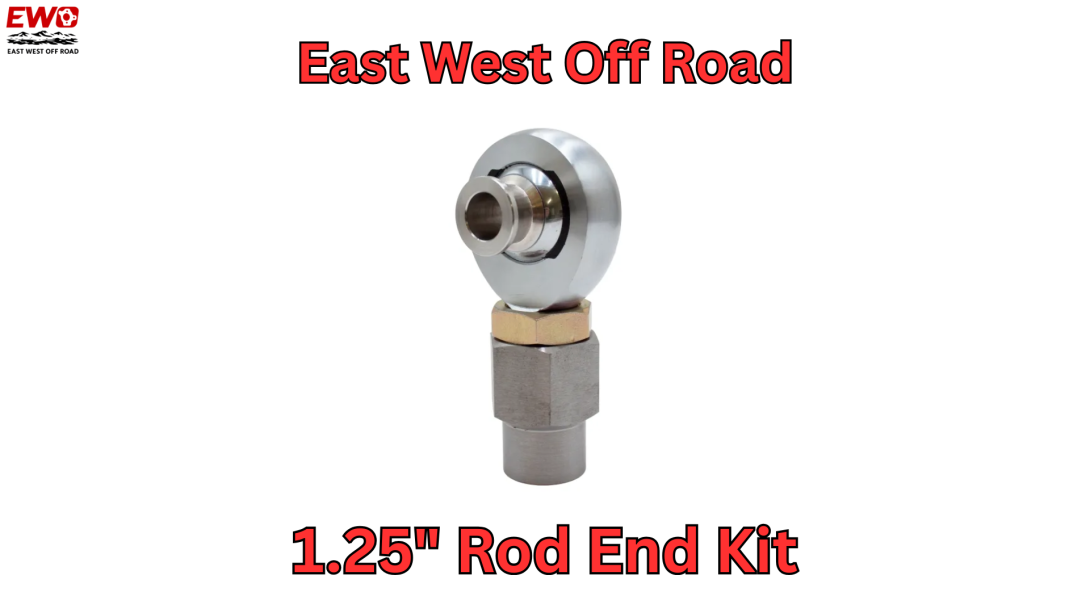
When selecting components for critical steering and suspension systems, moving beyond brand names and visual appearance is essential. The true measure of a component's capability lies in its technical specifications. For a 1 1/4 heim joint, understanding its detailed 1.25 heim joint specs is the difference between guessing and engineering a reliable, safe off-road vehicle. These specifications provide a clear, numerical blueprint of a component's strength, size, and compatibility, allowing builders to make informed decisions for high-stakes applications like a rock crawler 4 link kit or a heavy duty steering kit.
Why Technical Specifications Are Non-Negotiable
Off-road environments amplify forces and stress in ways street driving never does. A component that "looks strong" may not have the material integrity or design validation to handle repeated shock loads. Published specifications are the manufacturer's guarantee of performance. They allow you to calculate safety margins, ensure compatibility with other off road suspension parts, and build a system where every link in the chain is rated for the task. Ignoring specs and selecting parts based solely on size or price introduces unknown variables that can lead to premature wear or catastrophic failure on the trail.
Key Specification #1: Material Grade and Heat Treatment
The foundational spec is the material composition. The notation "chromoly" refers to chromium-molybdenum alloy steel, such as 4140 or 4340. This is a critical first filter. Beyond the alloy, the heat treatment process (e.g., hardened to a specific Rockwell C scale) is what unlocks the material's potential strength and toughness. A properly heat-treated chromoly heim joint will have a significantly higher heim joint load rating than an identical-looking part made from mild or non-heat-treated steel. This spec is the root of durability and is why quality chromoly rod ends are the standard for serious builds.
Key Specification #2: Load Ratings – Understanding the Numbers
The 76,200 lb load rating is a prime example of a vital, yet often misunderstood, specification. This is typically the radial static load rating, meaning the joint can withstand a force of 76,200 pounds applied parallel to its shank before permanent deformation. It's crucial to understand this is a ultimate failure rating in a controlled test, not a recommended working load. The dynamic and shock loads off-road require this massive safety buffer. When comparing a heim joint vs tie rod end, the heim's vastly superior published load rating is a quantifiable reason for its preference in extreme service. For a 1 ton steering upgrade, these numbers are not academic; they are the basis of safety.
Key Specification #3: Thread Size, Pitch, and Direction
Dimensional specs ensure everything fits together. For a 1.25 rod end kit, the thread is commonly 1.25"-12 (1.25 inch diameter, 12 threads per inch). The direction—right-hand (RH) or left-hand (LH)—is equally important. The inclusion of a 1.25-12 left hand thread adapter in a kit is a spec that enables adjustable turnbuckle setups for precise tuning of link or tie rod length. Mis-matching thread pitch or direction will render components useless. Builders must verify these specs match between the joint, its weld in bung 1.25, and any mounting hardware.
Key Specification #4: Bore Size, Width, and Misalignment
The bore size (the hole through the joint's head for a bolt) is another key dimension. A larger bore, like 1 inch, can accommodate a larger, stronger bolt, increasing the assembly's shear strength. The overall width of the joint affects packaging and clearance. Furthermore, the angular misalignment specification (often ± degrees) defines how far the joint can pivot smoothly. This spec directly informs the need for high misalignment spacers 1.25, which are used to achieve greater functional angles without binding the bearing. A comprehensive 1.25 heim joint kit will provide all these interrelated dimensional specs.
Application: Turning Specs into a Reliable Build
These specifications directly guide the build process. When fabricating a heavy duty off road steering kit, the load rating ensures the joint can handle steering box forces and impacts. The thread specs confirm compatibility with your hex head tube adapter and DOM tubing. The misalignment spec, combined with spacers, guarantees smooth operation at your suspension's lifted height. By cross-referencing the 1.25 heim joint specs against your vehicle's weight, use case, and geometric calculations, you engineer a system rather than just assembling parts. This disciplined approach is what defines professional-grade rock crawler suspension parts.
The Importance of Sourcing from Spec-Driven Manufacturers
Ultimately, the trustworthiness of a specification depends on the manufacturer. Reputable suppliers provide detailed spec sheets, material certifications, and test data. They design components like the JMX16T rod end to meet exacting performance standards. When reviewing products, prioritize those that transparently list these critical technical details over those that offer only vague marketing descriptions. This ensures that every component in your 4 link suspension kit or steering system performs as expected under the immense demands of off-road travel.
For complete technical specification sheets, material certifications, and application engineering data, please visit:
https://www.eastwestoffroad.com/product/1.25%22-rod-end-kit
Frequently Asked Questions
What is the difference between static, dynamic, and shock load ratings?
A static load rating (like the common 76,200 lb rating) is a force applied gradually until failure. A dynamic load rating is the load a joint can withstand for millions of cycles in motion—a much lower number. A shock load is a sudden, high-intensity force. Off-road builds primarily reference the static load rating to establish a baseline safety margin against unpredictable shock loads.
Can I use a heim joint if its misalignment spec is lower than my suspension's maximum angle?
Not without high misalignment spacers 1.25. Spacers effectively increase the usable angular range of the joint. If your suspension design exceeds the joint's innate misalignment spec and you don't use spacers, the joint will bind, creating a point of high stress and rapid wear, compromising both performance and the joint's load capacity.
How do I find the specs for an unbranded or generic heim joint?
This is a significant risk. Unbranded or generic parts often lack reliable, verified specifications. Without a material cert or load test data, you are assuming its capabilities. For non-critical applications, this might be acceptable, but for primary steering or suspension links, it is not recommended. Always source from manufacturers that provide documented 1.25 heim joint specs.
Is a higher Rockwell C (HRC) hardness always better?
Within a range, yes, as it indicates greater yield strength and wear resistance. However, if a steel is made too hard, it can become brittle and prone to cracking under impact. A quality manufacturer will heat-treat their chromoly rod ends to an optimal HRC that balances extreme hardness with necessary toughness for off-road impacts.
Why do some spec sheets list "lube" or "PTFE race"?
This is a critical performance spec. A "PTFE-lined race" or "Teflon-lined" specification indicates the bearing has a low-friction polymer liner. This requires special lubrication (often a specific grease) that won't degrade the liner. Using the wrong lubricant can destroy this lining, leading to metal-on-metal contact, rapid wear, and failure.