

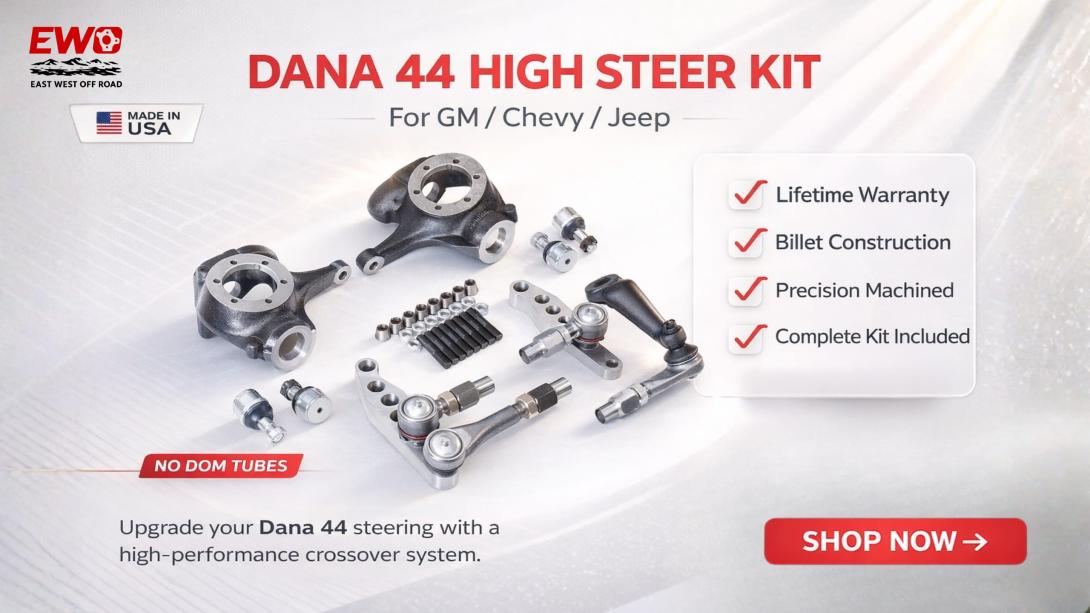
Ask any experienced off-road builder what part of a steering conversion keeps them up at night, and they'll point to the knuckles. Every pound of steering force your box generates, every impact your tires absorb, and every cyclic load from articulation passes through these two castings before reaching the tie rod. Skimp here, and nothing else matters. A comprehensive Dana 44 Steering Knuckle Kit solves this by providing matched flat top knuckles, fresh ball joints, billet steering arms, and all the precision hardware required to create a steering foundation that won't crack, loosen, or develop slop. The East West Off Road kit goes well beyond a simple knuckle swap—it's a complete knuckle assembly solution engineered for crossover steering conversions, built around USA-machined components, and designed to let you handle the DOM fabrication yourself to keep shipping costs reasonable.
Why the Knuckle Is the Single Most Critical Steering Component
The steering knuckle is the mechanical intersection where vertical suspension loads, horizontal steering forces, and rotational braking torque all meet simultaneously. It's the most complex casting on a solid front axle, and it's the part that determines whether your expensive steering upgrade actually translates into precise tire control.
Load Paths Through the Knuckle
When you turn the steering wheel, the pitman arm pushes the drag link, which rotates the passenger-side knuckle around its ball joint axis. That rotation pushes the tie rod, which rotates the driver-side knuckle. The steering arm bolted to the top of the knuckle experiences massive leverage—the force required to scrub a 37-inch tire across sandstone at low speed gets multiplied by the distance from the ball joint pivot to the tie rod attachment point. The knuckle has to transmit this force from the steering arm mounting surface down through the ball joint pivots without deflecting, cracking, or loosening the fasteners.
Why Factory Knuckles Fail at This Task
The stock Dana 44 knuckles on GM, Chevy, and Jeep applications have a curved, as-cast upper surface. This shape works fine for the factory push-pull steering linkage that bolts to the lower portion of the knuckle near the spindle. But for crossover or high steer setups that mount the steering arm on top of the knuckle, that curved surface is a fatal flaw. A steering arm bolted to a radiused surface only makes contact along a narrow line, concentrating stress instead of distributing it. The bolts experience bending loads rather than pure tension. Over time, the fasteners loosen, the bolt holes ovalize, and eventually the knuckle casting cracks at the stress riser.
The Flat Top Solution
A flat top knuckle solves this by providing a precision-machined horizontal pad with full surface contact for the steering arm. The clamping force of the mounting studs creates a frictional interface that handles rotational loads through surface area rather than bolt shear. It's the difference between bolting something to a machined engine deck versus clamping it to a raw casting—only one of those connections stays tight under cyclic loading.
What Makes the EWO Dana 44 Steering Knuckle Kit Different
The term "knuckle kit" gets used loosely in the aftermarket. Some vendors sell bare knuckles with no hardware. Others include imported castings with questionable metallurgy. The EWO kit takes the opposite approach—it's a complete, USA-made system that includes every component required to assemble a fully functional knuckle and steering arm setup.
USA-Made Flat Top Knuckles
The Dana 44 Flat Top Knuckles included in the EWO kit are cast and machined domestically. The castings have additional material in the steering arm pad area, specifically engineered to accommodate the drilled and tapped holes for mounting studs. After casting, the pads are precision-machined flat to guarantee complete contact with the billet steering arms. The spindle mounting surfaces are machined to factory tolerances, so your existing spindles, hubs, and brake components bolt up without modification.
Matched Driver and Passenger Set
The kit includes both Dana 44 driver passenger flat top knuckles as a matched pair, machined in the same setup to ensure identical pad height and stud spacing from side to side. This matters more than it might seem—if the left and right steering arm mounting surfaces aren't at exactly the same height, the tie rod connecting them sits at an angle. That angle puts the rod ends in constant bind, accelerates wear, and introduces a steering pull that you'll chase forever trying to diagnose.
Bottom Down Taper Configuration
The steering arm mounting holes use a bottom down taper knuckle Dana 44 design. The tapered bore is wider at the bottom of the pad and narrower at the top. When the mounting studs are inserted from above and the nuts are torqued, the conical washers wedge into these tapers from the top down. This creates a mechanical lock that vibration physically cannot loosen. The harder the system tries to shake the studs free, the tighter the conical washers wedge into the taper. This is the same retention principle used in heavy equipment pin connections and aircraft control surface fasteners.
Fresh Ball Joints Included
Installing new knuckles on old ball joints is a recipe for immediate steering slop. The EWO kit includes new Dana 44 upper lower ball joints sized correctly for the knuckle bores. The ball joints press into the axle inner C's, and the knuckles mount to the ball joint studs. Replacing everything at once means your entire knuckle assembly has zero accumulated wear—every pivot point starts fresh.
1.25-Inch Billet Steering Arms
The kit includes 1.25 inch thick billet steering arms machined from solid domestic aluminum blocks. These aren't cast arms with machined surfaces—they're carved from billet, which means the grain structure is uniform throughout and there are no internal voids or porosity. The 1.25-inch thickness provides bending rigidity that thinner arms can't match, and the arms are backed by a lifetime warranty. The 1 Ton High Steer Arms Dana 44 designation comes from their compatibility with standard GM 1-ton tie rod ends and their capacity to handle steering forces beyond what a Dana 44 axle can generate.
Complete Mounting Hardware
The kit doesn't send you to the hardware store mid-installation. It includes eight high-strength 9/16"-18 mounting studs, eight conical washers, eight lock nuts, and all necessary cotter pins. The studs are sized for full thread engagement in the knuckle with correct protrusion for the nuts and washers. There's no guessing about bolt length or thread pitch.
How the Knuckle Kit Integrates With a Complete Steering System
The EWO knuckle kit is designed as the foundation for a complete crossover steering conversion. While you can purchase knuckles and arms separately, the full Dana 44 High Steer Kit adds the tie rod ends, drag link ends, pitman arm, weld bungs, and jam nuts needed to complete the entire system.
Steering Arm to Tie Rod Interface
The billet steering arms are drilled with tapered bores that accept standard GM 1-ton tie rod ends. The tie rod side uses ES2234L ES2234R tie rod ends, and the drag link side uses ES2026R ES2027L drag link ends. These are off-the-shelf replacement parts available at any auto parts store in the country. The tapered studs seat directly into the arm bores with no adapter sleeves required—the tapers match by design, not by accident.
Pitman Arm Integration
The included 3 inch drop pitman arm 32 splines mounts to the 2WD steering box sector shaft and provides the correct drop for lifted applications. It's fully indexable, meaning you can clock it to the optimal position for your ride height rather than being locked into whatever clocking a fixed-arm design provides. The drag link end taper matches the pitman arm bore exactly.
The Complete System Approach
What distinguishes a true Chevy Dana 44 Crossover Steering Kit from a collection of parts is the engineering that goes into making everything work together. The knuckle pad height matches the arm footprint. The taper angles match across knuckles, arms, and pitman arm. The stud lengths are calculated for full thread engagement with the conical washer stack. Nothing requires shimming, reaming, or modifying. It's a Dana 44 Steering Knuckle Kit in the truest sense—a unified system where every component was designed in relation to every other component.
Installation: Swapping Knuckles the Right Way
Replacing knuckles is a substantial job that requires the right tools and attention to detail. Here's what the process entails.
Disassembly Sequence
The axle needs to be supported on jack stands with the wheels removed. The brake calipers come off first—hang them from the frame with wire, not by the brake hoses. Remove the hubs, rotors, and spindles. Pull the axle shafts. The factory knuckles can now be separated from the ball joints. This is often the most physically demanding step; years of corrosion and the tapered fit of the ball joint studs require a pickle fork, ball joint separator, or strategic hammer work.
Ball Joint Replacement
With the old knuckles off, the old ball joints get pressed out of the inner C's using a ball joint press—a tool most auto parts stores rent for a refundable deposit. The new EWO-supplied upper and lower ball joints press into the C's, paying attention to orientation. The upper and lower joints are different sizes and only fit their respective bores one way. Torque to factory specification and install fresh cotter pins.
Knuckle and Arm Installation
The new flat top knuckles slide onto the ball joint studs. Torque the lower ball joint nut first, then the upper. Verify smooth rotation without binding or vertical play. Place the billet arms on the machined pads, insert the 9/16-inch studs through the arms into the knuckles, place a conical washer under each nut with the taper facing down, and torque in a cross pattern. The conical washers self-center as they seat into the tapered bores.
Steering Box Requirement
A 2WD box crossover steering kit configuration is mandatory. The factory 4WD steering box has the wrong sector shaft rotation for crossover geometry. The 2WD box bolts directly to the factory frame mounts and the EWO pitman arm indexes onto its sector shaft.
Real-World Performance: What Changes When You Upgrade
The difference between factory knuckles with drilled-and-tapped arms and a proper flat top knuckle kit becomes apparent the first time you load the steering hard.
No More Loose Steering Arms
Drilled factory knuckles inevitably develop loose steering arms. The bolts stretch, the holes ovalize, and every trail run requires re-torquing fasteners that are slowly destroying the knuckle. The EWO flat top knuckles with conical washer retention stay tight. The taper-lock interface doesn't rely on thread friction alone, so the cyclic loads that back out standard bolts actually help seat the conical washers deeper.
Precise Steering Feel
When the steering arm is rigidly mounted to a properly machined knuckle, there's zero deflection between the steering box input and the tire response. The vague, elastic feel that plagues modified factory knuckles disappears. You turn the wheel, the tires respond immediately, and the feedback through the steering wheel tells you exactly what's happening at the contact patches.
Confidence for Bigger Tires and Harder Trails
Whether you're running a GM 1 Ton Steering Upgrade on a K20 or building a Square Body Crossover Steering Conversion on a K5 Blazer, the knuckle kit provides the foundation that makes everything else possible. Larger tires, hydraulic assist, harder trails—all of it depends on knuckles that won't crack, loosen, or deflect.
Frequently Asked Questions (FAQs)
What's included in a Dana 44 Steering Knuckle Kit?
The EWO kit includes a matched pair of USA-made flat top knuckles (driver and passenger side), 1.25-inch billet steering arms, eight 9/16-inch mounting studs, eight conical washers, eight lock nuts, and new upper and lower ball joints for both sides. It's a complete knuckle assembly package—everything from the ball joints out to the steering arm mounting hardware.
Can I install flat top knuckles without replacing my ball joints?
It's strongly discouraged. Removing old knuckles usually destroys the ball joints in the process, and even if they survive, installing worn joints into new knuckles defeats the purpose of the upgrade. The EWO kit includes new ball joints so you complete the entire knuckle rebuild in one job.
Are these knuckles compatible with my existing spindles and brakes?
Yes. The EWO flat top knuckles are machined to factory spindle mounting specifications. Your existing spindles, hubs, rotors, brake calipers, and axle shafts all bolt up without modification. The knuckles fit any Dana 44 with the standard 6-bolt spindle pattern.
What's the difference between flat top knuckles and standard Dana 44 knuckles?
Standard knuckles have a curved, as-cast upper surface that cannot properly mount a steering arm. Flat top knuckles have a precision-machined flat pad specifically designed to accept a steering arm with full surface contact. The EWO flat top knuckles also have additional material in the pad area to accommodate the drilled and tapped mounting holes.
Do I need special tools to install the knuckle kit?
You'll need a ball joint press (rentable from most auto parts stores), standard hand tools, and a torque wrench. A pickle fork or ball joint separator helps with removing the old knuckles. The steering arm studs and conical washers install with standard wrenches—no specialty tools required.
Will this knuckle kit work on a Ford Dana 44?
The EWO knuckle kit is designed for GM, Chevy, and Jeep Dana 44 applications that use the 6-bolt spindle mounting pattern. Ford Dana 44 axles typically use a 5-bolt spindle pattern and different knuckle geometry. Verify your spindle bolt pattern before ordering.
Can I use these knuckles with factory push-pull steering?
Flat top knuckles are designed for crossover or high steer steering systems that mount the steering arm on top of the knuckle. Factory push-pull steering attaches at the lower portion of the knuckle. If you're installing flat top knuckles, you should be converting to a complete crossover steering system.