

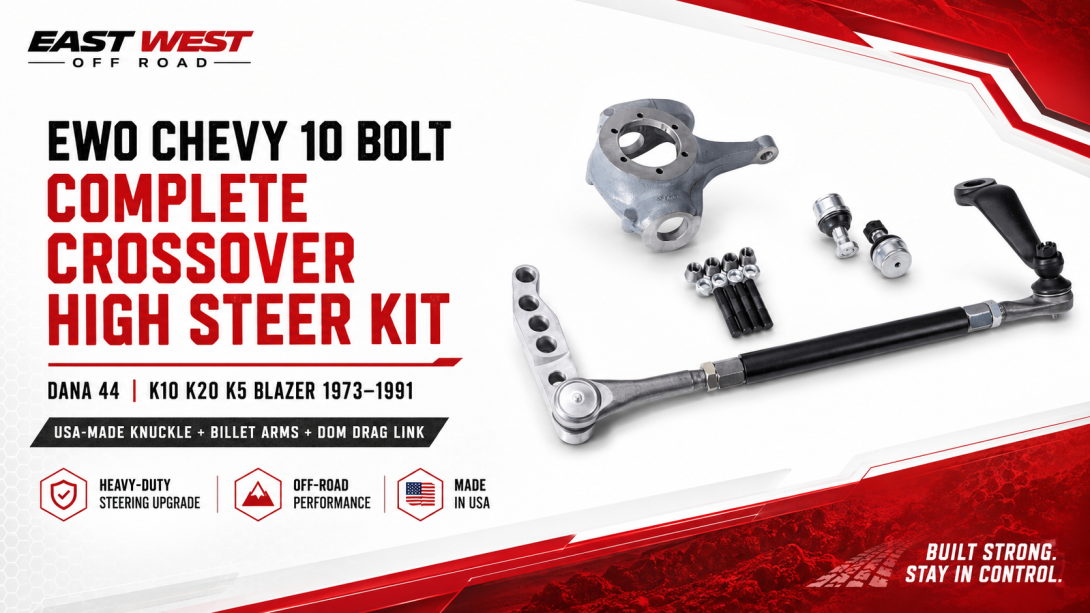
The Dana 44 steering knuckle is one of the most important structural and geometric components in a front steering system.
It supports the wheel-end assembly, rotates on the ball joints, and provides the connection through which steering force turns the wheel.
In a high-steer conversion, the knuckle also provides the foundation for the steering arm.
That makes correct knuckle selection essential.
What the Steering Knuckle Does
The knuckle connects several systems:
- Axle housing
- Ball joints
- Wheel-end assembly
- Steering linkage
When the steering link pushes or pulls on the steering arm, the knuckle rotates around its ball-joint axis.
That rotation changes wheel direction.
Any looseness or incorrect geometry at this point directly affects steering.
Ball-Joint Relationship
Upper and lower ball joints locate the knuckle while allowing rotation.
Worn ball joints can create:
- Steering play
- Alignment instability
- Irregular movement
- Tire wear
The EWO configuration includes metal-on-metal upper and lower ball joints for the compatible axle conversion.
What Makes a High-Steer Knuckle Different?
A high-steer configuration needs an appropriate upper mounting location for the steering arm.
The EWO USA-made passenger-side knuckle is intended to work with the supplied 1.25-inch billet high-steer arm.
Four 9/16-inch studs, conical washers, and lock nuts secure the arm.
The high location allows the crossover drag link to attach above the conventional lower steering position.
Steering-End Tapers
Tapered connections center and secure common steering ends.
The direction and dimensions of the taper matter.
The EWO knuckle uses a bottom-up taper.
The supplied slit tapered insert allows an alternative bottom-down arrangement where suitable.
This is particularly important when the builder is trying to position the drag link around leaf springs or other components.
Why Used Knuckles Need Careful Inspection
A decades-old Dana 44 component may have an unknown history.
Inspect for:
- Previous machining
- Damaged tapered holes
- Cracks
- Corrosion
- Worn ball-joint bores
- Damaged threads
- Previous repairs
A steering conversion is not the place to ignore questionable wheel-end components.
Knuckle Geometry and Steering Arm Geometry
The steering arm does not work independently.
Its height and joint location are meaningful only relative to the knuckle pivot axis and the rest of the steering.
The arm should be viewed as an extension of the knuckle assembly.
That is why a matched knuckle-and-arm approach can simplify planning.
Knuckle Fitment Is More Than “Dana 44”
Different Dana 44 applications use different outer assemblies.
When planning a Dana 44 steering knuckle upgrade, verify:
- Axle origin
- Knuckle side
- Ball-joint type
- Spindle arrangement
- Brake components
- Steering taper
- High-steer-arm interface
The axle model name alone is not enough.
Conclusion
The Dana 44 steering knuckle is the pivot point between steering input and wheel direction.
In a high-steer conversion, it also becomes the structural base for the elevated steering arm.
For compatible builds, the EWO USA-made Dana 44 steering kit includes the passenger-side knuckle, high-steer arm, ball joints, and related hardware needed to build that interface.
CTA
Treat the knuckle like the safety-critical component it is. Clean it, inspect every machined interface, verify every taper, and confirm ball-joint compatibility before the steering arm is installed.
FAQs
What does a Dana 44 steering knuckle do?
It supports the wheel-end assembly and pivots around the ball joints to steer the wheel. In a high-steer conversion, it can also support the high-steer arm.
What is a high-steer knuckle?
It is a knuckle configuration designed or prepared to accept an elevated steering arm used for high-steer or crossover applications.
Does the EWO knuckle support two taper orientations?
The supplied information states that it uses a bottom-up taper and includes a slit tapered insert for an alternative bottom-down orientation where suitable.
Should used knuckles be inspected before reuse?
Yes. Inspect tapered holes, ball-joint bores, mounting areas, threads, and the overall casting or forging for damage and previous modification.