

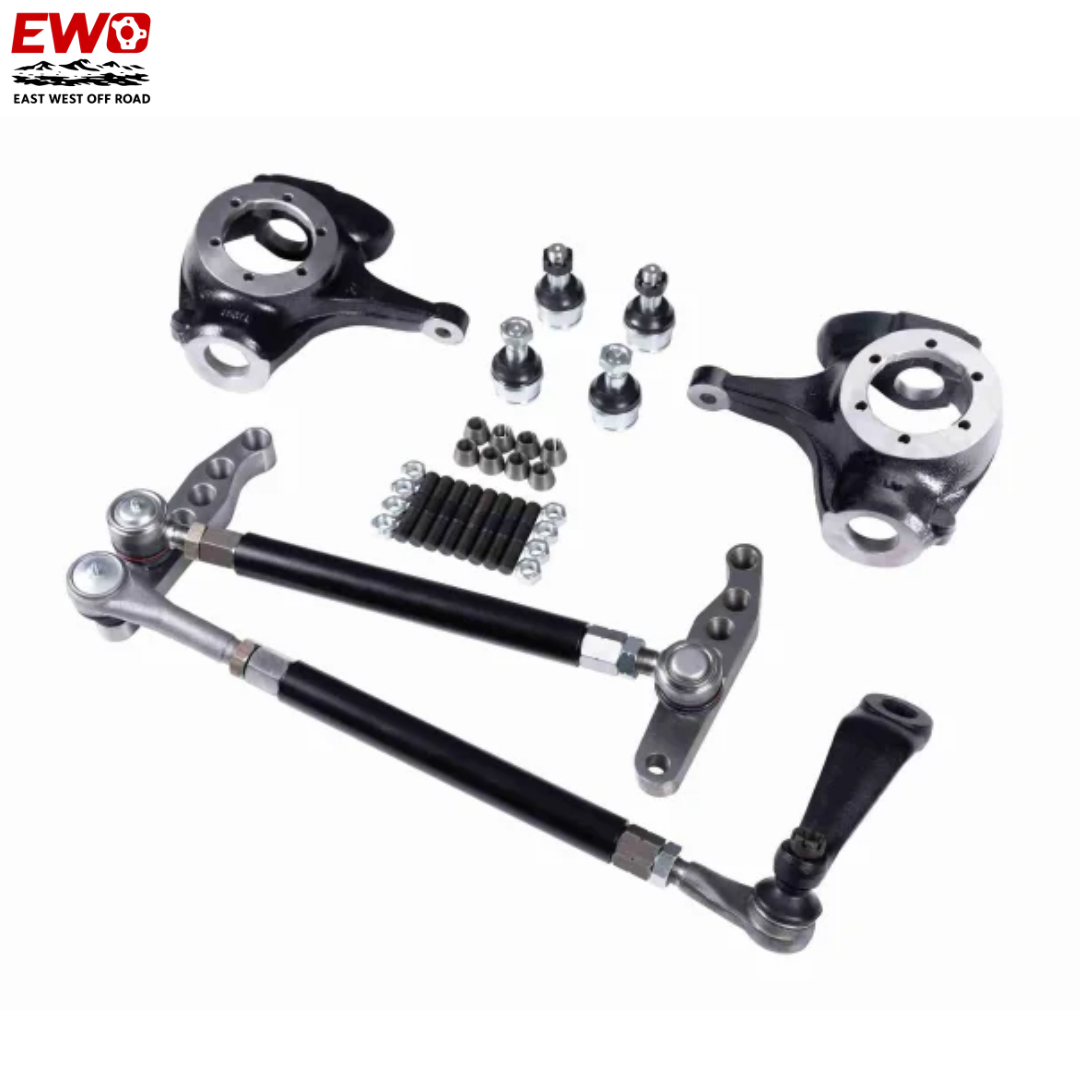
When you lift your truck 4+ inches and install bigger tires, your stock steering system becomes your biggest liability. The factory push-pull setup wasn't designed to handle the extreme angles and articulation your rig experiences on the trail. That's where a Dana 44 high steer crossover kit transforms not just how your truck handles—but whether you actually maintain control when it matters most.
This comprehensive guide reveals everything off-roaders need to know about Dana 44 steering upgrades, including how crossover steering eliminates bump steer, why flat-top knuckles matter, and how to choose the right system for your build.
What Is a Dana 44 High Steer Crossover Kit?
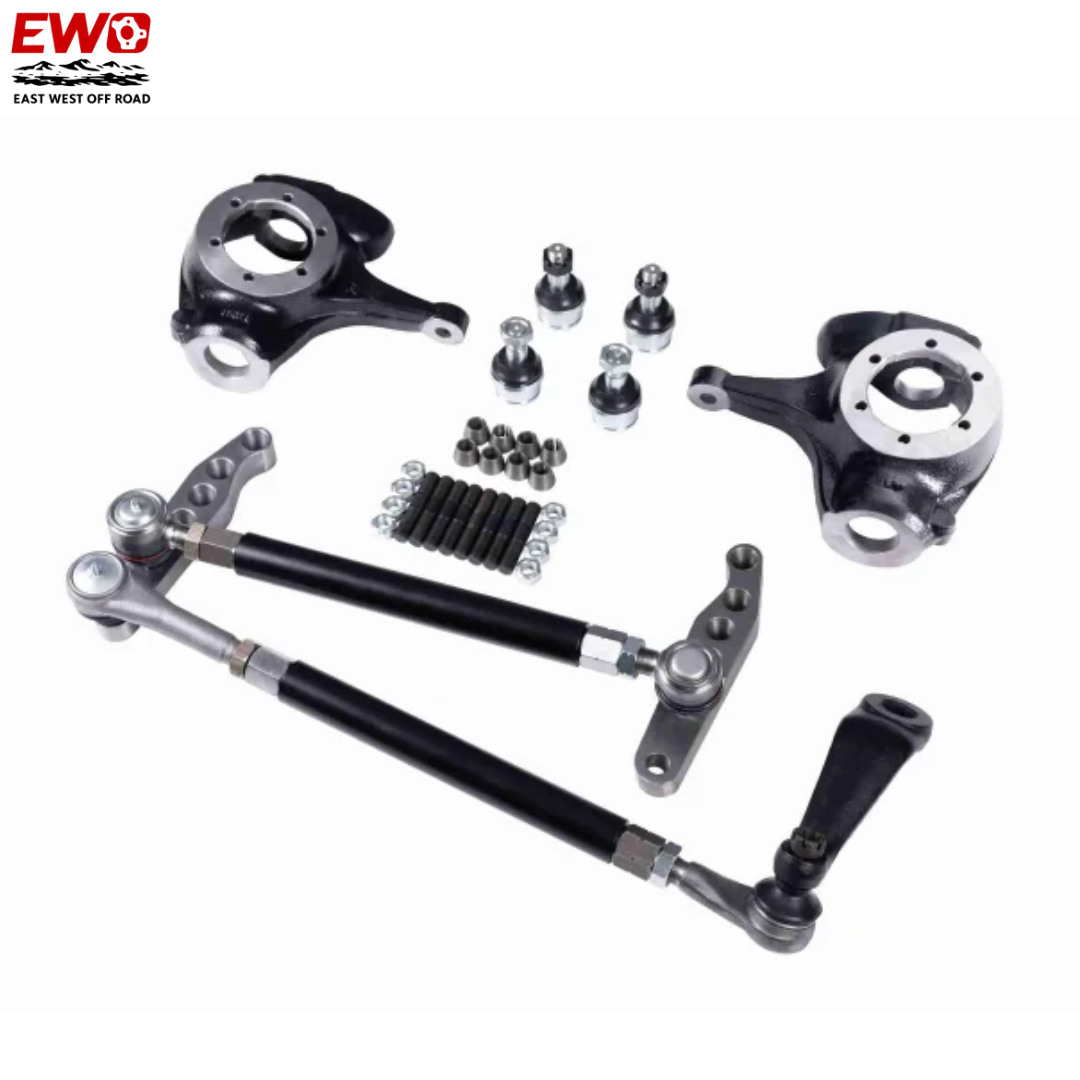
A Dana 44 high steer crossover steering kit combines two critical steering upgrades into one system: crossover steering geometry and elevated steering components for maximum rock clearance.
Crossover steering reverses the traditional push-pull setup. Instead of the drag link pushing from the driver's side toward the front of the axle, it now runs horizontally from the pitman arm directly to the passenger-side steering knuckle. This side-to-side connection dramatically improves steering geometry, especially when your suspension is fully articulated on extreme terrain.
High steer refers to mounting the tie rod connection at the top of the knuckle rather than the stock lower position. This lifts critical steering components 4–6 inches higher, protecting them from rock strikes, roots, and other trail hazards while maintaining cleaner suspension geometry.
Complete kits from manufacturers like East West Off-Road include everything needed: flat-top Dana 44 steering knuckles, machined steering arms with multiple bolt holes, reinforced pitman arms, custom drag links, and high-quality tie rod ends designed specifically for the application.
Why Your Stock Dana 44 Steering Fails After a Lift
The Bump Steer Problem
Stock factory steering systems were engineered with precise angles and parallel geometry—designed for stock ride height only. The moment you install a suspension lift, you violate those angles.
Bump steer occurs when the drag link and track bar no longer move in parallel planes. As your rig flexes over obstacles, the angles change dynamically. This causes the steering to self-correct involuntarily—you feel it as the steering wheel jerking, wandering, or requiring constant correction on bumpy terrain.
On lifted Dana 44 and Chevy 10-bolt trucks, bump steer becomes dangerous. You're fighting the steering instead of controlling it.
Limited Steering Lock
With factory push-pull steering on a lifted rig, something peculiar happens: at full suspension flex, you can't achieve full steering lock even with the steering wheel rotated all the way.
Imagine yourself rock crawling in a tight switchback. Your suspension is compressed and twisted. You crank the wheel to full lock—but the rig simply won't turn tight enough. The geometry has changed so dramatically that your wheels physically can't point where you need them to.
This isn't a minor inconvenience. It's the difference between making a technical obstacle and being stuck.
Poor Geometry Under Extreme Articulation
Factory steering geometry assumes your axle stays roughly centered under the truck. On rock crawls and extreme trails, your axle isn't centered—it's twisted, compressed, extended, and rotated in ways designers never intended.
Traditional steering components designed for road use can't adapt to this abuse. Crossover steering fundamentally changes the geometry to work under these extreme conditions, maintaining control and responsiveness even when your rig is articulated like a yoga instructor.
The Dana 44 High Steer Crossover Advantage: Why It Works
1. Perfect Steering Geometry at Any Suspension Position
Crossover steering runs the drag link horizontally from the pitman arm to the passenger knuckle. This creates a balanced load distribution across both front springs instead of hammering the driver's side spring alone.
The result? Full steering lock remains available throughout your suspension's entire travel range—whether compressed on rocks, extended in a ravine, or twisted sideways. Your steering geometry stays consistent, responsive, and predictable.
2. Eliminates Bump Steer Completely
By reconfiguring how the drag link and tie rod interact, crossover steering removes the dynamic angle changes that cause bump steer. The steering linkage moves in harmony with suspension flex, not against it.
Off-roaders who upgrade from push-pull to crossover steering consistently report the same experience: the steering wheel stops jerking, the rig tracks straight, and trails feel more confident and controllable.
3. Enhanced Rock Crawling Performance
High steer components positioned at the top of the knuckle provide 4–6 inches of additional clearance from obstacles. More importantly, this elevated geometry actually improves the mechanical advantage of your steering linkage while keeping it out of harm's way.
Traditional tie rod placement puts steering components right in the strike zone. A flat rock, a tree root, or a sharp obstacle can bend or destroy a tie rod. With high steer setup, your tie rod is protected while maintaining superior steering feel.
4. Better Protection & Longevity
Stock tie rod ends are vulnerable to rock strikes. Every impact degrades them. Off-roaders running high steer setups report dramatically fewer steering component failures because the geometry keeps linkage elevated and protected.
Additionally, load distribution across both front springs (instead of concentrating on the driver's side) means component bushings wear more evenly and last significantly longer.
5. Direct, Responsive Steering Feel
Crossover steering geometry provides more direct steering input with less play or vagueness. Your wheel movements translate more precisely to axle direction changes. This is especially noticeable at full lock during technical maneuvers.
The result is increased driver confidence and better vehicle control on challenging terrain.
Dana 44 Flat-Top Knuckles: The Foundation of High Steer
What Makes Flat-Top Knuckles Different?
Flat-top knuckles are cast with a machined flat surface on top specifically designed to accept high steer steering arms. This flat surface provides a strong, rigid mounting point for bolting steering arms directly to the knuckle top.
Standard Dana 44 knuckles from factory vehicles don't have this feature. They have a tapered boss designed for low-mount steering arms only. High steer conversions require flat-top knuckles—either factory original (on 1971–1976 Chevy Dana 44s and Jeep Wagoneers) or modern aftermarket castings.
The 4-Bolt Hole Advantage
Professional-grade flat-top knuckles feature four mounting holes for steering arm attachment instead of the traditional three. The extra bolt hole dramatically increases:
- Clamping force around the steering arm base
- Shear strength under extreme off-road loads
- Resistance to deflection during hard steering inputs
- Safety margin for high-horsepower diesels or hydro-assist steering
This seemingly small upgrade prevents one of the most catastrophic failures: a steering arm separating from the knuckle under full lock with maximum articulation.
Heavy-Duty Ductile Iron Construction
High-quality flat-top knuckles are cast from ductile iron with reinforced ribbing and extra material distribution. This isn't the thin factory casting—it's over-engineered for rock crawling abuse.
Manufacturers like Reid Racing and WFO Concepts build knuckles with thicker walls, added material around high-stress zones, and CNC precision drilling and tapping. These knuckles withstand years of extreme off-roading without cracking or stripping threads.
High Steer Arms: The Steering Connection
High steer arms are the brackets that bolt to the flat-top knuckles and connect to your steering linkage. Quality arms feature:
- 5.5" to 7.625" measurements from center (depending on application) for proper geometry
- Angled ends machined to compensate for ball joint axis inclination
- Black oxide or powder-coat finish for corrosion resistance
- Drilled holes sized for 9/16" x 18 TPI threaded studs (standard high-steer specification)
The angle of these arms is critical. Poorly designed arms can max out your steering rod ends at ride height, leaving no droop for suspension travel. Premium arms account for ball joint geometry to keep rod end angles within safe operating ranges throughout the suspension range.
Chevy 10-Bolt Crossover Steering: Compatibility & Applications
Many off-roaders confuse Dana 44 and Chevy 10-bolt applications. While these are technically different axles, they share compatible steering architectures in lifted truck applications.
Where They're Used
Application
Dana 44
Chevy 10-Bolt
Primary Use
1971–1976 Chevy
Factory option
Half/3/4 ton
Square bodies, K5 Blazers
1977–1991 Chevy
Swap option
Factory standard
Older trucks, budget builds
Jeep Wagoneer
Factory 44
Limited
Earlier Wagoneers only
GM Swaps
Aftermarket add
Common upgrade
Full-size truck conversions
Chevy 10-bolt steering upgrades typically reference 1977+ trucks that came with a different knuckle design than 1971–1976 Dana 44s. However, modern crossover steering kits are engineered to work with both architectures, making kit selection straightforward.
East West Off-Road's complete Dana 44 / Chevy 10-Bolt high steer crossover kit is explicitly engineered for compatibility across these variations, eliminating guesswork about fitment.
GM Dana 44 Steering Upgrade vs. 1-Ton Steering: When to Upgrade Beyond Dana 44
Dana 44 Steering Capability
Dana 44 steering systems (with proper crossover and high steer setup) handle:
- Lifted trucks: 4–8 inches of suspension lift
- Tire sizes: 33–37 inches for most applications
- Off-road use: Trail riding, rock crawling, moderate wheeling
- Trail conditions: Rocky terrain, technical obstacles, deep articulation
This covers 90% of off-roaders' needs. A properly upgraded Dana 44 steering system is genuinely impressive.
When You Need 1-Ton Steering
Some builds demand the additional capacity of 1-ton steering components (larger diameter tie rod ends, reinforced arms, heavier pitman arms):
- Extreme vehicles: 45+ inches of tires, 12+ inches of lift
- Suburbans & Dually trucks: Massive vehicle weight requiring extra durability
- Diesel engines: High-torque engines requiring maximum steering response
- Hydro-assist steering: Powered systems requiring robust mechanical foundation
For most lifted trucks and serious off-roaders, a quality Dana 44 crossover setup is absolutely sufficient and more economical than full 1-ton conversion.
Complete Dana 44 High Steer Crossover Kit Components Explained
What's Included in a Full Kit
Premium kits like the EWO Complete Dana 44 / Chevy 10-Bolt High Steer Crossover Kit include:
Steering Knuckles (Pair)
- Flat-top design, CNC-machined
- Four bolt holes for high steer arms
- Pre-drilled and tapped to 9/16" x 18 TPI
- Ductile iron construction
- Left and right hand versions
High Steer Steering Arms (Pair)
- Black oxide finish
- Drilled mounting holes
- 5.5" to 7.625" center measurements (application-specific)
- Angled ends for proper geometry
Steering Hardware
- Conical washers (6 per side)
- 9/16" studs and lock nuts
- Precision fasteners rated for high load
Pitman Arm (Drop Style)
- Coordinated with your steering box type
- 2-wheel drive and 4-wheel drive options
- Proper drop geometry for lifted applications
Drag Link & Tie Rod Components
- Heavy-duty tie rod ends designed for Dana 44 applications
- Crossover-specific drag link geometry
- Custom lengths available for 2–10" lift heights
- Ball joint pre-load springs for tight connections
Installation Hardware Package
- Grade 8 fasteners throughout
- Jam nuts for all threaded connections
- Protective coatings against corrosion
Why Complete Kits Matter
Buying individual components risks incompatibilities. A mismatched drag link geometry or incorrect pitman arm angle can cause steering issues even with quality parts.
Complete kits are engineered as a system, meaning every component works in harmony. The drag link geometry coordinates with the tie rod angle. The pitman arm drop matches your lift height. The steering arm angles account for ball joint inclination.
Installing a complete kit gives you the confidence that the system was designed and tested together.
Step-by-Step Installation Overview: What to Expect
While full installation requires professional equipment and mechanical skill, understanding the process helps you evaluate difficulty and plan accordingly.
Pre-Installation Requirements
- Flat-top knuckles (machined if converting factory knuckles)
- CNC drilling equipment or professional machining services
- Reaming tools for ball joint tapers (if needed)
- Precision torque wrench (critical for steering fasteners)
- Lift tools (floor jack, jack stands, press)
- 2-wheel drive steering box (if converting 4-wheel drive box)
Installation Process (Overview)
Phase 1: Axle Preparation (2–3 hours)
- Remove factory steering knuckles
- Clean and inspect axle steering bosses
- Install new flat-top knuckles with proper torque specifications
- Install ball joints in new knuckles
Phase 2: Steering Arm Installation (1–2 hours)
- Position high steer arms on knuckle flat tops
- Install bolts with conical washers
- Verify arm geometry and clearances
- Apply torque per specification (typically 60–80 ft-lbs)
Phase 3: Drag Link & Tie Rod Assembly (2–3 hours)
- Cut and weld drag link (if using tubing kit)
- Install heim joints at both ends
- Measure and verify geometry
- Install tie rod with proper angle
Phase 4: Pitman Arm & Steering Box Coordination (2–4 hours)
- Swap steering box if necessary
- Install drop pitman arm
- Verify alignment between pitman arm and right-hand steering arm
- Check clearances with engine crossmember
Phase 5: Final Assembly & Alignment (2–3 hours)
- Reassemble all fasteners with grade 8 bolts
- Apply thread-lock to critical connections
- Torque all fasteners to specification
- Perform alignment check
- Test steering through full range
Total Installation Time: 9–15 hours (professional shop or experienced DIYer with proper equipment)
Why Professional Installation is Often Worth It
Steering system accuracy directly impacts safety. Poor drilling, incorrect reaming, or misaligned components create safety hazards. Professional shops have CNC equipment, precision fixtures, and extensive experience ensuring perfect geometry.
The cost of professional installation ($800–$1,500) is minimal compared to the cost of on-trail steering failure.
Benefits You'll Experience After Installation
Immediate On-Road Changes
Tighter Steering Feel
- Reduced play and vagueness
- More direct wheel-to-tire response
- Improved parking lot handling
Eliminated Bump Steer
- Steering wheel stops jerking on bumpy roads
- Smoother highway driving
- Better control in construction zones
Full Steering Lock Available
- Tighter turning radius
- Improved maneuverability in parking situations
- More options in technical terrain
Off-Road Performance Gains
Confidence in Technical Terrain
- You can feel the trail beneath the steering wheel
- Steering inputs translate precisely to vehicle direction
- Rock crawling becomes more intuitive
Reduced Component Wear
- Spring bushings wear evenly (not just driver's side)
- Tie rod wear reduced due to improved geometry
- Longer service intervals between maintenance
Full Articulation Control
- Rig tracks true even when suspension is fully extended
- Steering response consistent from lock to lock
- No surprises during extreme flex
Offroad Steering Kit: Dana 44 vs. Competitors
How Dana 44 Compares to Dana 60 Steering
Factor
Dana 44
Dana 60
Weight
Lighter
Heavier
Tire Size Support
33–37" typical
37–45"+ capable
Steering Feel
Responsive
Heavy (without assist)
Cost
$150–$300 (kit)
$300–$600+ (kit)
Common Vehicles
Square bodies, K5, Jeeps
1-tons, Suburbans
Hydro Assist Required
Optional
Often necessary
For most off-roaders: Dana 44 is the right choice. It's lighter, more affordable, and provides excellent performance for typical lifting and tire sizes. Only spec-heavy builds or extreme applications require Dana 60.
Crossover vs. High-Steer-Only Setups
Crossover Steering (This Kit)
- Fixes steering geometry
- Reduces bump steer completely
- Enables full steering lock
- $2,500–$4,000 installed
High-Steer-Only (Lower Cost Option)
- Lifts steering components only
- Protects from rocks
- Doesn't fix bump steer
- $800–$1,500 installed
Recommendation: For lifted trucks with 4+ inches of suspension lift, crossover is the proper solution. High-steer-only is appropriate for lightly modified trucks or when crossover isn't possible due to geometry constraints.
FAQ: Dana 44 Steering Questions Off-Roaders Ask
Q1: What is the main difference between high steer and crossover steering?
A: High steer moves the tie rod connection to the top of the knuckle for rock protection. Crossover steering reconfigures the drag link to run side-to-side, fixing steering geometry. Many setups combine both for maximum performance.
Q2: Do I need crossover steering if I only have a 2-inch lift?
A: Not necessarily. Small lifts (under 3 inches) may not require crossover. However, if you're experiencing bump steer or steering wander, crossover is the solution regardless of lift height.
Q3: Can I install a Dana 44 crossover steering kit myself?
A: If you have machining equipment, mechanical skill, and patience, yes. However, most DIYers benefit from professional installation due to the precision required. Poor geometry leads to steering issues.
Q4: Are Dana 44 flat-top knuckles compatible with my truck?
A: Compatibility depends on your vehicle year and axle variant. 1971–1976 Chevy Dana 44s came with factory flat-tops. Other applications require aftermarket knuckles. Verify with your kit manufacturer.
Q5: What happens if I don't upgrade my steering after lifting my truck?
A: You'll experience persistent bump steer, reduced steering lock availability, component wear acceleration, and diminished trail control—making off-roading less safe and enjoyable.
Q6: How much does a complete Dana 44 high steer crossover kit cost?
A: Complete kits range from $2,000–$4,500 depending on components and quality. The EWO Complete Kit starts around $2,000–$2,500 before installation.
Q7: Will crossover steering improve my street driving?
A: Absolutely. Better geometry means straighter tracking, reduced steering correction, and improved highway stability—benefits that apply everywhere, not just trails.
Q8: How long does a properly installed crossover steering kit last?
A: With quality components and proper maintenance, 10+ years of heavy off-road use. Periodic greasing and fastener checks ensure longevity.
Q9: Do I need hydro-assist steering with a Dana 44 crossover kit?
A: No, but it's beneficial if running 35"+ tires or diesel engines. A quality high-steer crossover setup handles manual steering on typical builds.
Q10: Can I retrofit a crossover steering kit to a stock truck?
A: Yes, absolutely. This is one of the most popular upgrades for lifted trucks. Any truck with a Dana 44 or Chevy 10-bolt can be upgraded.
Choosing the Right Offroad Steering Kit for Your Build
Questions to Ask Before Purchasing
1. What's your vehicle?
- Year, make, model
- Dana 44 or Chevy 10-bolt?
- Knuckle type (flat-top or round)?
2. How much lift do you have?
- Current height in inches
- Plans for additional lift?
- Affects drag link length
3. What tire size are you running?
- Current size
- Upgrade plans?
- Larger tires demand stronger steering
4. What's your primary use?
- Trail riding vs. rock crawling
- Frequency of off-road use
- Vehicle weight and engine power
5. Budget and installation capability
- DIY or professional install?
- Budget range for kit + installation
- Timeline flexibility
East West Off-Road's Complete Solution
The EWO Complete Dana 44 / Chevy 10-Bolt High Steer Crossover Kit with Knuckles addresses all these variables:
- Pre-engineered for compatibility across common applications
- Includes everything needed for a complete installation
- American-made components prioritizing durability
- Proven on thousands of rigs with documented performance
- Support team available to answer application-specific questions
Contact info@eastwestoffroad.com for fitment verification, installation assistance, or technical questions.
Conclusion: Why Crossover Steering Belongs on Your Lifted Off-Road Rig
If you've lifted your truck and upgraded your tires, steering geometry deserves equal attention. Factory steering systems simply weren't designed for the angles and articulation your rig now experiences.
A Dana 44 high steer crossover kit isn't a luxury upgrade—it's a safety necessity for serious off-roading. It eliminates bump steer, restores steering geometry across the full suspension range, protects components from trail hazards, and transforms driving feel both on and off the pavement.
The difference between fighting your steering and trusting it completely is the difference between a capable off-roader and someone constantly wrestling with their rig. Crossover steering makes that difference.
Ready to conquer any terrain with confidence? The EWO Complete Dana 44 High Steer Crossover Kit gives you the steering geometry your lifted truck deserves.
Contact East West Off-Road today:
- Email: info@eastwestoffroad.com
- Get your kit installed by professionals or consult our technical team for DIY support
- Trail-tested, proven performance on some of the toughest terrain in North America
Your next adventure deserves steering you can trust. Upgrade to crossover steering today.