

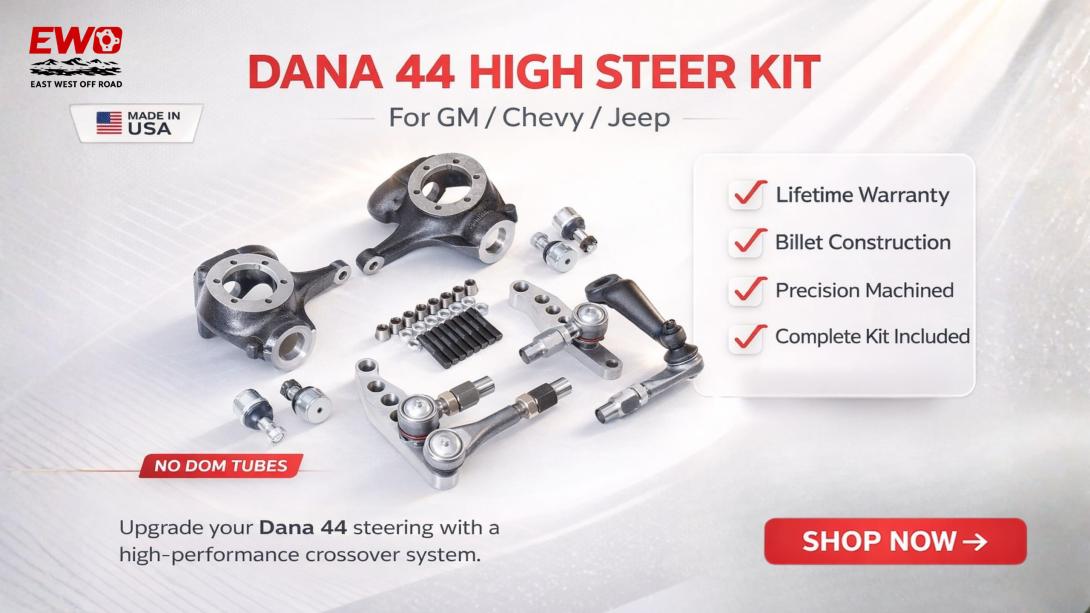
You can bolt the fanciest steering arms and the beefiest tie rod ends onto your Dana 44, but if the foundation isn't right, none of it matters. The part that carries every pound of steering force from your box to your tires is the knuckle, and for high steer or crossover applications, only one design works: Dana 44 Flat Top Knuckles. These aren't a cosmetic upgrade or a convenience item—they're a structural requirement. Without a true machined flat top surface, a steering arm cannot seat properly against the knuckle casting, and every off-road mile becomes a gamble on whether the bolts will shear or the casting will crack. The East West Off Road kit solves this from the ground up with USA-made flat top knuckles purpose-built for crossover steering, eliminating the compromises that come with modifying stock units.
What Exactly Are Dana 44 Flat Top Knuckles?
Factory Dana 44 knuckles on most GM, Chevy, and Jeep applications feature a curved or radiused upper surface. This shape works fine for the stock push-pull steering linkage, which attaches at the lower portion of the knuckle near the spindle. But when you want to mount a steering arm on top of the knuckle for crossover or high steer geometry, that curved surface becomes a liability. A flat top knuckle has a precision-machined horizontal pad on the upper surface, designed specifically to accept a high steer arm with full surface contact across the mounting interface.
The Difference Between Flat Top and Standard Knuckles
A standard knuckle's upper surface is essentially raw casting with a gentle radius. If you attempt to bolt a steering arm to this surface, only a small percentage of the arm actually touches the knuckle. The rest floats in the air, supported only by the bolts. Under steering load, this gap allows micro-movement that hammers the fasteners, ovalizes the bolt holes, and eventually causes catastrophic failure. A flat top knuckle, by contrast, provides 100% contact across the machined surface. The bolts clamp the arm to the knuckle in pure compression, while the frictional interface between the two flat surfaces handles the rotational forces. This is standard engineering practice for structural connections—it's the same principle behind why cylinder heads must have flat deck surfaces.
Why Drilling a Stock Knuckle Is Dangerous
The internet is full of forum posts suggesting you can simply drill and tap a stock knuckle for steering arm bolts. This advice is dangerously wrong. Drilling into a curved casting creates an uneven bolt seat, concentrates stress at the sharp edges of the hole, and removes material from an area that was never engineered to carry steering loads. The casting thickness varies, so you might only have a few threads of engagement in some spots. Add the vibration and impact loads of off-road driving, and a drilled knuckle becomes a fatigue failure waiting to happen. The EWO Dana 44 Flat Top Knuckles are cast with additional material in the mounting pad area specifically to accommodate the drilled and tapped holes for steering arm studs. This isn't a modification—it's an engineered feature.
The EWO Flat Top Knuckle Advantage
East West Off Road manufactures their flat top knuckles in the United States from domestic castings. This isn't an offshore copy of an OEM part; it's a purpose-built performance component designed around the specific demands of crossover steering conversions.
Bottom Down Taper Configuration
The EWO knuckles feature a bottom down taper knuckle Dana 44 configuration. This means the tapered holes for the steering arm mounting studs are oriented with the larger diameter at the bottom of the knuckle pad, narrowing as they go upward. When the studs are installed from the top and torqued down, the conical washers seat into these tapers, creating a wedge-lock effect that absolutely prevents the studs from working loose. This is the same taper-lock principle used in industrial machinery subjected to constant vibration. Compare this to a straight-bore bolt hole, where the only thing keeping the fastener tight is thread friction—a battle that off-road vibration eventually wins.
Driver and Passenger Side Matched Set
The kit includes both Dana 44 driver passenger flat top knuckles as a matched pair. Why does matching matter? Because the machining setup ensures both knuckles share identical pad height, stud spacing, and taper depth. If you piece together knuckles from different sources—say, a junkyard driver side and an aftermarket passenger side—you risk ending up with slightly different steering arm heights or bolt patterns. On a crossover system where the tie rod connects both knuckles directly, even a small height discrepancy creates an angular misalignment that chews through tie rod ends prematurely.
Integrated Ball Joint Seats
The knuckles come ready to accept Dana 44 upper lower ball joints, which are included in the EWO complete kit. The ball joint bores are machined to factory press-fit tolerances, so the new joints seat correctly without requiring oversized aftermarket ball joints or shimming. This attention to dimensional accuracy extends to the spindle mounting surface, ensuring your wheel bearings and spindles bolt up without alignment issues.
How Flat Top Knuckles Enable the Complete High Steer System
Flat top knuckles don't work in isolation. They're the foundation component that makes every other piece of the steering system function correctly. Without them, you simply cannot build a reliable crossover steering setup.
Mounting Platform for 1.25-Inch Billet Steering Arms
The machined flat pad on these knuckles provides the perfect mounting surface for the 1.25 inch thick billet steering arms that come in the EWO kit. These arms—carved from solid domestic billet aluminum—require a dead-flat mounting surface to distribute load evenly across their entire footprint. When torqued to specification with the supplied 9/16"-18 studs and conical washers, the arm and knuckle effectively become a single structural unit. The 1.25-inch arm thickness resists bending and flex, but only because the flat top knuckle underneath it refuses to yield or deform under the clamping load.
Enabling Crossover Steering Geometry
The flat top design places the steering arm mounting surface significantly higher than the spindle centerline. This elevated position is what makes high steer geometry possible. By mounting the tie rod above the axle centerline rather than below it, the entire steering linkage gains ground clearance and the drag link angle can be optimized for reduced bump steer. When you're shopping for a Dana 44 High Steer Kit, the knuckles are the single most critical component—everything else bolts to them.
Compatibility With 1-Ton Steering Upgrades
The EWO flat top knuckles are designed specifically for the GM 1 Ton Steering Upgrade path. The stud pattern, taper angles, and pad dimensions match the billet arms and standard GM 1-ton tie rod ends. This means you're not locked into proprietary steering components. The ES2234L ES2234R tie rod ends and ES2026R ES2027L drag link ends used in the complete kit are standard replacement parts available at any auto parts store in the country. The knuckles don't care what brand of tie rod end you run, as long as it's the correct taper and thread size.
Vehicles That Need Dana 44 Flat Top Knuckles
If you're building any of the following, flat top knuckles should be on your must-have list.
Square Body Chevy and GM Trucks
The 1973-1987 Chevy and GMC K-series trucks are the most common candidates for crossover steering conversions. These trucks left the factory with Dana 44 front axles and push-pull steering that becomes borderline dangerous with lift kits. A Square Body Crossover Steering Conversion starts with swapping the factory knuckles for flat top units. Once installed, the truck can accept high steer arms that correct the steering geometry issues inherent to lifted solid-axle vehicles.
Jeep J-Series and Full-Size Cherokees
Jeep J10, J20, and full-size Cherokee (SJ) models equipped with Dana 44 front axles use the same knuckle interface as their GM cousins. The Chevy Dana 44 Crossover Steering Kit fits these Jeeps without modification because the flat top knuckles share the same bolt pattern and spindle dimensions. This interchangeability is a major advantage for Jeep builders who want to run GM-spec 1-ton steering components.
Solid Axle Swaps and Custom Builds
Any Dana 44 being swapped into a vehicle that didn't originally come with one—think TJ Wranglers, XJ Cherokees, or even Toyota pickups—should receive flat top knuckles during the build. The axle will likely be out of the vehicle for cleaning and re-gearing anyway, making it the ideal time to upgrade the knuckles before the steering system is designed around them.
Installation Considerations for Flat Top Knuckles
Swapping knuckles is more involved than bolting on a steering arm, but the process is straightforward for anyone with basic mechanical skills and the right tools.
Ball Joint Replacement Is Mandatory
You cannot reuse old ball joints when installing new knuckles. The removal process typically destroys the old joints, and even if they survive, installing worn ball joints into brand-new knuckles is false economy. The EWO kit includes fresh upper and lower ball joints, so you're replacing everything in one job. A ball joint press is required—most auto parts stores rent these for free with a deposit.
Torque Specifications and Conical Washer Seating
The 9/16"-18 studs that secure the steering arms to the flat top knuckles must be torqued in a cross-pattern to the manufacturer's specification. The conical washers are not optional—they center the stud in the tapered bore and prevent the clamping load from loosening under vibration. If a conical washer doesn't seat flush, check for debris in the taper or a burr on the washer itself before increasing torque.
Alignment After Installation
Once the knuckles are installed with the new ball joints and steering arms, the entire front end alignment must be reset. Toe is the critical adjustment—crossover steering systems are very sensitive to toe settings, and even a quarter-inch of toe-out can cause wandering on the highway. Set toe to approximately 1/8-inch toe-in and verify after the first trail run.
Why the EWO Complete Kit Is the Smartest Purchase Path
You can technically piece together a flat top knuckle conversion from various sources—junkyard knuckles, aftermarket arms from one vendor, hardware from another. But the EWO approach of bundling everything into a single Dana 44 Steering Knuckle Kit eliminates the compatibility guesswork.
Machined as a System
Every component in the EWO kit is machined to work together. The flat top knuckle pad dimensions match the billet arm footprint exactly. The taper angles on the knuckle bores match the conical washers and studs perfectly. The ball joint bores are sized for the included joints. There's no mixing and matching of taper angles—a common headache when combining parts from different manufacturers.
The "Without DOM" Savings Model
The EWO complete high steer kit without DOM tubes continues the theme of practical value. You get every precision component—USA-made knuckles, billet arms, ball joints, tie rod ends, drag link ends, pitman arm, and all hardware—shipped in a compact box without the dimensional weight surcharges that come with eight-foot steel tubes. The 1 ton steering without DOM tubing approach saves serious money on shipping while giving you the flexibility to source tubing locally and cut it to your exact specifications.
Lifetime Warranty Confidence
The 1.25-inch billet steering arms carry a lifetime warranty, and the flat top knuckles are manufactured to standards that back up that confidence. When the foundation component—the knuckle—is built right, everything bolted to it performs better and lasts longer.
Frequently Asked Questions (FAQs)
Can I use Dana 44 Flat Top Knuckles with my factory steering linkage?
No. Flat top knuckles are designed specifically for crossover or high steer steering systems that mount the steering arm on top of the knuckle. Your factory push-pull steering linkage attaches at the lower portion of the knuckle and is incompatible with flat top designs. If you're installing flat top knuckles, you should be converting to a complete crossover steering system.
Are flat top knuckles stronger than standard Dana 44 knuckles?
The strength advantage comes from the design's compatibility with proper steering arm mounting, not necessarily from the knuckle casting itself being dramatically thicker. However, EWO flat top knuckles are cast with additional material in the steering arm mounting pad area, and the machined flat surface distributes load far more effectively than the curved surface of a standard knuckle. A properly installed steering arm on a flat top knuckle is significantly stronger than a drilled-and-tapped stock knuckle.
Do I need to replace my ball joints when installing flat top knuckles?
Yes. Ball joint removal is destructive in most cases, and even if your old joints survive the extraction process, installing worn joints into new knuckles makes no sense. The EWO kit includes new upper and lower ball joints, so you complete the entire knuckle rebuild in one job.
Will these flat top knuckles work on a Ford Dana 44?
The EWO flat top knuckles are designed for GM, Chevy, and Jeep Dana 44 applications that use the standard 6-bolt spindle mounting pattern. Ford Dana 44 axles typically use a 5-bolt spindle pattern and different knuckle geometry. Check your spindle bolt pattern before ordering. Many Ford applications require different knuckle castings.
Can I install the flat top knuckles without removing the axle from the vehicle?
Yes, the knuckles can be changed with the axle housing still bolted under the vehicle. You'll need to remove the wheels, brake calipers, hubs, rotors, spindles, and axle shafts to access the ball joints. The axle housing itself can remain in place. A ball joint press and a sturdy jack stand setup are essential.
What steering box works with the flat top knuckle crossover setup?
You must use a 2WD steering box for crossover steering. The factory 4WD box has the pitman arm swinging rearward, which is correct for push-pull steering but reversed for a crossover drag link that runs forward. The 2WD box crossover steering kit requirement is non-negotiable—installing crossover steering with a 4WD box will reverse your steering direction.
Are these knuckles compatible with high steer arms from other manufacturers?
The EWO flat top knuckles use a standard stud pattern and taper that's common across the industry, but for guaranteed fitment and safety, pairing EWO knuckles with EWO steering arms is strongly recommended. Mixing components from different manufacturers introduces variables in taper angle, stud spacing, and pad flatness that can compromise the integrity of the connection.