

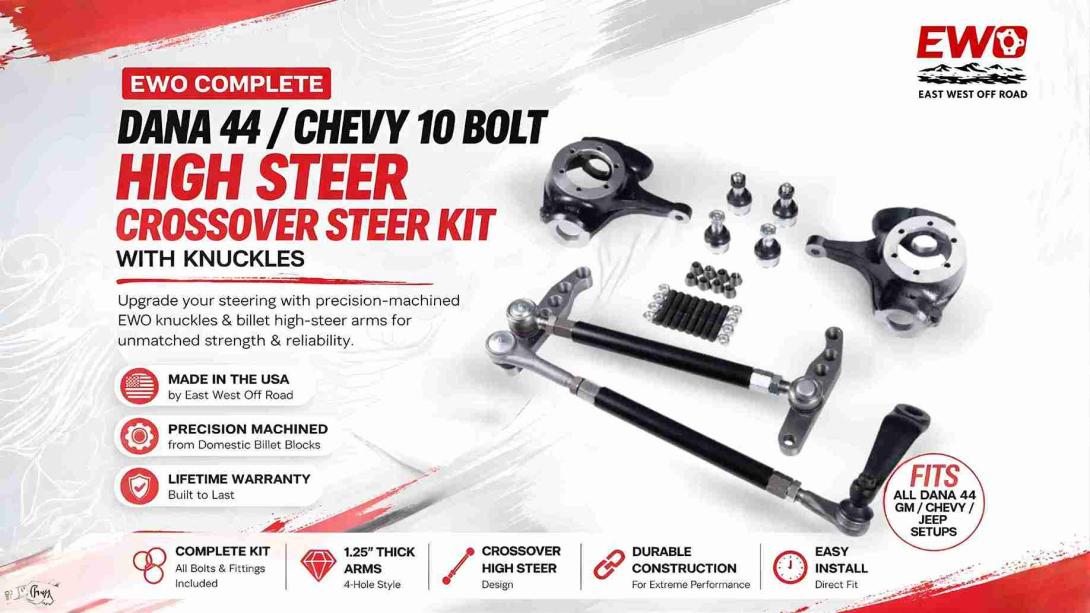
Dana 44 driver and passenger flat top knuckles provide the mounting foundation for a high-steer arrangement that spans both sides of the front axle. Instead of treating crossover steering as a passenger-side-only modification, a complete system considers how the drag link, tie rod, high-steer arms, knuckles, ball joints, and mounting hardware function together.
The EWO package includes both flat-top knuckles and corresponding high-steer arms. That paired approach simplifies component planning because the system begins with known axle-side steering components rather than unidentified existing knuckles.
Why Would a High-Steer System Use Both Flat-Top Knuckles?
Both knuckles allow the steering layout to be planned across the entire axle.
The passenger side is especially important for crossover steering because the drag link reaches from the steering box toward the opposite-side steering arm.
The driver side remains part of the system because left- and right-side steering movement must stay coordinated through the tie rod.
Using both flat-top knuckles can also support elevated linkage placement across the steering arrangement.
The exact tie-rod and drag-link positions depend on the intended system, so the knuckles should always be considered with the steering arms rather than as isolated axle components.
What Is a Flat-Top Knuckle?
A flat-top knuckle is a steering knuckle with an upper area suitable for the intended high-steer arm mounting arrangement.
In a high-steer conversion, that mounting platform allows a steering arm to sit above the knuckle and provide an elevated linkage attachment point.
High-steer placement is designed to improve steering-component clearance.
This is useful in off-road builds where lower linkage can sit closer to obstacles.
However, a flat top alone does not automatically establish compatibility with every high-steer arm.
The arm, knuckle, mounting hardware, and steering layout need to be designed to work together.
How Do High-Steer Arms Mount to the Knuckles?
The EWO package includes corresponding driver- and passenger-side high-steer arms.
It also includes Dana 44 studs, conical washers, lock nuts, and related mounting hardware.
Those pieces create the arm-to-knuckle mounting arrangement used by the system.
The steering arms themselves are 1.25 inches thick and manufactured from domestic billet blocks.
They are precision-machined in-house in the United States.
The lifetime warranty applies to the steering arms.
For more about how the knuckle conversion works as a whole, see the Dana 44 flat-top knuckle conversion guide.
Why Does the Passenger-Side Knuckle Matter in Crossover Steering?
Crossover steering routes the drag link from the steering box across toward the opposite-side steering hardware.
That makes the passenger-side steering arm an important connection point in the mechanical layout.
The pitman arm begins the drag-link path at the steering box.
The drag link then carries steering input across to the passenger-side steering component.
The tie rod coordinates movement between the two knuckles.
This is why crossover steering should be understood as a complete left-to-right system rather than simply adding one arm to one side of the axle.
Why Does the Driver-Side Knuckle Matter?
The driver side participates in the tie-rod side of the steering system and supports the complete high-steer arrangement.
Even when the crossover drag link terminates on the opposite side, the front wheels still need coordinated steering movement.
Providing the driver-side flat-top knuckle and steering arm means the system can be planned with matched high-steer components across both sides.
That can simplify steering-component sourcing and help the builder avoid mixing unrelated knuckles and arms.
The EWO Dana 44 high-steer package with both knuckles uses this matched approach.
What Role Do Ball Joints Play?
The complete package includes upper and lower Dana 44 ball joints.
Ball joints support steering-knuckle movement in the applicable ball-joint configuration.
Their condition and installation are important because the knuckle must move correctly while remaining properly located relative to the axle.
A high-steer arm cannot compensate for worn or incorrectly installed supporting components.
That is why a knuckle-focused steering upgrade should include inspection of the complete axle-end assembly rather than only the new steering-arm hardware.
How Do Flat-Top Knuckles Affect Steering Clearance?
The knuckles provide the mounting platform that allows high-steer arms to position steering linkage higher.
The higher attachment location is designed to improve steering-component clearance.
For an off-road vehicle, that can place suitable linkage farther from rocks and trail obstacles than some lower steering arrangements.
Actual clearance still depends on:
- Tie-rod position.
- Drag-link position.
- Wheel and tire combination.
- Wheel backspacing.
- Suspension travel.
- Steering angle.
- Axle articulation.
High steer improves component placement, but it does not create guaranteed obstacle clearance under every condition.
How Do Flat-Top Knuckles Affect Steering Geometry?
They affect geometry indirectly by establishing where high-steer arms can position linkage attachment points.
Changing steering-arm height changes the spatial relationship among the knuckle, drag link, tie rod, pitman arm, and steering box.
Correctly configured crossover steering is designed to improve steering geometry and reduce bump steer.
That outcome depends on the complete vehicle.
Suspension lift, axle location, steering-box position, arm height, and final linkage angle all contribute.
Knuckles should therefore be selected as part of a steering-system plan rather than simply because the buyer wants “high steer.”
How Should Buyers Match Knuckles and Steering Arms?
The safest approach is to verify that the knuckle and arm are intended to work together in the same system.
Avoid assuming that all “Dana 44” parts are interchangeable.
Dana 44 axles have been used in many configurations, and existing knuckles may differ by application or previous modification.
A matched package reduces that uncertainty.
For a closer look at the steering-arm side, review the 1.25-inch billet high-steer arm guide.
When combining components from different sources, professional verification becomes even more important because mounting interfaces, hardware, linkage placement, and geometry may differ.
Fitment and Installation Considerations
Before replacing or installing knuckles, positively identify the front axle.
Do not rely only on the vehicle badge.
Older Chevy, GMC, Jeep, K10, K20, K5, and custom 4x4 builds may have swapped axles or replacement steering components.
The complete EWO crossover setup also requires a 2WD steering box.
Its DOM tubing and weld-bung arrangement can require vehicle-specific fabrication.
After installation, professional alignment and final inspection are recommended.
Verify:
- Ball-joint condition and installation.
- Steering-arm mounting.
- Hardware security.
- Full steering travel.
- Tie-rod clearance.
- Drag-link clearance.
- Suspension articulation.
- Wheel and tire interference.
- Potential binding.
Steering and knuckle work should be treated as safety-critical.
Frequently Asked Questions
Why does the EWO kit include both driver and passenger flat-top knuckles?
The complete high-steer crossover layout involves both sides of the axle. The passenger side supports the crossover drag-link arrangement, while the driver side participates in the tie-rod and overall high-steer system. Supplying both knuckles also helps keep the arm-and-knuckle configuration matched.
Are Dana 44 flat-top knuckles universal?
No. Dana 44 axles exist in multiple configurations, and the axle name alone does not guarantee that every knuckle or steering arm is interchangeable. Buyers should positively identify the axle and confirm component compatibility before purchasing.
Do the EWO knuckles come with ball joints?
The confirmed package includes upper and lower Dana 44 ball joints. They are part of the complete steering and knuckle package described in the supplied product information.
Are the high-steer arms included with the flat-top knuckles?
Yes. The complete EWO kit includes driver- and passenger-side high-steer arms along with both flat-top knuckles. Steering-arm studs, conical washers, lock nuts, and mounting hardware are also included.
Does installing flat-top knuckles automatically improve steering geometry?
No. The knuckles allow high-steer arm installation, but final geometry depends on the steering arms, drag link, tie rod, pitman arm, steering box, suspension lift, axle position, and final fabrication. The complete system must be configured correctly.
Final Thoughts
Driver- and passenger-side flat-top knuckles form the foundation of a complete high-steer system across the axle.
Their value is not simply that they have a flat mounting area. Their real role is supporting matched steering arms that establish the linkage positions used by the crossover and tie-rod arrangement.
For applicable Dana 44 and Chevy 10 Bolt projects, review the EWO system with matched flat-top knuckles and billet high-steer arms and confirm axle identity, steering-box requirements, fabrication, ball joints, clearance, and alignment before installation.