

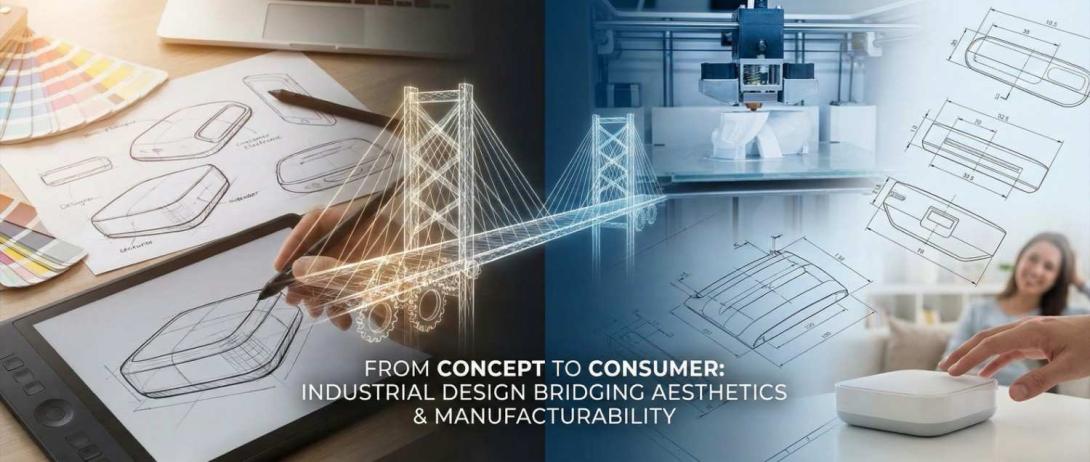
The "Napkin Sketch" Trap
Every great product begins with a spark, a rough sketch on a napkin, or a sudden realization in the shower. But there is a massive chasm between a compelling idea and a commercially viable product.
A study by the Industrial Designers Society of America (IDSA) suggests that for every 3,000 raw ideas, only one becomes a commercially successful product. Why? Because too often, companies treat aesthetics and engineering as separate phases. They design a beautiful shell, only to find out later that the internal components don’t fit, the materials are too expensive, or the shape is impossible to mold.
This disconnect is the primary driver of budget overruns and delayed launches. The solution lies in a holistic approach to industrial design services, one that weaves visual appeal and manufacturability together from day one.
Beyond "Making It Pretty": The Strategic Role of Design
In the modern market, consumers have been trained by giants like Apple and Dyson to expect perfection. A product cannot just work well; it must feel intuitive, look premium, and withstand daily use. However, for startups and small manufacturers, achieving this balance is a high-wire act.
Effective industrial design is not just about styling; it is a strategic process that aligns User Experience (UX) with Business Goals. It asks the critical questions early:
- Who is the user, and how will they hold this device?
- Does this curve add value, or does it just add tooling cost?
- Can this material withstand the regulatory standards in the USA, Europe, or Australia?
The Convergence of Art and Engineering
To bridge the gap between a concept and a consumer-ready product, leading firms are moving away from linear workflows. Instead, they are adopting an integrated model in which product design services encompass both creative ideation and rigorous engineering.
1. Visualization and Ergonomics (The "Human" Element)
The journey starts with understanding the human factor. Through Product Concept Development, designers use sketches and photorealistic rendering to explore form factors. This is where brand identity is forged. But a pretty picture isn't enough. Advanced firms use ergonomic studies to ensure the product fits the user's hand and lifestyle, reducing the risk of market rejection upon launch.
2. The Digital Twin: Validation Before Production
This is where the magic happens. By leveraging 3D CAD Modeling, industrial designers can create a "digital twin" of the product. This allows for virtual stress testing using Finite Element Analysis (FEA) and Computational Fluid Dynamics (CFD).
- Why this matters: You can identify weak points in a plastic enclosure or overheating issues in electronics before cutting a single piece of steel for molds.
3. Design for Manufacturing (DFM)
A beautiful design is useless if it costs $500 to build a product you planned to sell for $200. Professional industrial design services integrate DFM principles from the concept phase onward. This involves simplifying assemblies, selecting standard materials, and designing parts optimized for specific manufacturing processes such as injection molding or CNC machining.
Navigating the Global Maze: Compliance and Certification
One often-overlooked aspect of bringing a product to market is regulatory compliance. A design might look fantastic, but if it doesn't meet CE marking requirements for Europe or UL standards for the USA, it cannot be sold.
Experienced design partners, such as Tesla Mechanical Designs, understand that compliance isn't an afterthought; it's a design constraint. By addressing safety, thermal performance, and material toxicity early in the design process, companies avoid the nightmare of failing certification tests just as they are ready to ship.
Actionable Takeaways for Product Innovators
If you are navigating the journey from prototype to production, here is how to ensure your design survives the transition:
- Integrate Early: Don't hire industrial design services just for the "look." Bring them in to solve usability and assembly challenges simultaneously.
- Prioritize Prototyping: Use rapid prototyping (3D printing) to validate ergonomics physically, not just on a screen.
- Think Global: If you plan to sell internationally, ensure your design partner understands global standards (ISO, CE, CSA) to prevent costly redesigns later.
- Audit Your BOM: constantly review your Bill of Materials. Can a custom part be replaced with an off-the-shelf component without sacrificing aesthetics?
Conclusion: Design is Your Competitive Advantage
In a crowded marketplace, the products that win are those that feel inevitable, where the form follows the function so perfectly that the user can't imagine it any other way. This level of polish doesn't happen by accident. It is the result of a deliberate, disciplined process that bridges the gap between the artist's vision and the engineer's reality.
By partnering with expert product design services that understand this duality, you don't just launch a product; you launch a brand that is built to last.