

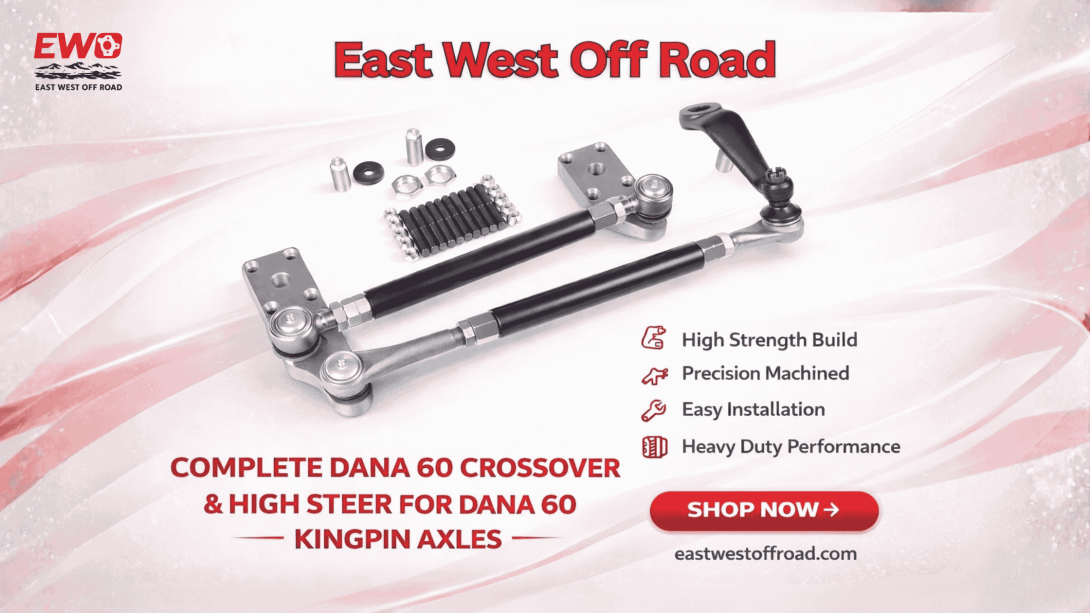
Square-body Chevy trucks and K30 one-ton rigs earned their reputation on the backs of kingpin Dana 60 front axles. The axle itself is nearly bulletproof, but the factory push-pull steering system is a different story. Anyone who has wrestled a lifted K5 Blazer or K30 dually through a rutted trail knows the white-knuckle experience of bump steer, where the steering wheel jerks violently with every suspension cycle. The definitive solution is a Chevy Dana 60 Crossover Steering conversion. By eliminating the push-pull steering box and relocating the drag link to the passenger-side knuckle, crossover steering synchronizes the linkage with the track bar and transforms a wandering, unpredictable truck into a rig that tracks straight and steers precisely. For Chevy owners ready to retire their factory steering, the complete solution starts with a Dana 60 Crossover Steering kit built specifically for kingpin axles.
The Square Body Steering Problem Explained
General Motors built millions of square-body trucks between 1973 and 1987, and the one-ton 4x4 variants received the coveted kingpin Dana 60. These trucks were engineered for farm duty and highway towing, not for rock crawling on 40-inch tires. The steering system reflects this original design intent.
Push-Pull Steering: A Flawed Foundation
The factory Chevy 4x4 steering box mounts inside the frame rail with the sector shaft pointing forward. The pitman arm swings fore and aft, pushing and pulling a drag link that connects to a steering arm on the driver-side knuckle. This push-pull arrangement was cost-effective for General Motors but creates a fundamental geometry problem. The drag link operates in a completely different plane than the track bar, so when the suspension compresses or droops, the drag link length effectively changes while the track bar length stays fixed. The result is the axle steering itself without driver input, a phenomenon known as bump steer.
Frame Flex and Steering Box Fatigue
The square-body Chevy frame rail at the steering box mount is notorious for cracking, even with stock tire sizes. The push-pull box places enormous leverage on the frame as it tries to turn heavy tires while the axle pushes back. Over time, the frame fatigues around the bolt holes, and once micro-cracks form, they propagate until the steering box literally tears off the frame. A crossover steering conversion addresses this by using a different steering box orientation that loads the frame in a more distributed pattern, but frame reinforcement remains essential on any Chevy build pushing serious tire.
How Crossover Steering Fixes Chevy Dana 60 Geometry
Crossover steering fundamentally changes how force travels from the steering wheel to the tires. Instead of pushing and pulling on the driver-side knuckle only, a crossover system uses a drag link that runs from the steering box to a high steer arm on the passenger-side knuckle.
The Two-Wheel-Drive Steering Box Swap
The magic of Chevy Dana 60 Crossover Steering starts at the steering box. A two-wheel-drive Chevy steering box from the same era mounts to the outside of the frame rail and swings side to side, exactly the motion needed for a crossover drag link. Alternatively, aftermarket crossover steering boxes are available that bolt directly in place of the factory 4x4 box but provide the correct sector shaft motion. This box must be mounted with a heavy-duty frame reinforcement plate, welded or bolted, to prevent the frame cracking that plagues even stock trucks.
Parallel Geometry and Bump Steer Elimination
With the crossover steering box in place, the drag link now runs from the pitman arm across to the passenger-side high steer arm. This places the drag link in the same horizontal plane as the track bar. When both components are parallel and of equal length, the axle can cycle through its full range of motion without changing toe. The steering wheel stays dead calm over washboard roads and rock ledges alike. This is the single biggest handling improvement most Chevy owners will ever experience, and it is the reason crossover steering is considered mandatory for any seriously wheeled square-body.
Key Components of a Chevy-Specific Crossover System
Not all crossover steering kits are designed with Chevy applications in mind. The steering box interface, pitman arm taper, and frame mounting considerations are unique to these trucks.
Billet High Steer Arms for Kingpin Knuckles
The Chevy kingpin Dana 60 knuckle has a flat, five-stud mounting surface that is perfectly suited for billet high steer arms. The 1.25 inch thick Dana 60 billet arms provide the strength overhead needed to steer heavy one-ton truck tires through technical terrain. Cast arms are prone to cracking at the stud bosses, but billet steel machined from a solid block has uniform grain structure and zero internal voids. The 5 hole pattern Dana 60 steering arms spread the steering load across five fasteners, a critical upgrade from the factory three-bolt pattern that concentrates stress dangerously.
When paired with Dana 60 high strength studs 180000 PSI, these arms create a friction bond with the knuckle that eliminates the micro-movement responsible for wallowing out mounting holes. Once torqued properly, the studs stretch slightly in tension, clamping the arm to the knuckle with thousands of pounds of force. This is the foundation that every other steering component depends on.
DOM Tubing and the Fabrication Advantage
The drag link and tie rod are fabricated from 1.50 OD .250 wall DOM tubing. Drawn Over Mandrel tubing is seamless, with a uniform wall thickness that standard ERW pipe cannot match. The .250-inch wall provides serious dent resistance for the tie rod, which lives in the danger zone below the axle even with high steer arms. The Dana 60 crossover steering with DOM tubing specification ensures that when the tie rod does contact a rock, it glances off rather than bending. The drag link uses the same tubing spec, providing a stiff connection between the steering box and passenger knuckle that transmits steering input without flex.
GM 1-Ton Tie Rod Ends and Proper Tapers
Chevy trucks use specific taper dimensions for their steering components. The GM 1 Ton Tie Rod Ends included in a proper kit match these tapers exactly. The ES2026R ES2027L drag link ends connect the drag link to the pitman arm and passenger knuckle with zero slop when the tapers are matched. The ES2234L ES2234R tie rod ends provide the same precision fit for the tie rod connecting both knuckles. These ends are greaseable, allowing fresh grease to be pumped through the zerk fittings to purge contamination after muddy trail rides. The rod ends thread into 7/8-18 weld bungs and jam nuts that get fully welded into the DOM tubing for a permanent, slip-free connection that will never rotate out of adjustment.
The Complete East West Offroad Solution for Chevy Trucks
Piecing together a steering system from junkyard parts and different manufacturers creates tolerance stack-up and taper mismatches that result in sloppy steering. The East West Offroad Dana 60 kit arrives with every component pre-selected to work together on a Chevy kingpin Dana 60.
What the Kit Includes
The complete Dana 60 kingpin steering kit boxes up everything required for installation: driver and passenger side billet high steer arms machined from domestic steel, two pre-cut lengths of DOM tubing for the drag link and tie rod, all four GM 1-ton rod ends with mounting hardware, ten 180,000 PSI studs with tapered conical nuts, and the weld-in bungs with matching jam nuts. Grease fittings, spacers, and detailed installation hardware round out the package. There is no scavenging parts counters or junkyards, every piece is included and verified compatible.
The Pitman Arm Consideration
The pitman arm is the interface between the steering box sector shaft and the drag link. On a Chevy crossover conversion, the correct pitman arm length and taper are critical. Too much drop angles the drag link out of parallel with the track bar, reintroducing bump steer. The East West Offroad kit offers an optional pitman arm matched to the ES2026R ES2027L drag link ends taper, eliminating the guesswork. This arm is flat or minimally dropped to keep the drag link and track bar in the same plane on trucks with moderate lift heights.
EWO Quality and USA Manufacturing
The EWO kingpin high steer kit is machined in the United States from domestically sourced billet steel. This provides full traceability from the steel mill to the finished part, a level of quality control that imported kits simply cannot offer. American manufacturing means the engineer who designed the arms is available to answer fitment questions, and replacement parts ship from domestic inventory rather than waiting for overseas containers. For a steering component where failure means complete loss of vehicle control, this assurance matters.
Installation Guide for Chevy Dana 60 Crossover Steering
Installing a crossover steering system on a square-body Chevy is a weekend project for someone with fabrication experience. The process involves mechanical assembly, welding, and precise alignment.
Steering Box Mounting and Frame Reinforcement
Before touching the axle, the steering box must be mounted correctly. Remove the factory push-pull box and thoroughly inspect the frame rail for cracks. Even hairline cracks must be stop-drilled and welded before proceeding. Install a frame reinforcement plate on both the inside and outside of the frame rail, these plates spread the steering box load across a much larger area and prevent future cracking. Mount the two-wheel-drive or aftermarket crossover steering box to the reinforced frame using Grade 8 hardware torqued to specification. The box must be perfectly square to the frame to prevent binding in the steering shaft u-joints.
Knuckle Preparation and Arm Installation
Remove the factory steering arms from the kingpin knuckles and clean the mounting surfaces down to bare steel. Any paint, rust, or debris between the arm and knuckle reduces clamping friction and accelerates stud fatigue. Chase the threaded holes with a bottoming tap to ensure the new Dana 60 high strength studs 180000 PSI thread in fully without bottoming on debris. Apply high-strength red thread locker to the knuckle-side threads and bottom the studs by hand. Install the billet arms over the studs and torque the conical nuts in a star pattern to the manufacturer's specification. The arms must sit perfectly flat against the knuckle face with zero gap.
Fabricating the Drag Link and Tie Rod
The DOM tubing comes pre-cut but requires welding the bungs in place. Slide the 7/8-18 weld bungs and jam nuts into each tube end, leaving a small root gap for weld penetration. Tack each bung in four quadrants and verify the rod ends thread in smoothly. Weld in short passes, alternating sides to control heat and prevent bung distortion. Once the welds cool, thread in the rod ends and assemble the drag link and tie rod on the truck. Set the toe with the full vehicle weight on the suspension, targeting 1/16 to 1/8 inch of toe-in. Tighten the jam nuts firmly and grease all four rod ends until fresh grease appears at the boot edges.
Alignment and Test Drive
After assembly, center the steering box by counting turns lock-to-lock and positioning the box at the exact midpoint. Adjust the drag link length so the wheels point straight ahead with the box centered. This ensures equal steering travel in both directions. Torque all fasteners and recheck after 500 miles of driving. The initial test drive should reveal a dramatically calmer steering wheel, no more sawing back and forth to keep the truck in its lane on the highway.
Common Square Body Chevy Fitment Questions
Every Chevy build is slightly different, and several variables affect crossover steering fitment and performance.
Lift Height and Drag Link Angle
The amount of suspension lift directly impacts drag link and track bar angles. On trucks with 4 inches of lift or less, a flat pitman arm and factory track bar mount typically achieve parallel geometry. Trucks with 6 inches or more of lift often require a track bar drop bracket at the frame end to bring the bar angle down to match the drag link. Measure both angles at ride height before finalizing the pitman arm selection.
Axle Swap Considerations
Many Chevy owners swap kingpin Dana 60 axles into trucks that originally had Dana 44 or 10-bolt axles. This Kingpin Dana 60 Steering Upgrade requires verifying that the axle is indeed a kingpin unit and not a ball joint Dana 60 from a later Ford application. Kingpin knuckles have a large hex cap visible on top of the upper knuckle. Ball joint knuckles have a smooth top with a grease fitting. The steering arms and mounting patterns are completely different between the two types.
Hydro Assist Readiness
Square-body Chevys running tires larger than 40 inches or competing in rock crawling events frequently add hydraulic ram assist to reduce steering effort. The billet high steer arms in the East West Offroad kit include provisions for mounting a hydraulic ram. The 1 Ton Steering Upgrade Kit components are engineered to handle the additional force of a ram pushing and pulling on the tie rod without bending or shearing fasteners. The five-stud arm pattern provides the clamping overhead needed to survive hydro assist forces.
Conclusion
The factory push-pull steering on a square-body Chevy Dana 60 was barely adequate when these trucks rolled off the assembly line with 235/85R16 tires. Lift the suspension, bolt on modern rubber, and point the nose at a trail, and that factory steering becomes a dangerous liability. Chevy Dana 60 Crossover Steering conversion replaces the flawed push-pull geometry with a crossover system that synchronizes the drag link and track bar, eliminating bump steer and providing precise, predictable handling both on the highway and in the rocks. Billet high steer arms, DOM tubing, and GM 1-ton rod ends deliver the strength needed for serious off-road use, while USA manufacturing ensures every component meets published specifications. Frame reinforcement, proper pitman arm selection, and careful welding during installation complete the transformation from wandering and unpredictable to locked-in and confident. Build your Chevy steering system once with components engineered to handle the abuse that kingpin Dana 60 axles are famous for surviving. The complete upgrade is available as a Dana 60 High Steer Kit that includes everything required for a professional-grade installation.
Frequently Asked Questions (FAQs)
Will crossover steering work with my factory Chevy 4x4 steering box?
No. The factory 4x4 steering box swings the pitman arm fore and aft, which is incompatible with crossover steering geometry. You must swap to a two-wheel-drive Chevy steering box from the same era or an aftermarket crossover box that swings side to side. This is a required part of the conversion, not an optional upgrade.
Can I keep my factory track bar with crossover steering?
You can keep the factory track bar if the mounting points place it parallel with the new drag link. On lifted trucks, the factory track bar angle is often too steep, requiring an adjustable track bar and possibly a frame-end drop bracket to achieve parallel geometry with the drag link.
Is this kit a direct bolt-on or does it require welding?
The high steer arms bolt directly to the knuckles without any welding required. However, the drag link and tie rod require welding the threaded bungs into the DOM tubing. This is a fabrication step that should be performed by someone with welding experience, as the quality of these welds directly impacts steering safety.
What pitman arm do I need for my Chevy crossover steering conversion?
The correct pitman arm matches the GM 1-ton taper of the ES2026R ES2027L drag link ends and places the drag link parallel with the track bar. A flat or minimally dropped pitman arm works for most trucks with 4 to 6 inches of lift. East West Offroad offers an optional pitman arm matched to this kit's rod end tapers.
Does this kit work with Chevy Dana 60 axles that have been swapped into other vehicles?
Yes. The kit is designed for the kingpin Dana 60 axle itself, regardless of what vehicle it currently resides under. The high steer arms, studs, rod ends, and tubing are axle-specific, not chassis-specific. The vehicle-specific portion of the conversion is the steering box and pitman arm selection for the receiving chassis.