
A procurement team negotiates a great contract. Six months later, nobody can say whether buyers are using it. Invoices arrive that do not match agreed prices. A key supplier's risk rating changes, and the news reaches procurement last. Each step was handled by a different tool, and none of them talked to the others.
This is the gap Source-to-Pay platforms are designed to close. By connecting sourcing, contracting, purchasing, supplier management, and payment in one environment, they give enterprises control over the full procurement lifecycle. For CXOs, CPOs, and finance leaders, S2P is shifting from a nice efficiency tool to a core part of how businesses stay resilient and competitive.
Click Here For More Information: https://qksgroup.com/market-research/spark-matrix-source-to-pay-q4-2025-9567
Market Overview: From Point Tools to a Unified Platform
QKS Group describes a Source-to-Pay (S2P) platform as one that automates and optimizes end-to-end sourcing and procurement to improve internal controls, strengthen supply chain processes, offer comprehensive spend visibility, and reduce supplier risk and compliance exposure. By centralizing procurement data in one place, it helps organizations standardize processes, lower total cost of ownership, and respond quickly when conditions change.
A typical S2P suite covers:
- Spend analysis and category planning
- Sourcing events, RFx, and auctions
- Contract lifecycle management
- Supplier onboarding, performance, and risk management
- Requisitioning, purchase orders, and invoicing
- Payment and reconciliation
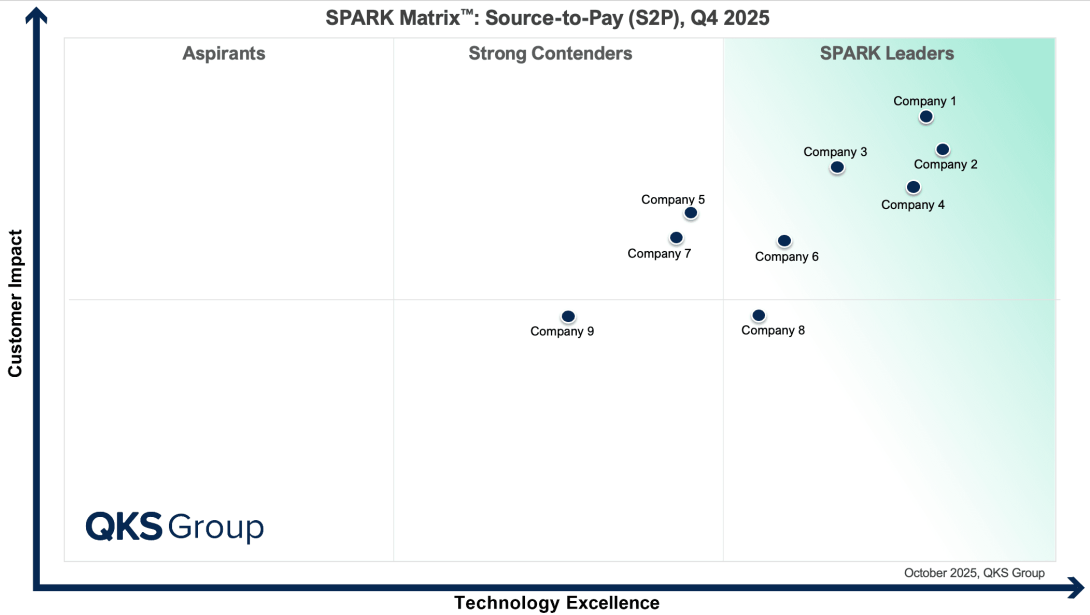
QKS Group's SPARK Matrix evaluates leading vendors including Coupa, Esker, GEP, Ivalua, JAGGAER, Oracle, Proactis, SAP, and Zycus. QKS Group's research notes that leading vendors are working toward a single procurement platform that is modular, built on a single codebase, rich in intelligence, and increasingly agentic.
Key Challenges Businesses Face
Procurement teams are asked to do more with less. Common obstacles include:
- Disconnected systems. Sourcing, contracts, and payments sit in separate tools, which breaks the data trail.
- Limited spend visibility. Without clean, consolidated data, savings opportunities stay hidden.
- Contract leakage. Negotiated terms are not always applied at the point of purchase.
- Supplier risk. Financial, geopolitical, and compliance risks change faster than manual reviews can track.
- Manual and repetitive work. Buyers spend time on administration instead of strategy.
- Low adoption. Clunky interfaces push employees to buy outside the system.
- Rising compliance demands. ESG, ethics, and regulatory expectations keep expanding.
Key Trends and Innovations
Agentic procurement. AI agents are beginning to handle tasks such as drafting sourcing events, answering buyer queries, and resolving invoice exceptions, with people supervising the outcomes.
Intelligence built into the platform. Machine learning supports spend classification, savings identification, price benchmarking, and supplier recommendations.
Single-codebase architecture. One unified platform reduces integration effort and delivers a consistent user experience across modules.
Modular, composable design. Buyers can start with the modules they need and expand over time.
Continuous supplier risk monitoring. Real-time signals on financial health, sanctions, and disruptions help teams act early.
Generative AI for contracts and sourcing. Faster drafting, clause comparison, and summarization shorten cycle times.
Sustainability and diversity tracking. ESG and supplier diversity data are becoming standard parts of sourcing decisions.
Check SPARK Plus Study Here: https://qksgroup.com/sparkplus?market-id=344&market-name=source-to-pay
Benefits and Business Impact
A strong S2P platform delivers value across the business:
- Measurable savings. Better sourcing and contract compliance reduce cost.
- Full spend visibility. One data source supports smarter category strategy.
- Stronger controls. Policy-driven workflows and audit trails reduce compliance risk.
- Higher productivity. Automation frees buyers for negotiation and supplier strategy.
- Supplier resilience. Proactive risk monitoring lowers the impact of disruption.
- Faster cycle times. Sourcing, approval, and payment move quicker.
- Scalability. The platform supports growth across regions, categories, and business units.
Real-World Use Cases
Category savings. A manufacturer uses spend analytics to find fragmented purchasing in packaging. A consolidated sourcing event delivers better pricing and fewer suppliers.
Contract compliance. A bank links contracts to purchasing and invoicing. Buyers are guided to negotiated rates, and price mismatches are flagged before payment.
Supplier risk response. A pharmaceutical company monitors supplier health continuously. When a key vendor shows signs of distress, the team activates a backup source early.
Faster onboarding. A global services firm streamlines supplier registration and compliance checks, cutting the time it takes to start working with new vendors.
Sustainable sourcing. A retailer builds ESG criteria into sourcing events and tracks supplier performance against its carbon and diversity goals.
How to Choose the Right Solution
Start with your biggest procurement priorities, whether cost, control, risk, or speed. Then evaluate vendors against these criteria:
- End-to-end depth. Check native capability across sourcing, contracts, procurement, and payment.
- Platform architecture. Look for a modular, unified design rather than stitched-together acquisitions.
- AI and agentic capability. Ask for live examples, not roadmap slides.
- Integration. Confirm smooth connections with ERP, finance, and data systems.
- Supplier risk and ESG. Review monitoring, scoring, and reporting features.
- User experience. Strong usability drives adoption and reduces off-system buying.
- Configurability and scalability. The platform should adapt to your processes and grow with you.
- Vendor strength. Evaluate roadmap, customer references, and implementation support.
An independent view makes comparison easier. QKS Group's SPARK Matrix assesses vendors on capability, differentiation, and market position, helping buyers shortlist with more confidence.
Future Outlook (2025–2028)
Over the next few years, S2P will become lighter, smarter, and more autonomous. Expect AI agents to take on routine sourcing and buying activities, while procurement professionals focus on strategy, negotiation, and supplier relationships.
Supply chain volatility and regulatory scrutiny will keep risk and sustainability data at the center of purchasing decisions. Modular platforms with strong intelligence and open integration will gain ground over rigid suites. Vendors that deliver agility, resilience, and measurable outcomes will lead the market.
Download Sample Report Here: https://qksgroup.com/download-sample-form/spark-matrix-source-to-pay-q4-2025-9567
Conclusion
Procurement now sits at the heart of enterprise performance. Fragmented tools make it harder to control cost, manage risk, and respond to change. A modern Source-to-Pay platform unifies the process, adds intelligence at every step, and turns procurement into a true strategic contributor.
For CXOs and procurement leaders, the next step is straightforward: review how your sourcing-to-payment process works today, identify the gaps, and compare vendors using an independent framework such as QKS Group's SPARK Matrix.