

Is your engineering team spending more time "fixing" external drawings than actually designing? You aren't alone. As we navigate 2026, the Architecture, Engineering, and Construction (AEC) industry is facing a paradoxical challenge: while digital transformation has made global collaboration easier, the "quality gap" in outsourced CAD and BIM services remains a top-tier frustration for project managers.
According to recent Deloitte 2026 Industry Outlooks, investment in digital structures is projected to pivot toward a 1.8% growth this year, with a massive surge in AI-driven data center construction. This boom is forcing firms to scale rapidly, often turning to outsourcing to manage the load. However, a "cheap" drawing that requires three rounds of internal revisions is the most expensive drawing you’ll ever buy.
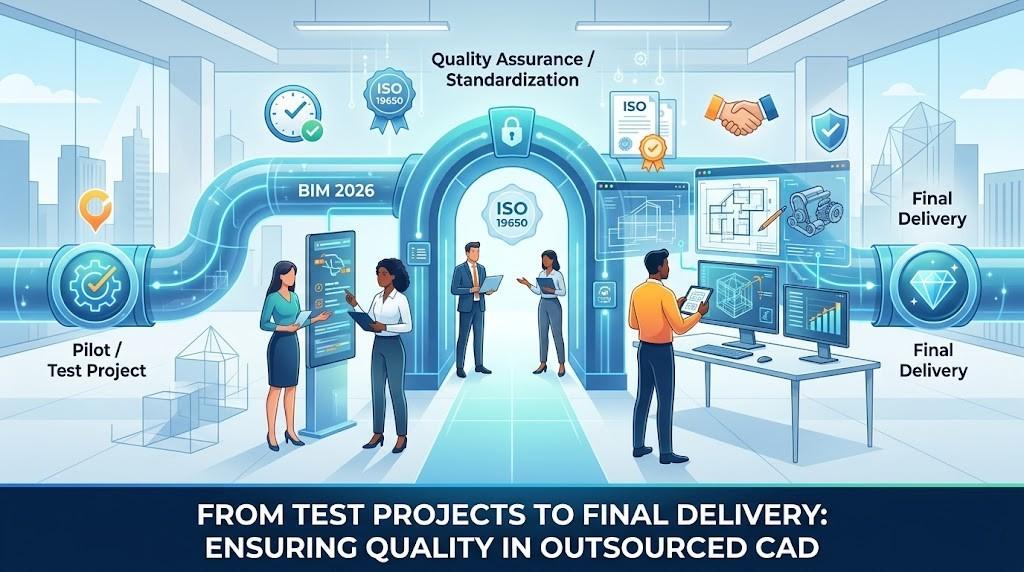
Transitioning from a promising pilot project to a seamless, high-quality final delivery isn't magic—it’s a process. Here is how you can bridge that gap and ensure your outsourced CAD partner actually makes your life easier.
1. The Pilot Project: More Than Just a "Test"
Think of the pilot project as a first date. You aren't just looking for technical skills; you’re looking for compatibility. In the AEC world, this means testing how well an external team absorbs your specific "office DNA"—your layers, your line weights, and your unique Revit families.
Recent industry data suggests that over 60% of outsourcing failures stem from poorly defined expectations during the initial 30 days. To avoid this, your pilot shouldn't be a "throwaway" task. It should be a live, mid-complexity component of a real project.
- Establish the "Gold Standard": Provide a "Reference Package" that represents your perfect delivery.
- The "Feedback Loop" Metric: During the pilot, don't just count errors. Measure how many of those errors are repeated in the second submission. If they learn fast, they’re keepers.
- Defining the "IM" Shift: With the ISO 19650:2026 updates, the industry is moving from "BIM" (modeling) to "IM" (Information Management). Ensure your partner understands this shift; they shouldn't just be drawing lines; they should be managing data across the asset lifecycle.
2. Standardization: The Language of Quality
One of the biggest hurdles in global CAD outsourcing is the variation in regional standards. A drafter in Asia might use different notation than an engineer in the UK or the US. Without a centralized Information Production Plan (IPP)—the new 2026 terminology for a BIM Execution Plan—you are essentially playing a game of "telephone" with your blueprints.
Pro Tip: Before you go all-in with a partner, it’s vital to vet them properly. If you’re still in the scouting phase, check out this guide on how to select the best CAD service provider to ensure you’re starting with a solid foundation.
Standardization should cover:
- Layering and Naming Conventions: Total alignment with ISO 13567 or your internal CAD standards.
- Software Versioning: In 2026, version compatibility is a major bottleneck. Ensure your partner is synced with your specific build of AutoCAD or Revit to prevent "proxy object" nightmares.
- Clash Detection Protocols: Quality isn't just about what's on the sheet; it’s about what’s happening in 3D space. Demand regular Navisworks or Revit Interference Checks as part of every milestone.
3. The 9-Step Information Management Process
The release of the ISO 19650:2026 Draft International Standard has introduced a Unified 9-Step Process for information management. This isn't just for the "big players"; it’s a blueprint for quality in outsourcing.
For a successful CAD delivery, you must focus on the "Information Production Requirements." Your outsourced team shouldn't just receive a PDF and a "good luck." They need structured data requirements at the start of every task. When the hand-off is structured, the delivery is predictable.
4. Moving Toward "Final Delivery" Without the Drama
As you move from the pilot phase into full-scale production, the "casual" nature of early communication needs to be backed by a rigorous Quality Assurance (QA) Framework.
A common pitfall is the "Black Box" syndrome—where you send a task and wait two weeks for a result, only to find it's 20% off-mark. Instead, implement Asynchronous Transparency. In 2026, tools like Miro, Slack, and integrated Common Data Environments (CDEs) allow you to see the "work in progress" without micromanaging.
The "Final 10%" Rule: The last 10% of a CAD project—the annotations, the sheet sets, the title block details—often takes 30% of the time. To ensure quality, don't wait until the 100% submission. Set a "90% Review" milestone. This allows you to catch stylistic preferences before the final files are "inked" and delivered.
Actionable Takeaways for AEC Leaders
- Treat the Pilot as a Stress Test: Use a project with a tight deadline and specific standards to see how the partner handles pressure and technical nuances.
- Audit the Tech Stack: Ensure they are using AI-assisted drafting tools (standard in 2026) for tasks like dimensioning and layer cleanup, which reduces human error.
- Validate Against ISO 19650:2026: Ask your provider how they are adapting to the shift from "BIM" to "Information Management."
- Incorporate "Live" Coordination: Move away from email. Use a CDE where you can leave "redlines" directly on the 3D model or CAD file in real-time.
The Road Ahead: Quality as a Strategy
The AEC industry is no longer just about bricks and mortar; it’s about data and delivery. Outsourcing your CAD needs shouldn't feel like a gamble. By treating your partner as a "Production Team" rather than a "Vendor," and by implementing the rigorous standards of the 2026 digital landscape, you turn a cost-saving measure into a competitive advantage.
Quality isn't an act; it's a habit. And in outsourced CAD, that habit starts with the very first test project.