

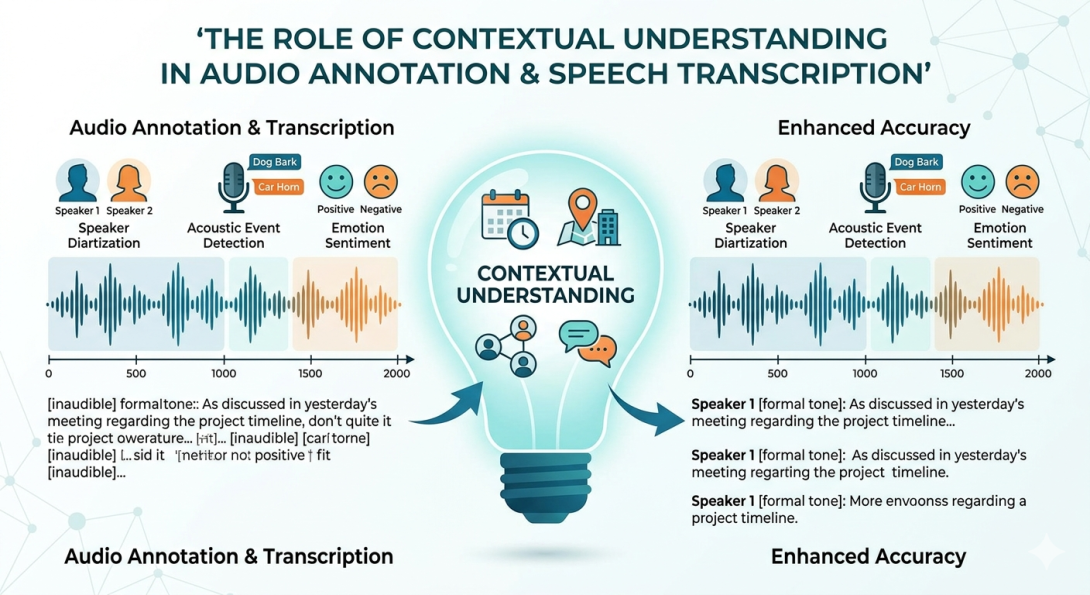
As artificial intelligence continues to reshape industries, the demand for high-quality audio datasets has increased significantly. From virtual assistants and call center analytics to healthcare documentation and multilingual voice applications, AI systems rely heavily on accurately annotated and transcribed audio data. However, achieving accuracy in audio annotation and speech transcription involves more than simply converting spoken words into text. It requires a deep understanding of context.
Contextual understanding plays a critical role in ensuring that audio data is interpreted correctly, preserving meaning, intent, emotion, and situational relevance. Without context, even the most advanced speech recognition systems can produce inaccurate results that affect downstream AI model performance. At Annotera, we recognize that context-aware audio annotation and transcription are essential for developing intelligent and reliable AI solutions.
Understanding Context in Audio Annotation and Speech Transcription
Context refers to the surrounding information that helps determine the meaning of spoken language. In audio annotation and speech transcription, context can include:
- Speaker intent
- Tone and emotion
- Industry-specific terminology
- Conversational flow
- Background sounds
- Regional accents and dialects
- Cultural and linguistic nuances
A single word or phrase can have multiple meanings depending on how and where it is used. For example, the word "charge" could refer to a financial transaction, an electrical property, or a legal accusation. Without understanding the surrounding conversation, annotators and AI systems may misinterpret the intended meaning.
This is why contextual understanding has become a fundamental requirement for creating high-quality audio datasets.
Why Context Matters in Speech Transcription
Speech transcription is often viewed as a straightforward process of converting speech into text. However, real-world conversations are rarely simple. Speakers may interrupt each other, use slang, switch languages, or refer to previously mentioned topics.
Context enables transcription specialists to:
Improve Word Recognition Accuracy
Many words sound similar but carry different meanings. Context helps determine the correct spelling and interpretation.
For instance:
- "Their" vs. "There"
- "Site" vs. "Sight"
- "Principal" vs. "Principle"
Human annotators who understand the subject matter can accurately identify the intended word, ensuring higher transcription quality.
Preserve Meaning and Intent
Accurate transcription goes beyond capturing words. It involves preserving the speaker’s intended message.
Consider the sentence:
"That's just great."
Depending on tone and context, this statement may express genuine appreciation or sarcasm. A context-aware transcription process can capture additional annotations that help AI systems understand the true meaning behind the words.
Handle Industry-Specific Terminology
Industries such as healthcare, finance, legal services, and technology frequently use specialized terminology.
For example:
- Medical consultations include complex clinical terms.
- Financial discussions involve technical investment vocabulary.
- Legal proceedings contain case-specific language.
A professional audio annotation company with domain expertise can accurately transcribe and annotate such content while maintaining contextual accuracy.
The Importance of Context in Audio Annotation
Audio annotation involves labeling audio data to train machine learning models. These labels may include speech segments, speaker identities, emotions, sound events, intent categories, and more.
Context significantly impacts annotation quality in several ways.
Speaker Identification and Diarization
Many AI applications require models to distinguish between multiple speakers in a conversation.
Without context, overlapping dialogue and rapid speaker transitions can create confusion. Contextual understanding helps annotators accurately identify who is speaking and when speaker changes occur.
This is especially important in:
- Customer support calls
- Virtual meetings
- Interviews
- Medical consultations
Accurate speaker diarization improves conversational AI and speech analytics performance.
Emotion and Sentiment Annotation
Modern AI systems increasingly rely on emotion recognition capabilities.
Context helps annotators distinguish between emotions that may sound similar but carry different meanings.
For example:
- Excitement
- Frustration
- Sarcasm
- Anxiety
- Satisfaction
The same phrase can convey different emotions depending on vocal tone and conversational context. Proper annotation allows AI models to learn these distinctions more effectively.
Sound Event Classification
Audio datasets often contain more than speech. Background sounds may include:
- Traffic noise
- Alarms
- Animal sounds
- Machinery
- Music
- Environmental disturbances
Context helps annotators correctly categorize these sounds and understand their relevance within the recording. This improves the performance of sound recognition and environmental monitoring systems.
Challenges of Contextual Understanding
Despite its importance, contextual annotation presents several challenges.
Diverse Accents and Dialects
Global AI applications must handle speakers from different regions and linguistic backgrounds.
Variations in pronunciation, vocabulary, and speech patterns can make transcription difficult. Context helps annotators interpret unfamiliar speech more accurately and maintain consistency across datasets.
Code-Switching and Multilingual Conversations
Many conversations involve switching between languages within a single interaction.
For example, customer support calls in multilingual regions often contain a mix of English and local languages. Context-aware annotators can accurately identify language transitions and preserve meaning throughout the transcript.
Ambiguous Language
People frequently use:
- Idioms
- Colloquialisms
- Abbreviations
- Slang
- Indirect references
Understanding the broader conversation is essential for correctly interpreting these expressions. Without contextual awareness, annotation errors can significantly impact AI model training.
How Context Improves AI Model Performance
The quality of training data directly influences the quality of AI models. Context-rich audio annotation and transcription deliver several benefits.
Enhanced Speech Recognition
When transcripts accurately reflect speaker intent and terminology, automatic speech recognition models achieve better accuracy across diverse use cases.
Better Conversational AI
Chatbots, virtual assistants, and voice-enabled applications depend on contextual understanding to generate relevant responses.
High-quality annotations help these systems understand:
- User intent
- Conversation history
- Emotional cues
- Complex dialogue structures
Improved Sentiment Analysis
Organizations increasingly use AI to analyze customer interactions.
Context-aware annotations allow sentiment analysis models to recognize subtle emotional signals, leading to more accurate business insights and customer experience evaluations.
Stronger Multilingual Capabilities
Global applications require AI systems that understand multiple languages, accents, and dialects.
Contextually annotated datasets provide the diversity and depth needed to train robust multilingual models.
Why Businesses Choose Audio Annotation Outsourcing
Building large-scale audio datasets requires specialized expertise, technology, and quality control processes. As a result, many organizations turn to audio annotation outsourcing to accelerate AI development while maintaining data quality.
Outsourcing provides access to:
- Experienced linguistic specialists
- Domain-specific experts
- Scalable annotation teams
- Established quality assurance frameworks
- Faster project turnaround times
Partnering with an experienced provider enables organizations to focus on AI innovation while ensuring high-quality training data production.
The Value of Data Annotation Outsourcing for AI Projects
Audio annotation is often part of a broader AI data strategy that includes image, video, text, and multimodal datasets.
Through data annotation outsourcing, businesses gain access to specialized resources capable of managing complex annotation requirements across multiple data formats.
An experienced data annotation company can implement standardized workflows, maintain annotation consistency, and support large-scale AI initiatives with greater efficiency.
Moreover, outsourcing reduces operational overhead while providing flexibility to scale annotation efforts as project demands evolve.
How Annotera Delivers Context-Aware Audio Annotation and Transcription
At Annotera, we understand that context is the foundation of high-quality audio data. Our teams combine linguistic expertise, domain knowledge, and rigorous quality assurance processes to deliver accurate and contextually relevant annotations.
As a trusted audio annotation company, we support a wide range of use cases, including:
- Speech recognition training
- Conversational AI development
- Emotion detection systems
- Call center analytics
- Healthcare voice applications
- Multilingual AI solutions
Our approach emphasizes contextual accuracy at every stage of the annotation and transcription workflow. By leveraging skilled human annotators and robust quality control methodologies, we help organizations build AI models that understand not only what is being said but also what is truly meant.
Conclusion
Contextual understanding is no longer optional in audio annotation and speech transcription. It is a critical factor that determines the accuracy, reliability, and effectiveness of AI systems. From recognizing speaker intent and emotional cues to interpreting industry-specific terminology and multilingual conversations, context enables the creation of richer and more valuable training datasets.
As AI applications become increasingly sophisticated, organizations need annotation partners capable of delivering context-aware data at scale. Through expert audio annotation outsourcing and comprehensive data annotation outsourcing services, Annotera helps businesses create high-quality datasets that drive smarter, more accurate AI solutions for the future.