
Managing content at scale is harder than it looks. Ask anyone who's worked inside a mid-to-large organization — files get duplicated, approvals stall, version histories become a mess, and no one can find the document they need when they actually need it. That's not just frustrating. It's expensive.
Enterprise content management addresses exactly this problem. And for companies handling high volumes of documents daily, getting it right can change how the entire business operates.
What Enterprise Content Management Actually Means
At its core, enterprise content management (ECM) is a system — or more accurately, a strategy supported by tools — for capturing, storing, organizing, and distributing business content across an organization. That content might be invoices, contracts, marketing assets, employee records, or technical files.
ECM isn't just about filing things neatly. It's about making sure the right people can access the right information at the right time, with full control over who sees what and when.
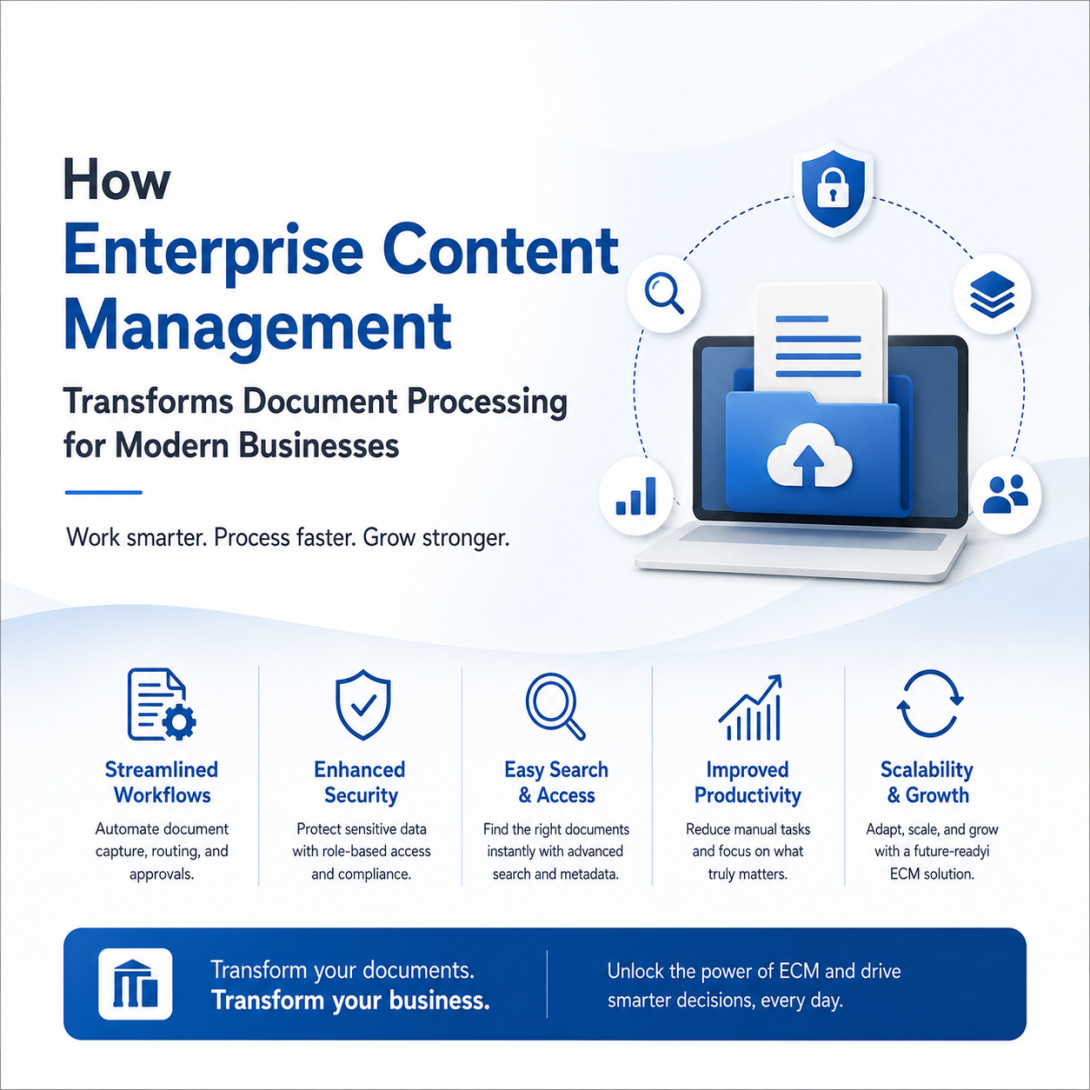
Modern ECM platforms typically handle:
- Document capture and classification
- Workflow automation and approval routing
- Version control and audit trails
- Integration with existing business systems (ERP, CRM, etc.)
- Compliance and records management
When these pieces work together, the operational difference is significant.
The Connection Between ECM and Document Processing
Document processing is where a lot of organizations quietly lose time. Think about a typical invoice workflow — it arrives by email, someone downloads it, maybe it gets renamed, forwarded, printed, signed, scanned, and re-uploaded. That's five to seven manual steps for a single document.
Efficient document processing, backed by a well-implemented ECM system, compresses that into one or two automated steps. Documents get captured, classified by type, routed to the right person, and archived — all without anyone manually pushing them through the pipeline.
For industries like legal, finance, healthcare, and publishing, this kind of efficiency isn't optional. It's foundational.
Why Prepress Teams Benefit More Than Most
One area where ECM delivers outsized value is in prepress workflows. Efficient prepress processes depend heavily on file accuracy, version control, and handoff clarity between design, production, and print teams.
When prepress files are managed inside a proper ECM environment, teams stop asking questions like "which version did we send to the printer?" or "where's the approved artwork?" Everything is tracked, timestamped, and accessible — which reduces costly reprints, missed deadlines, and the kind of errors that only surface at the wrong moment.
A print production company we've seen described it simply: before ECM, proofing cycles took three days. After, it was down to one. That's not a minor improvement. That's a shift in how the business can price and compete.
Choosing the Right ECM Approach
Not every ECM platform fits every organization. Some businesses need cloud-native flexibility. Others operate in regulated environments and need on-premise solutions with strict access controls.
A few things worth evaluating before committing to a platform:
- Scalability — Can it grow with your document volumes without performance degradation?
- Integration depth — Does it connect cleanly with tools your teams already use?
- User adoption — Complex systems that people route around aren't actually solving anything
- Compliance coverage — Particularly important for regulated industries
Getting the selection right matters more than getting it done fast.
Conclusion
Enterprise content management isn't a technology trend — it's an operational necessity for businesses that can't afford to lose time, accuracy, or competitive edge to disorganized document workflows. When document processing runs cleanly and prepress processes become predictable, the whole organization moves better.
The businesses that invest in this infrastructure aren't doing it because it sounds good. They're doing it because the alternative — chaos at scale — is simply too costly to sustain.
Frequently Asked Questions
What is the primary purpose of enterprise content management?
ECM systems are designed to help organizations manage the full lifecycle of business content — from initial capture to archiving or deletion — in a structured, searchable, and controlled way. The goal is operational efficiency and information governance.
How does ECM improve document processing workflows?
By automating repetitive steps like classification, routing, and approval, ECM significantly reduces the manual handling of documents. This shortens processing time, minimizes errors, and creates a clear audit trail for compliance purposes.
Can small businesses benefit from enterprise content management tools?
Yes — many modern ECM platforms offer scalable pricing and cloud-based options that make them accessible to smaller teams. The core benefits of version control, document organization, and workflow automation apply at any company size.