
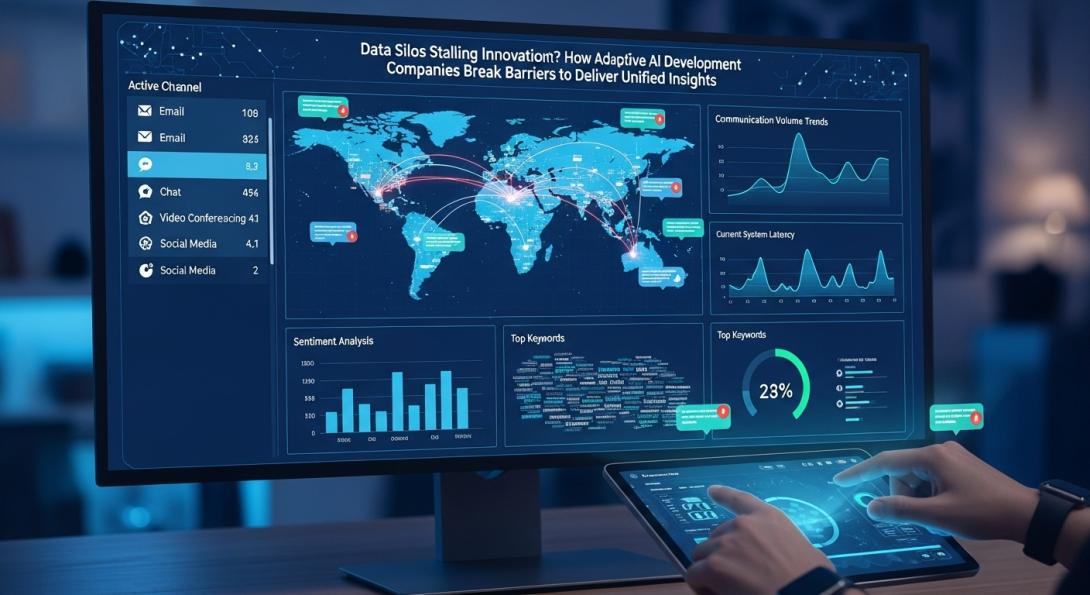
As businesses across industries increasingly recognize the critical impact of data-driven decision-making, the challenges posed by data silos can no longer be ignored. Adaptive AI Development offers organizations not only the tools but also the frameworks required to overcome fragmentation and usher in a new era of connected intelligence.
Adaptive AI Development Companies are at the forefront of helping enterprises build cohesive data ecosystems. Their services extend beyond mere integration; they ensure that data from diverse sources is normalized, contextualized, and made actionable in real time. This transformation is pivotal for companies aiming to respond swiftly to customer demands, market fluctuations, and operational inefficiencies.
Several Adaptive AI Development Solutions are now designed with scalability and interoperability in mind. These solutions leverage machine learning algorithms that adapt as new data becomes available, enabling businesses to refine strategies and enhance insights without manual intervention. This level of automation and learning ensures that organizations stay ahead of competitors and maintain a proactive approach to innovation.
Case Study: Healthcare and Adaptive AI Development
Consider the healthcare sector, where patient data is often scattered across various departments and institutions. Adaptive AI Development Services have been instrumental in consolidating patient histories, diagnostics, and treatment plans into a unified platform. A leading healthcare provider collaborated with an Adaptive AI Development Company to implement a solution that integrates electronic health records (EHRs), wearable device data, and lab results. The result was a comprehensive patient profile that supported personalized care plans, improved diagnostic accuracy, and reduced hospital readmissions by 30%.
This example underscores how Adaptive Artificial Intelligence Development Solutions are not just about technology—they’re about delivering measurable outcomes that enhance patient well-being and streamline workflows for medical professionals.
The Financial Sector: Harnessing Unified Insights
In the financial services industry, data silos often hinder risk assessment and investment strategies. An Adaptive AI Development Solution was deployed by a global investment firm to merge data from legacy systems, real-time market feeds, and customer behavior analytics. The Adaptive AI Development framework enabled predictive insights that allowed portfolio managers to recalibrate investments within minutes of market shifts, significantly reducing exposure to volatile assets.
Here, the role of Adaptive Artificial Intelligence Development Services was to ensure seamless communication between traditionally isolated datasets, thereby fostering agility and precision in decision-making.
The Manufacturing Industry: Driving Operational Efficiency
For manufacturers, fragmented data from supply chains, machinery, and customer orders leads to inefficiencies and increased costs. By working with an Adaptive AI Development Company, several enterprises have adopted AI-driven solutions that monitor production lines, predict maintenance schedules, and synchronize supply logistics.
One such company implemented Adaptive AI Development Solutions that integrated real-time sensor data with historical performance metrics, allowing maintenance teams to preemptively address equipment failures. The result was a 20% decrease in downtime and a 15% increase in overall operational efficiency.
Breaking Barriers: How Adaptive AI Development Ensures Data Integrity
Data consolidation is not without its challenges. Issues such as inconsistent data formats, security protocols, and governance structures complicate integration efforts. Adaptive AI Development Services tackle these issues by employing:
- Data Mapping and Standardization: Algorithms that identify and reconcile data discrepancies, ensuring a common language across datasets.
- Secure APIs: Controlled interfaces that allow safe data sharing while maintaining compliance with industry regulations.
- Continuous Learning: Adaptive AI models that adjust to new patterns and anomalies, safeguarding the integrity of evolving datasets.
These approaches ensure that data from different departments, vendors, or geographic regions can be securely and reliably merged into actionable insights without compromising accuracy or privacy.
Strategic Benefits of Unified Insights Through Adaptive AI Development
Adopting Adaptive Artificial Intelligence Development Solutions offers strategic advantages that extend beyond operational improvements:
- Enhanced Decision-Making: Unified datasets provide a holistic view that supports informed choices, reducing the guesswork inherent in fragmented data landscapes.
- Increased Innovation: Access to comprehensive datasets fuels creative problem-solving and new product development.
- Improved Customer Experience: Integrated insights into customer behavior, preferences, and feedback allow businesses to deliver highly personalized services.
- Risk Mitigation: Adaptive AI Development frameworks identify patterns and anomalies early, enabling preemptive action against threats and inefficiencies.
- Scalability: As organizations grow, Adaptive AI Development Companies ensure that systems remain flexible and capable of handling expanding data requirements.
Challenges to Consider
While the benefits are significant, businesses must also address key challenges when implementing Adaptive AI Development Solutions:
- Data Privacy and Security: As more data is integrated, the risk of breaches increases. Companies must adopt stringent encryption protocols and access controls.
- Bias and Fairness: AI models that learn from historical data may inadvertently replicate existing biases unless carefully monitored and adjusted.
- Cultural Resistance: Employees accustomed to traditional processes may resist new systems. Successful deployment requires change management strategies and continuous training.
- Cost of Implementation: While long-term gains are substantial, the initial investment in infrastructure, talent, and training can be significant.
Adaptive AI Development Companies play a vital role in helping enterprises navigate these challenges through expert consulting, tailored implementation strategies, and ongoing support services.
Looking Ahead: The Future of Unified Insights in Enterprise Ecosystems
The next wave of digital transformation will be defined by how well organizations can harness data from disparate sources to drive continuous learning and adaptive intelligence. Adaptive AI Development is no longer a luxury—it is a necessity for businesses that seek resilience, agility, and growth in uncertain markets.
Future developments in AI technologies, such as federated learning and explainable AI, are expected to further enhance the ability of Adaptive Artificial Intelligence Development Solutions to integrate and interpret complex datasets while maintaining transparency and trust.
Moreover, as regulatory environments tighten and ethical considerations gain prominence, Adaptive AI Development Services will be instrumental in designing systems that are not only efficient but also accountable and fair.
Conclusion
The challenge of data silos is one of the most significant barriers to innovation and efficiency in today’s enterprise landscape. Adaptive AI Development Companies are uniquely positioned to break these barriers by providing solutions that unify data, enhance decision-making, and foster an environment of continuous learning.
Through real-world applications in healthcare, finance, and manufacturing, Adaptive Artificial Intelligence Development Solutions have proven their ability to transform fragmented information into actionable insights, driving improved outcomes, customer satisfaction, and operational efficiency.
As organizations strive to remain competitive in an increasingly data-driven world, investing in Adaptive AI Development Services will be critical. By doing so, enterprises can unlock the full potential of their data assets while building systems that are secure, scalable, and aligned with ethical and regulatory standards.
The future belongs to businesses that embrace intelligent connectivity, and Adaptive AI Development is the cornerstone of this evolution.