

The global carbon dioxide market size 2026 was valued at USD 11.90 billion in 2025 and is projected to grow from USD 12.20 billion in 2026 to USD 16.30 billion by 2034, registering a CAGR of 3.60% during the 2026–2034 forecast period.
Carbon dioxide is a colorless, odorless chemical compound approximately 60% denser than dry air. Though present in low atmospheric concentrations, it plays a critical role in the carbon cycle and has wide-ranging industrial applications — from food carbonation and medical procedures to oil recovery and metal fabrication.
Key Market Drivers
1. Growing Demand from Food & Beverage Industry CO₂ is widely used for beverage carbonation, food freezing, and pH control in the food & beverage sector. Rising consumer demand for carbonated drinks and packaged foods continues to fuel market expansion. The food & beverage segment is expected to hold 59.84% of end-use market share in 2026.
2. Expanding Medical Applications CO₂ is increasingly utilized in minimally invasive surgeries such as endoscopy and laparoscopy, respiratory stimulation, tissue freezing, and vaccine cold chain logistics via dry ice. The growing need for advanced surgical procedures globally is a significant growth catalyst.
3. Adoption of Carbon Capture and Storage (CCS) Technology CCS captures CO₂ from fossil fuel combustion and industrial processes, making it available for enhanced oil recovery and other industrial uses. The U.S. Department of Energy committed up to USD 35 million in September 2023 to advance atmospheric CO₂ removal technologies, signaling strong governmental support for CCS expansion.
4. Oil & Gas Sector Demand CO₂ is used as a supercritical solvent in enhanced oil recovery, capable of boosting oil output by 15–20%. This application drives stable demand from the oil & gas segment globally.
Get a Free Sample PDF - https://www.fortunebusinessinsights.com/enquiry/request-sample-pdf/carbon-dioxide-market-102866
Market Restraints
A key challenge is the complexity surrounding CO₂ transportation. Pipelines are the primary mode of transport, but the lack of standardized quality authentication protocols increases maintenance costs and the risk of atmospheric leakage. Additionally, international agreements such as the Kyoto Protocol, aimed at limiting greenhouse gas emissions, may temper market growth over the forecast period.
The COVID-19 pandemic temporarily disrupted production, as shutdowns of ethyl alcohol manufacturing facilities caused a global CO₂ shortage — highlighting the market's supply chain vulnerabilities.
Segmentation Analysis
By Form
- Liquid (dominant): Projected to hold 54.92% share in 2026, used across food processing, healthcare, and chemical manufacturing due to its versatility.
- Gas: Used in carbonated beverages, welding, fire suppression, and enhanced oil recovery.
- Solid (Dry Ice): Used in food logistics, medical transport, and industrial surface cleaning.
By Source
- Ethyl Alcohol (leading): Expected to contribute 35.25% globally in 2026, as fermentation-derived CO₂ is widely captured in the brewing and baking industries.
- Hydrogen: Growing segment; though not a direct CO₂ source, hydrogen production processes generate CO₂ as a byproduct.
- Others include ethylene oxide and substitute natural gas.
By End-Use Industry
- Food & Beverage — largest segment (~59.84% share in 2026)
- Oil & Gas — stable demand via enhanced recovery
- Medical — fast-growing due to advanced procedures and vaccine logistics
- Metal Fabrication — CO₂ used as shielding gas in welding
- Firefighting — steady, specialized demand
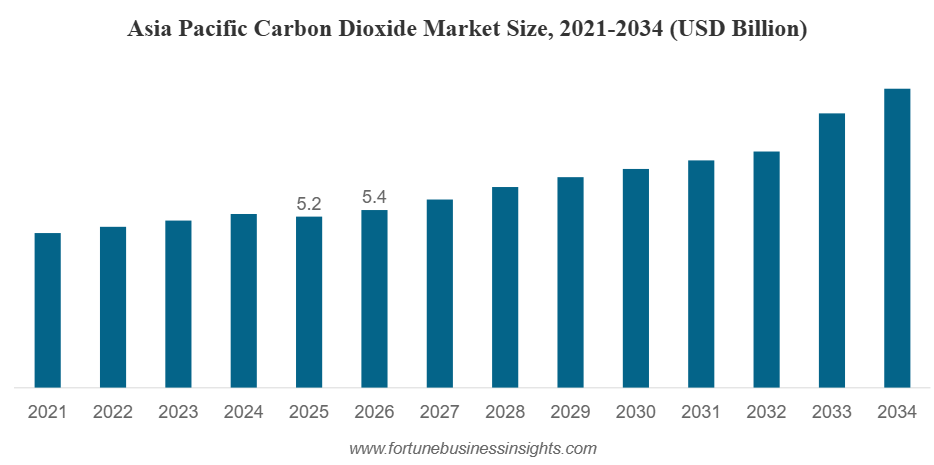
Asia Pacific leads the market, driven by China's manufacturing dominance, India's growing beverage consumption, and high medical industry demand. North America, led by the U.S. (projected at USD 2.9 billion in 2026), benefits from oil recovery applications and a robust food & beverage sector.
Competitive Landscape
Key players heavily invest in R&D and pursue acquisitions to strengthen market position. Major companies include:
- Linde plc (Ireland)
- Air Products and Chemicals, Inc. (U.S.)
- Air Liquide (France)
- The Messer Group GmbH (Germany)
- Matheson Tri-Gas, Inc. (U.S.)
- POET, LLC (U.S.)
- Sicgil India Limited (India)
Notable Developments:
- April 2023 — ExxonMobil partnered with Linde to store CO₂ from a blue hydrogen complex in California, aiming to capture 90% of process emissions.
- February 2023 — POET announced a new dry ice facility in Laddonia capturing 200+ tons/day of CO₂ for food and industrial use.
- March 2021 — Air Liquide partnered with Gippsland Basin Joint Venture in Australia to capture, purify, and supply CO₂ to local industries.
Conclusion
The global carbon dioxide market is on a steady growth trajectory, underpinned by rising demand across food & beverage, medical, and oil & gas industries. The integration of CCS technology, increasing medical procedures, and the expanding processed food market present significant opportunities. However, transportation challenges and environmental regulatory pressures remain key considerations for stakeholders navigating this evolving landscape.