

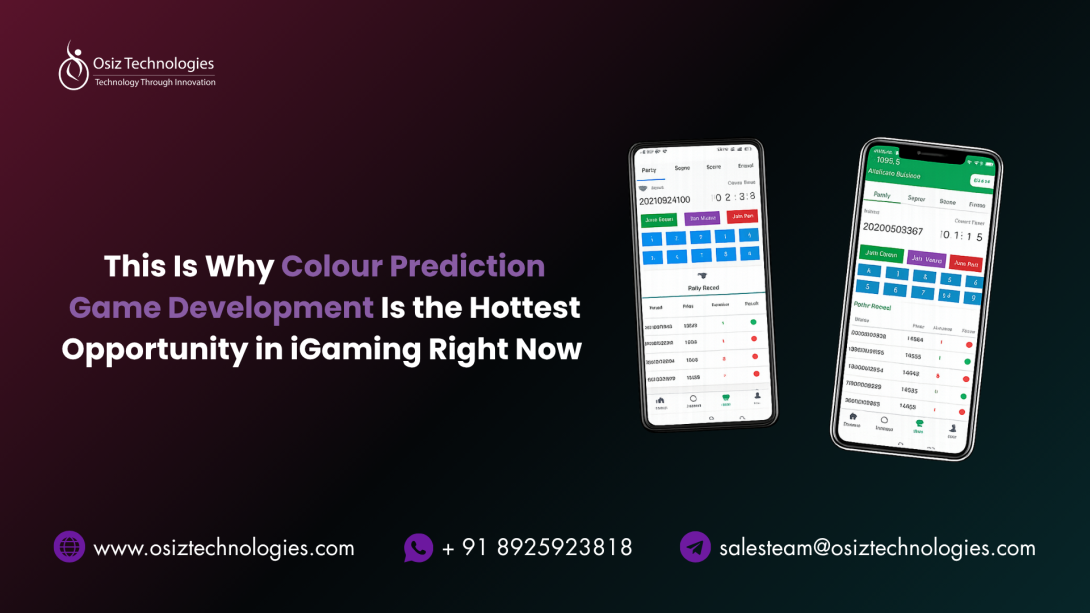
The global colour prediction game development market stands at $2.1 billion in 2026 - growing at 15% CAGR toward $5.6 billion by 2033. Inside an online gaming industry now worth over $321 billion, online colour prediction game development is producing one of the cleanest growth lines in the entire sector.
The opportunity gap is real. Sports betting and casino verticals are saturated. Real money colour prediction game development remains underpenetrated relative to its revenue potential - and most founders have not moved yet.
This post gives you what you need to act: the tech stack serious platforms run today, the features players stay for, the monetisation models generating consistent operator margins, and a market entry plan built for where the industry stands right now.
What Colour Prediction Games Actually Are - And Why They Dominate Mobile iGaming in 2026
Colour prediction game development sits at the most valuable overlap in digital gaming today - where casual mechanics meet real-money engagement.
The mechanic is deliberately simple. A player predicts which colour appears next, places a stake, and gets an instant result. The full cycle runs in under 10 seconds. That speed is the product.
Here is why this format wins with today's mobile audience:
Instant feedback loop: predict, result, reward, repeat. No loading screens, no complex rule sets to learn, no waiting rounds
Zero social pressure: results are aggregate, not competitive. Players engage without the leaderboard friction that pushes casual users away from skill-based formats
Casual feel, iGaming revenue: operators run real-money mechanics inside an experience players perceive as low-stakes entertainment. Session length and deposit frequency consistently outperform many traditional iGaming verticals
Colour prediction game app development leads adoption in Asia Pacific and Southeast Asia — markets where mobile-first users, dense payment infrastructure, and high gaming engagement intersect. North America is accelerating. The global infrastructure supporting these platforms is mature and fully operational today.
The Tech Stack Every Serious Colour Prediction Platform Runs in 2026
How to build a colour prediction game app: Layer a blockchain-verified provably fair RNG at the base, connect it to a real-time WebSocket backend, and deliver the front end through React Native or Flutter for full cross-platform coverage in a single codebase. That three-layer architecture is the production standard across every competitive colour prediction game platform today.
The best tech stack for colour prediction game development in 2026 breaks down as follows:
AI-generated dynamic content: top colour prediction game app development studios use AI to drive personalised round pacing, adaptive session variation, and content diversity without manual production overhead. Standard practice on competitive platforms today
Blockchain RNG: players verify individual round results independently. Blockchain makes that verification instant, transparent, and dispute-proof - directly reducing chargeback rates and building long-term platform trust
React Native / Flutter: single codebase, full iOS and Android output, faster deployment cycles, lower maintenance overhead. Cross-platform play across web, app, and mini-game formats is a standard player expectation today
WebSockets + Node.js: result delivery above 1.5 seconds measurably increases session abandonment. Sub-second latency is a retention variable, not a technical preference
HTML5 instant-play: browser-based access with zero download requirement. A direct acquisition advantage in markets where storage-conscious users avoid app installs
Micro-reward mechanics and social sharing integration are production features on every serious colour prediction game software build today. Both drive organic acquisition at near-zero cost per user - and players expect them.
Must-Have Features for a Colour Prediction Game That Retains Players in 2026
The colour prediction game features list 2026 is defined by what players already experience on leading platforms. Launching below this standard means competing against established operators with a weaker product.
Player-facing features:
Real-time animated result feed: sub-second latency, smooth result animation. The core product moment every session is built around. Execution here determines first-session retention
Multi-payment integration: UPI for India, crypto wallets for Southeast Asia and MENA, local payment methods per region. A player who cannot deposit in their preferred method does not deposit
Provably fair algorithm and player-visible: the provably fair colour prediction game standard means players verify individual round outcomes independently. Platforms that offer this convert and retain at measurably higher rates. It is also a direct trust signal that reduces regulatory friction
Daily bonus + referral loop: referral mechanics with immediate reward delivery consistently outperform traditional affiliate programmes for organic growth in mobile-first markets
Colour psychology-informed UX: hue selection, contrast ratios, and animation timing calibrated to player perception of fairness and excitement. Leading colour prediction game software treats UX as a retention tool, not an aesthetic choice
Operator-facing features:
Admin fraud detection dashboard: real-time flagging of suspicious betting patterns. Protects margin and satisfies compliance requirements across India, Southeast Asia, and MENA jurisdictions
How Operators Are Monetising Colour Prediction Apps in 2026
Real money colour prediction game development produces layered revenue - which is why operator margins remain predictable even at modest player volumes.
Revenue models operators run today:
House edge model: operator holds a fixed percentage of every round's total stake pool. No jackpot exposure, no variance risk, consistent daily revenue regardless of individual player outcomes.
VIP tiers + subscription passes: high-frequency players move into tiered programmes with faster withdrawals, higher stake limits, and exclusive round formats. Subscription passes for daily bonus access convert strongly in active markets today.
White label colour prediction game licensing: the fastest revenue path available. A white label colour prediction game delivers a tested codebase, operational payment integrations, and compliance documentation. Operators go from decision to live colour prediction game platform in weeks, not months.
Affiliate + social referral revenue: sharing mechanics built into the result feed turn players into acquisition channels. Cost per acquired user through referral consistently undercuts paid media in mobile-first markets.
The platform model is also expanding into B2B infrastructure licensing - established operators licensing their platform to regional entrants, creating a second revenue stream that scales with zero additional player acquisition cost.
How to Enter the Colour Prediction Game Market in 2026 - Your Action Plan
The colour prediction game development company you choose or the build path you take -is the single most consequential decision in your market entry.
Custom build vs white label - 2026 cost and time reality:
A custom build typically runs between $40,000 and $150,000+ with a time to market of 4 to 9 months, depending on feature depth, regional compliance requirements, and payment integration complexity. Operators who need speed choose a white label colour prediction game instead - costing $8,000 to $30,000 with a live platform in as little as 3 to 8 weeks. For most iGaming startups entering the market in 2026, the white label path delivers faster revenue without sacrificing platform quality. Get itemised quotes either way - not day-rate estimates.
Colour prediction game development cost in 2026 is driven by feature depth, payment integration complexity, and regional compliance requirements. Get itemised quotes, not day-rate estimates.
Region-specific compliance - 2026 status:
India: skill gaming vs chance classification is state-specific. Andhra Pradesh, Telangana, and Tamil Nadu maintain active restrictions. Legal counsel per state is non-negotiable before launch
Southeast Asia: PAGCOR (Philippines), MGA (Malta), and Curaçao licences are the three most operator-friendly frameworks active in the region today
MENA: crypto-native platforms operate where fiat-based real-money gaming faces structural restrictions. Licensing structure and payment architecture matter as much as geography
Asia Pacific leads global adoption. North America is the fastest-growing secondary market. Regulatory frameworks in both regions are stable and operator-navigable today.
5-point checklist - choosing the right colour prediction game development company:
- Can they show live platforms - not demos - with verifiable player traffic?
- Do they provide provably fair certification documentation - not just a verbal assurance?
- Is regional compliance support included in scope or billed separately?
- What does post-launch SLA look like in writing - response times, uptime guarantees?
- Do they have payment integration experience in your specific target market?
Conclusion:
The $2.1 billion market in 2026 is the floor, not the ceiling. At $5.6 billion by 2033, colour prediction game development carries a seven-year growth runway on infrastructure that is fully operational right now.
For colour prediction game development for iGaming startups, the case is clear. The mechanic is proven, the tech stack is defined, the monetisation models produce predictable margins, and the white label path puts operators live in weeks.
A provably fair colour prediction game, built on the right platform, launched in the right region, with the right compliance structure is a revenue-generating business today - not a future one. The founders who move now will be the operators competitors are trying to catch in 2028.
The colour prediction game development company you partner with determines how fast you move and how well protected you are when you get there. Choose on evidence.