

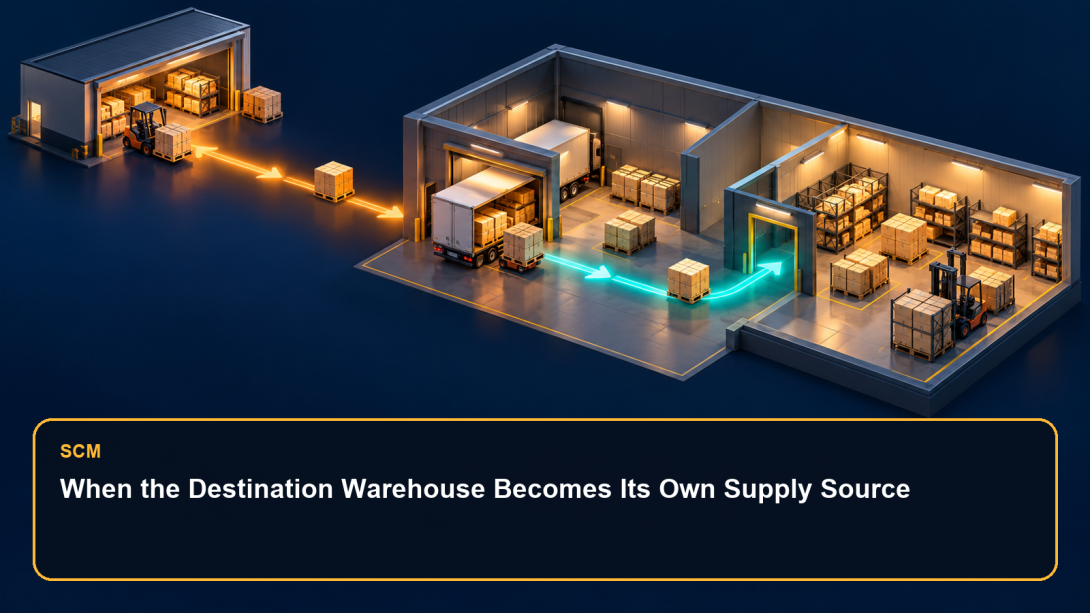
Picture a hospital inventory organization with a central storeroom and a smaller surgical supply area. The destination needs sterile kits urgently. This is a useful Fusion SCM Cloud Online Training case because another organization can transfer the kits, while stock may also exist inside the destination organization. The 26D capability has a narrow scope: it applies only to transfer supply requests created from Oracle Self Service Procurement inventory destination requisitions. Within that boundary, the task is to examine both paths while preserving the controls that make each movement valid.
One Request, Two Kinds of Movement
In this feature, an inventory destination requisition entered in Oracle Self Service Procurement expresses a need at a particular destination. Its transfer supply request can be satisfied through an interorganization movement, where material crosses organization boundaries, or an intraorganization movement, where material changes location within the same inventory organization. Those paths can serve the same demand, yet they are not interchangeable records. They use different source and destination context, and each must be supported by valid item and organization attributes before it can be recommended. Other replenishment requests are outside the stated scope.
The distinction matters most when physical distance disguises the data model. Two rooms on one campus may belong to separate inventory organizations, while two buildings farther apart may be subinventories of one organization. Users should therefore read the organization and subinventory values rather than infer the transaction type from a map. A short physical trip does not prove an internal move, and an internal move does not remove the need for controlled material handling.
Why the Destination Can Qualify as a Source
A destination organization is not automatically a usable source merely because it holds the item somewhere. Eligibility depends on the applicable item and organization setup. The requested item must be valid for the context, and the internal location must be capable of supplying the destination. This protects the requester from seeing a convenient but unusable option. It also turns item setup into part of the fulfillment decision rather than background master data that can be reviewed later.
Consider the surgical supply area requesting forty kits. The central storeroom in the same organization has sixty available, while a regional warehouse in another organization has hundreds. The internal quantity may reduce transport effort, but the recommendation must first pass the same basic validity logic. Quantity alone is not enough. Users should confirm the source identity, usable quantity, destination details, and required date before interpreting the option as the best operational answer.
Recommendation Order Is Not a Travel-Time Promise
The same-organization option can appear last in the recommendation list when it is eligible. That placement is easy to misunderstand. It does not by itself state that the stock is physically farthest away, slowest to move, or least economical. It reflects how the recommendation is presented. A requester still needs to compare availability and business context. List position should guide review, not replace judgment about the actual route and the required fulfillment time.
This creates a useful review habit: separate system eligibility from the final sourcing choice. First ask whether each candidate is valid. Then compare the date, quantity, transfer type, handling constraints, and local operating policy. If an internal source is selected simply because it sounds nearby, hidden constraints may surface later. If it is ignored simply because it appears last, a practical inventory option may be missed. Both errors begin when display order is treated as a complete decision.
The Setup Gate Behind the New Option
The capability depends on an opt-in that allows items to be transferred within the same organization for inventory destination requisitions. Without that gate, a team should not expect the destination organization to appear as an additional candidate. This makes environment readiness part of scenario testing. A test that checks only whether the requisition submits can pass while failing to prove that the intended recommendation scope is active.
Oracle 26D What's New explains that the destination organization is evaluated as an additional potential source while eligible sources from other organizations continue to be returned. A focused test should therefore use an item with known internal and external candidates. Capture the candidate set, verify the internal source is last when eligible, and confirm that established external priorities remain intact. That evidence is more useful than a screenshot showing one successful request with no controlled comparison.
A Safer Requester Decision Pattern
Start with the demand facts: item, destination, quantity, unit of measure, and required date. Next, inspect every recommended source and identify its transfer type. For an internal candidate, confirm the supplying subinventory and whether local material handling can complete the move on time. For an external candidate, review the source organization and transport implications. Record why the selected source fits the request, especially when the choice differs from the first visible recommendation.
The requester should also avoid consuming all internal stock without considering other nearby demand. An operating room may need forty kits now, but the central storeroom may be protecting an emergency buffer. The recommendation identifies an eligible source; it does not erase replenishment policy or clinical priority. A responsible choice combines system validity with the operational reason for preserving or moving stock. That boundary keeps automation useful without pretending every trade-off is encoded in one ranking.
Testing the Full Handoff
A complete test follows the request beyond source selection. Verify that submission creates the intended supply order and that the resulting movement uses the chosen internal or external context. Check the destination, quantity, unit, and dates again after creation. If the wrong transfer type appears downstream, return to the selected source and setup rather than editing symptoms in execution. The test should prove continuity from requisition through recommendation to the created movement.
Negative cases are equally revealing. Use an item that is invalid for the destination organization, remove available internal stock, or test without the opt-in in a controlled environment. The destination should not appear merely because it was expected. These cases demonstrate that eligibility rules are doing work. They also teach support teams to diagnose a missing recommendation through setup, item context, and availability instead of repeatedly recreating the requisition with slightly different wording.
Conclusion
A same-organization source adds flexibility, but only for the Self Service Procurement transfer requests covered by this capability, and it asks users to read recommendation context carefully. The durable approach is to distinguish internal from cross-organization movement, validate item and organization eligibility, interpret ranking cautiously, and verify the created transaction. Practitioners working through Oracle Fusion SCM Online Training can use that evidence chain to explain which source they selected, why it was valid, and how the downstream movement proves the decision. The sequence turns a convenient option into a controlled fulfillment choice.