

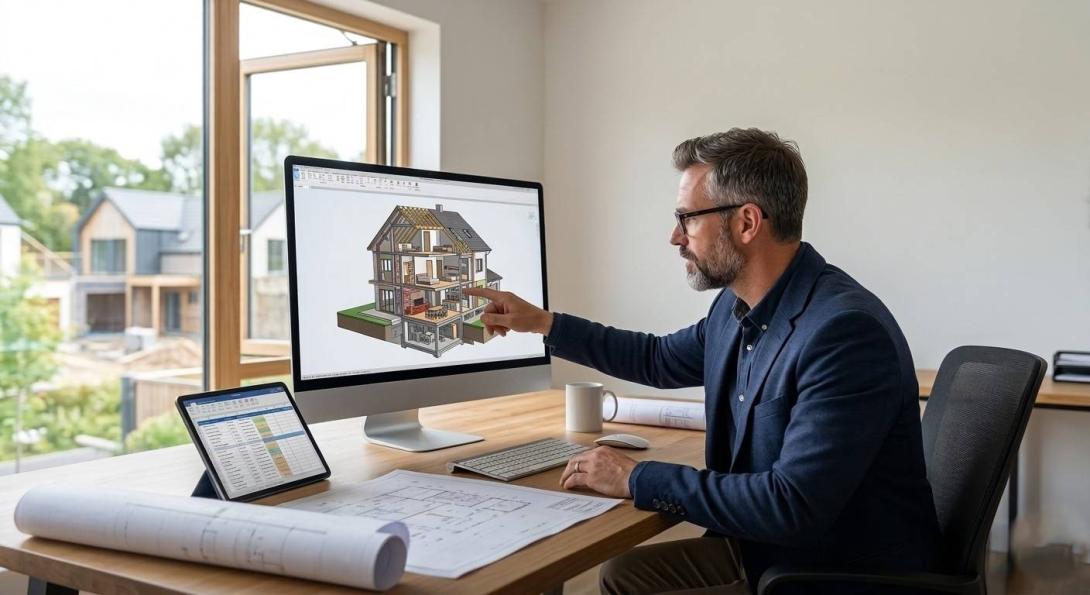
For decades, the residential design process followed a familiar, tedious drafting flat 2D lines, surviving endless revision loops, and hoping the client could somehow visualize the final product.
But the construction industry has evolved. Today’s deadlines are tighter, material costs are higher, and client expectations are off the charts. Yet, a stubborn myth still holds many residential architects back: the idea that Building Information Modeling (BIM) is only for skyscrapers and massive commercial complexes.
It’s time to put that myth to rest. Forward-thinking architects are realizing that BIM isn’t about the size of the project it’s about the efficiency of the workflow. Here is why you need to stop just drawing lines and start intelligently building residential models.
1. Design With Precision, Build Without Surprises
In traditional 2D drafting, catching a design flaw like an HVAC duct running straight through a load-bearing beam relies entirely on human oversight. Too often, these clashes aren't discovered until the contractor is standing on-site, halting construction and driving up costs.
BIM tools, such as Autodesk Revit, eliminate this guesswork.
- Automated Clash Detection: The software actively highlights interferences between architectural, structural, and MEP elements before a single brick is laid.
- Proactive Problem Solving: By catching errors in a digital environment, architects can focus on creative design rather than putting out expensive, real-world fires.
2. Create a Single Source of Truth for Your Team
A custom home is never built by one person; it requires flawless synchronization between architects, structural engineers, interior designers, and contractors. When you rely on static 2D files, version control quickly becomes a nightmare of endless email threads.
BIM introduces a Common Data Environment (CDE). Instead of working in silos, the entire project team collaborates on one centralized, live digital model. If the architect moves a load-bearing wall, the structural engineer’s view is instantly updated. Everyone stays on the exact same page, drastically reducing miscommunication and speeding up the timeline from concept to handover.
3. Sell the Vision, Not Just the Floor Plan
Let’s be honest: most homeowners cannot read a 2D floor plan. They will nod along during your presentation, but they struggle to grasp ceiling heights, natural light flow, or how a space will actually feel.
BIM transforms how you communicate with your clients. Instead of asking them to imagine the space, you can show them.
- Virtual Walkthroughs: Clients can explore fully realized 3D models of their future home.
- Faster Approvals: When clients understand exactly what they are getting, they are more confident. This builds immense trust and significantly cuts down on late-stage revision requests.
4. Turn Blueprints into Data-Rich Playbooks
A BIM model does much more than generate a beautiful 3D rendering it attaches critical, real-world data to every single element of your design.
In a BIM environment, a window isn’t just a rectangle drawn on a wall. It is an intelligent object containing data about its manufacturer, precise dimensions, thermal properties, and cost. This structured flow of information allows architects and builders to instantly generate highly accurate material take-offs, cost estimates, and construction schedules.
The architectural landscape is shifting. Continuing to rely solely on 2D drafting means leaving time, money, and client satisfaction on the table.
By adopting BIM for residential projects, you create a powerful value proposition: delivering highly accurate, clash-free designs, collaborating flawlessly with builders, and giving homeowners a crystal-clear vision of their dream home.