

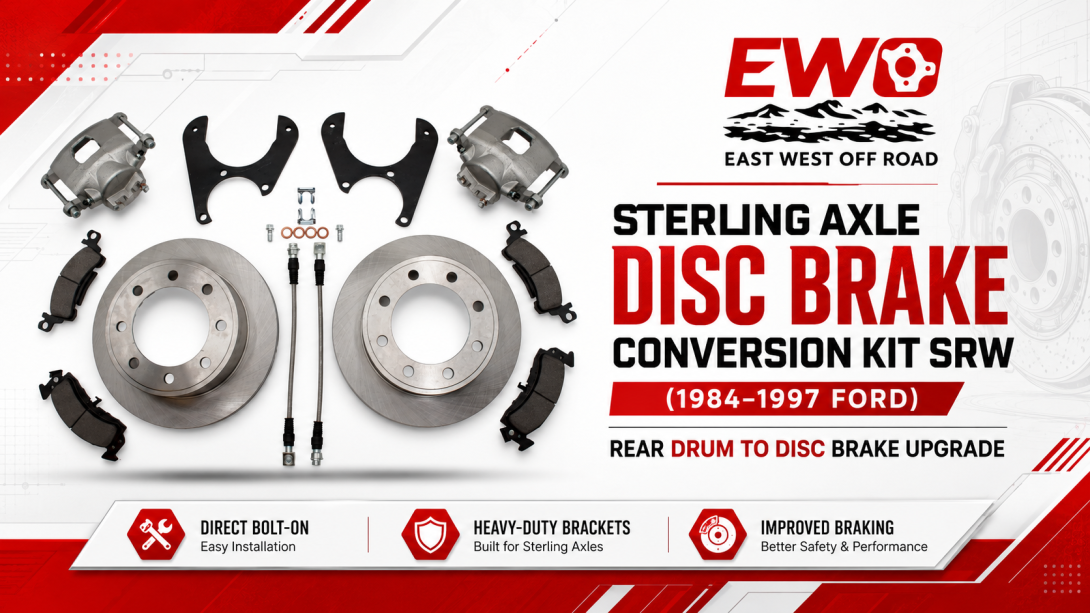
A sterling SRW brake upgrade is a practical way to modernize the rear braking system on a compatible 1984–1997 Ford Sterling Single Rear Wheel axle. For owners restoring an older F-Series truck, building a tow rig, upgrading an off-road project, or installing a Sterling axle into a custom chassis, replacing the original rear drum setup with a disc brake system can make routine inspection and servicing more straightforward.
The East West Off Road Sterling Axle Disc Brake Conversion Kit SRW is designed for the listed 1984–1997 Ford Sterling SRW application and gives buyers a dedicated path from rear drums to a rotor-and-caliper layout. The current kit also offers selectable parking-brake calipers and steel-braided brake hoses, allowing the conversion to be planned around the truck’s intended use.
What Does SRW Mean on a Ford Sterling Axle?
SRW means Single Rear Wheel.
An SRW truck has one rear wheel on each side of the axle.
This differs from a DRW, or Dual Rear Wheel, setup where two rear wheels are mounted on each side.
That distinction matters because SRW and DRW axles can differ in:
- Hub geometry
- Brake bracket offset
- Rotor position
- Wheel spacing
- Wheel clearance
- Mounting details
A brake conversion designed for an SRW axle should not automatically be installed on a dually axle simply because both are part of the Ford Sterling family.
Why Upgrade a Sterling SRW Rear Axle?
Many older Sterling axles were equipped with substantial rear drum brakes.
Those systems can work well when properly maintained, but owners often choose a disc conversion when rebuilding or modifying the truck.
Reasons include:
- Easier visual brake inspection
- Simpler pad servicing
- Modern rotor-and-caliper layout
- Easier access after trail use
- Restoration or restomod projects
- Axle swaps
- Tow-rig modernization
- Replacing aging drum hardware
- Building a custom rear axle package
A rear disc brake conversion truck project can also make sense when the original drums, wheel cylinders, shoes, springs, and adjusters all need replacement at the same time.
What Changes During a Drum-to-Disc Conversion?
A drum brake system typically uses:
- Brake drums
- Brake shoes
- Wheel cylinders
- Return springs
- Retainers
- Adjusters
A disc setup typically uses:
- Brake rotors
- Calipers
- Disc brake pads
- Caliper mounting brackets
- Brake hoses
- Hydraulic fittings
- Mounting hardware
A drum to disc brake conversion kit changes not only the friction components but also the way the rear brakes are mounted, inspected, serviced, and connected hydraulically.
Parking-brake operation may also change depending on the kit.
Why Disc Brakes Are Easier to Inspect
One of the biggest practical advantages of rear disc brakes is access.
With drum brakes, the friction material and much of the hardware are enclosed inside the drum.
With discs, you can usually see:
- Rotor condition
- Caliper condition
- Pad thickness
- Hose routing
- Fluid leaks
without disassembling the entire brake assembly.
That can be especially useful on work trucks and trail rigs that require frequent inspection.
Easier Routine Brake Service
Rear drum service can involve multiple springs, adjusters, retainers, and shoe components.
Disc brake service typically centers on:
- Pads
- Rotors
- Calipers
- Caliper hardware
- Brake hoses
That simpler component layout is one reason a sterling axle disc brake conversion kit can be attractive during a full rear axle rebuild.
Sterling 10.25 SRW Brake Upgrade
The Sterling 10.25 is one of the axle families most commonly associated with older Ford SRW brake conversions.
Current aftermarket kits commonly target the Sterling 10.25 full-float SRW axle used in older Ford 3/4-ton and 1-ton trucks. Some installation guides also distinguish between 1985–1992 and 1993–1997 variants, reinforcing the importance of identifying the exact axle generation before installation.
When shopping for a ford 10.25 disc brake kit, verify:
- Actual axle model
- SRW configuration
- Axle generation
- Lug pattern
- Hub arrangement
- Existing brake configuration
- Wheel size
- Parking-brake needs
Do Not Identify the Axle by Truck Year Alone
A truck’s original model year does not guarantee that its current rear axle is original.
Older Ford trucks are often modified.
A previous owner may have installed:
- A different Sterling axle
- A later axle
- Different hubs
- New wheels
- Custom suspension
- Modified brake hardware
For that reason, physically identify the axle before ordering parts.
This is one of the most important steps in any ford truck brake upgrade.
Sterling 10.25 vs. Sterling 10.5
Buyers often search for both:
- Ford 10.25 disc brake kit
- Ford 10.5 Sterling brake conversion
Although both belong to the Sterling family, they should not automatically be treated as interchangeable.
Differences can include:
- Hub design
- Rotor position
- Factory brake setup
- Lug pattern
- Bracket geometry
- Axle generation
The EWO product covered here is specifically positioned around its listed 1984–1997 Ford Sterling SRW application.
If your truck uses a later Sterling 10.5 or a swapped axle, verify fitment before ordering.
SRW vs. DRW Brake Conversions
Current aftermarket search results clearly separate SRW and DRW Sterling conversion kits. DRW kits can use different brackets, spacing, and installation methods, and some are specifically weld-on systems.
That means a SRW disc brake conversion should be selected specifically for the single-rear-wheel axle.
Do not buy based solely on:
- “Sterling”
- “10.25”
- Truck model
- Truck year
Verify the axle configuration itself.
Can a Sterling SRW Disc Conversion Improve Serviceability?
Yes, serviceability is one of the strongest reasons to make the change.
Disc brakes typically make it easier to inspect:
- Pad wear
- Rotor condition
- Calipers
- Brake hoses
- Leaks
This can be especially valuable on trucks that see:
- Frequent towing
- Off-road use
- Mud
- Water crossings
- Long trips
- Heavy-duty work
A sterling rear axle disc brakes setup can therefore offer maintenance advantages even when outright braking performance is not the only goal.
Does Rear Disc Conversion Automatically Mean Better Braking?
Not always.
A complete braking system includes:
- Front brakes
- Rear brakes
- Tires
- Master cylinder
- Brake booster
- Brake fluid
- Hydraulic lines
- Brake bias
- Vehicle weight
- Load distribution
A truck braking performance upgrade should be evaluated as a system.
Installing rear discs alone does not guarantee a specific stopping-distance improvement.
Heat Management and Disc Brakes
Brake systems turn vehicle motion into heat.
Disc brake rotors are exposed to airflow, which can help release heat during repeated braking.
This can be useful during:
- Towing
- Long downhill grades
- Trail driving
- Repeated stops
However, brake fade also depends on:
- Pad material
- Rotor size
- Brake fluid
- Vehicle weight
- Front/rear brake balance
A high performance brake kit truck setup should therefore be planned around the full vehicle.
Parking Brake Planning
Parking-brake capability is one of the most important factors in a rear disc conversion.
The current EWO product offers selectable parking-brake calipers.
That matters because not every hydraulic disc caliper has a mechanical parking-brake function.
A parking brake can be important for:
- Street use
- Parking on hills
- Work trucks
- Tow rigs
- Manual-transmission vehicles
- Inspection requirements
Plan this before installation rather than treating it as an afterthought.
Parking Brake Cable Compatibility
A parking-brake-capable caliper does not necessarily mean the stock Ford cable attaches directly.
Depending on the vehicle, the conversion may require:
- Cable adapters
- Custom cable length
- New brackets
- Modified routing
- Adjustment
Current competitor kits also treat emergency-brake calipers and cables as separate configuration decisions, which is another reason to plan the parking brake early.
Steel-Braided Brake Hose Option
The EWO Sterling SRW conversion also offers a steel-braided brake-hose option.
Flexible brake hoses must accommodate movement while carrying hydraulic pressure to the calipers.
When planning the hoses, check:
- Length
- Fittings
- Routing
- Suspension travel
- Abrasion points
- Wheel clearance
A braided hose is only useful when it is properly routed and protected.
Brake Hose Routing Matters
After installation, the hose should not:
- Rub against a wheel
- Contact the tire
- Stretch at full droop
- Get pinched under compression
- Touch a sharp edge
- Contact hot exhaust parts
Inspect the hose throughout the expected suspension travel.
Sterling SRW Brake Upgrade for Off-Road Trucks
A sterling SRW brake upgrade can make particular sense on an off-road build.
Trail driving can expose brakes to:
- Mud
- Water
- Sand
- Rocks
- Dirt
- Repeated heat cycles
An open rotor-and-caliper setup can be easier to inspect and clean after trail use.
That does not remove the need for regular maintenance.
Brake Conversion for Tow Rigs
Sterling axles are common under heavy Ford trucks that are used for towing.
If the truck regularly pulls a trailer, treat the conversion as part of a broader brake-system review.
Inspect:
- Front brakes
- Rear brakes
- Trailer brakes
- Brake controller
- Master cylinder
- Booster
- Brake fluid
- Tires
A heavy duty brake conversion kit cannot compensate for weak trailer brakes or worn front brakes.
Brake Bias After Conversion
Front and rear brakes need to work together correctly.
Changing rear brake hardware can affect the balance of the system.
Too much rear braking may encourage rear-wheel lockup.
Too little rear braking can leave the front axle doing too much work.
Brake balance depends on:
- Caliper piston area
- Rotor diameter
- Master cylinder
- Proportioning
- Vehicle weight distribution
- Tire traction
If the truck is heavily modified, have the completed system evaluated by a qualified brake professional.
Master Cylinder Considerations
A rear disc conversion does not automatically require a new master cylinder.
However, the existing unit still needs to work correctly with the completed system.
Consider:
- Bore size
- Caliper fluid volume
- Pedal travel
- Front brake setup
- Booster condition
If pedal travel changes dramatically after the conversion, identify the cause before driving normally.
Brake Booster Condition
The booster assists the driver in applying brake pressure.
A weak booster can cause:
- High pedal effort
- Poor brake assist
- Inconsistent feel
Make sure existing brake-system problems are corrected before evaluating the final behavior of the new rear discs.
Wheel and Caliper Clearance
Disc brake calipers occupy space differently than drums.
Before completing a rear axle brake conversion kit installation, verify:
- Wheel diameter
- Wheel barrel shape
- Wheel offset
- Backspacing
- Caliper clearance
- Rotor clearance
Never assume that wheel diameter alone guarantees fit.
Two wheels of the same nominal diameter can have different internal barrel shapes.
Lug Pattern and Hub Configuration
Older Sterling SRW axles can use different hub and wheel arrangements from later axles.
Confirm:
- Lug pattern
- Hub style
- Rotor mounting
- Wheel configuration
Competitor fitment information can help illustrate what to inspect, but another manufacturer’s exact lug-pattern or hub claims should not automatically be applied to the EWO product.
What to Inspect While the Drum Brakes Are Removed
A conversion is a good time to inspect the rest of the axle.
Check:
- Wheel bearings
- Bearing races
- Axle seals
- Wheel studs
- Hubs
- Brake lines
- Hose mounts
- Differential leaks
Repair any leaks before installing fresh friction components.
Why Axle Seal Leaks Matter
Gear oil or grease can contaminate brake pads and rotor surfaces.
That can reduce braking effectiveness.
If the original drum assembly shows contamination, correct the leak before completing the disc conversion.
Installation Planning
Before beginning your ford sterling disc brake conversion, complete these checks.
Confirm the Axle
Verify Sterling family, SRW configuration, and axle generation.
Verify Kit Contents
Make sure you have all required parts and options.
Plan the Parking Brake
Know whether you need parking-brake calipers or additional cable hardware.
Check Wheels
Verify caliper and rotor clearance.
Inspect Hydraulics
Check hard lines, hoses, master cylinder, booster, and fluid condition.
Review Instructions
Use the exact instructions for your kit.
Brake mounting hardware should never be improvised.
Caliper Bracket Alignment
Caliper brackets position the calipers relative to the rotors.
Incorrect bracket placement can lead to:
- Caliper interference
- Uneven pad contact
- Rotor rubbing
- Misalignment
Install brackets and spacers exactly as specified by the kit manufacturer.
Early vs. Late Sterling Axle Variations
Current Sterling 10.25 installation resources distinguish between earlier and later SRW axle versions, including differences in how the conversion brackets are spaced.
This matters because not every Sterling 10.25 uses identical installation geometry.
Identify the exact version before final assembly.
Caliper Orientation and Bleeding
The brake system must be properly bled after the hydraulic lines are opened.
Caliper orientation is critical because trapped air needs to reach the bleeder.
If the caliper is installed incorrectly, air may remain in the system and cause a soft pedal.
Before driving:
- Bleed the brakes
- Check fluid level
- Inspect for leaks
- Confirm a firm pedal
- Recheck hardware
Bedding New Brake Components
New pads and rotors may require a break-in or bedding procedure.
Follow the recommendations of the actual pad and rotor manufacturer.
Do not assume one universal bedding process applies to every component.
Is There a Weight-Savings Benefit?
Some aftermarket Sterling conversion companies advertise weight savings compared with original drum assemblies.
Those claims vary by kit and should not be automatically applied to another product.
Actual weight change depends on:
- Drums
- Hubs
- Rotors
- Calipers
- Brackets
- Hardware
If weight reduction is important, compare verified component weights.
Sterling SRW Brake Upgrade for Restorations
A brake conversion can fit well into a restomod, but it may not be right for every restoration.
Keep the Factory Drums When:
- Originality is the main priority
- The factory system is complete
- Replacement components are readily available
- The truck is being restored to stock specification
Consider Rear Discs When:
- Serviceability matters more than originality
- The truck is being modified anyway
- The drum system needs major rebuilding
- The axle is part of a custom project
- The truck sees regular trail or work use
What to Look for in a Heavy-Duty Conversion Kit
When comparing products, evaluate:
- Exact axle fitment
- SRW compatibility
- Kit contents
- Rotor and caliper setup
- Parking-brake option
- Brake hoses
- Wheel clearance
- Replacement parts
- Installation requirements
- Manufacturer support
Avoid selecting a conversion solely based on price.
Replacement Parts Matter Long-Term
Pads, rotors, hoses, and calipers are wear components.
Before purchasing, determine whether replacement parts can be sourced later.
This is especially important for a work truck or trail rig that may remain in service for many years.
Why Choose the East West Off Road Sterling SRW Kit?
For owners considering a rear disc brake conversion kit, the EWO product is positioned specifically around the listed 1984–1997 Ford Sterling SRW application.
Current product positioning includes:
- 1984–1997 Ford Sterling application
- SRW-focused fitment
- Rear drum-to-disc conversion
- Optional parking-brake calipers
- Optional steel-braided brake hoses
That gives buyers a dedicated starting point for upgrading an older Sterling SRW rear axle.
Before-You-Buy Checklist
Before ordering, confirm:
- Actual Sterling axle
- SRW configuration
- Axle generation
- Lug pattern
- Hub arrangement
- Wheel clearance
- Parking-brake needs
- Brake hose choice
- Hydraulic system condition
- Master-cylinder condition
- Booster condition
- Front brake condition
- Installation requirements
The older and more modified the truck is, the more important physical verification becomes.
Final Thoughts
A sterling SRW brake upgrade can modernize the rear brake system on a compatible older Ford Sterling axle while making routine brake inspection and servicing more accessible.
For the right 1984–1997 SRW application, converting from drums to discs can make sense for:
- Restorations
- Restomods
- Trail trucks
- Tow rigs
- Work trucks
- Custom axle swaps
The East West Off Road Sterling Axle Disc Brake Conversion Kit SRW provides a dedicated rear drum-to-disc option with configurable parking-brake and brake-hose upgrades.
The most important step is fitment verification.
Identify the axle, confirm SRW configuration, inspect the hubs and wheels, plan the parking brake, and evaluate the complete hydraulic system before installation.
A successful brake upgrade is not simply about replacing drums with rotors—it is about building a rear brake system that works correctly with the entire truck.
Frequently Asked Questions (FAQs)
What is a sterling SRW brake upgrade?
It is an upgrade to the braking system on a Ford Sterling Single Rear Wheel axle. In this application, it typically means converting the original rear drum setup to disc brakes.
What does SRW mean?
SRW means Single Rear Wheel, with one rear wheel mounted on each side of the axle.
What years is the EWO Sterling SRW kit designed for?
The product is listed for 1984–1997 Ford Sterling SRW applications.
Is this commonly used on a Sterling 10.25?
The Sterling 10.25 SRW axle is a common rear disc conversion application in older Ford trucks. Confirm exact EWO compatibility before ordering.
Will an SRW kit fit a DRW axle?
Do not assume so. DRW axles may require different brackets, spacing, hubs, and wheel-clearance solutions.
What is the main benefit of converting rear drums to discs?
Common advantages include easier visual inspection, simpler pad servicing, easier cleaning, and modernization of the rear brake system.
Does a rear disc conversion guarantee shorter stopping distances?
No. Overall braking depends on the complete system, including tires, front brakes, hydraulic components, brake balance, and vehicle weight.
Does EWO offer parking-brake calipers?
Yes. Parking-brake calipers are offered as a selectable option on the current product configuration.
Are steel-braided brake hoses available?
Yes. The EWO product also offers steel-braided hoses as an option.
Do I need to modify the parking-brake cable?
Possibly. Cable requirements depend on the truck and selected caliper setup.
Do I need a new master cylinder?
Not necessarily. The correct master cylinder depends on the final brake-system configuration.
Do I need to bleed the brakes after installation?
Yes. Any time the hydraulic brake system is opened, it must be properly bled before driving.
Will my existing wheels fit?
That depends on wheel diameter, barrel shape, offset, backspacing, rotor size, and caliper location.
Is this upgrade suitable for off-road use?
It can be attractive for off-road builds because disc brake components are relatively accessible for inspection and cleaning.
Is a Sterling SRW disc conversion useful for towing?
It can be part of a broader tow-rig brake upgrade, but front brakes, trailer brakes, hydraulic condition, tires, and vehicle load also need to be considered.
How do I know which Sterling axle I have?
Inspect the axle physically, including housing, hubs, lug pattern, current brake configuration, and identifying tags or markings where available.
Are all Sterling 10.25 axles the same?
No. Current installation resources distinguish between different SRW axle generations, so specific installation details can vary.
What should I inspect while doing the conversion?
Inspect wheel bearings, seals, hubs, wheel studs, brake lines, hoses, and any axle leaks.
Can leaking gear oil affect the new brakes?
Yes. Gear oil can contaminate brake pads and rotor surfaces. Repair axle-seal leaks before completing the brake installation.
Should I rebuild the drums or convert to discs?
Rebuild the drums when originality is important and the factory system suits your needs. Consider discs when easier servicing, modernization, or custom-build requirements are higher priorities.
Where can I buy the EWO Sterling SRW disc brake kit?
The East West Off Road Sterling Axle Disc Brake Conversion Kit SRW is available through the Buy Now link at the top of this guide.