
The global Luxury Electric Vehicle Market is experiencing significant growth as consumers increasingly prefer premium vehicles that combine advanced technology, high performance, comfort, and sustainable mobility. Luxury electric vehicles (EVs) offer features such as long driving ranges, sophisticated infotainment systems, advanced driver-assistance technologies, and innovative interior designs. Growing environmental awareness and the expansion of electric vehicle charging infrastructure are also encouraging consumers to consider luxury electric mobility.
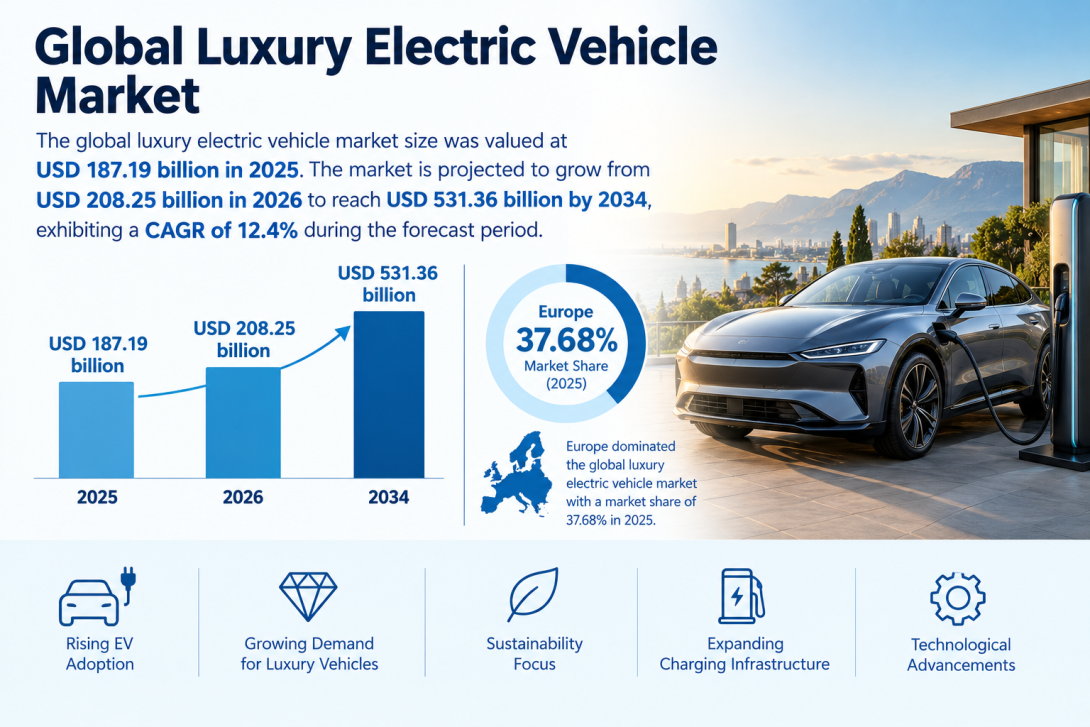
According to Fortune Business Insights, the global luxury electric vehicle market size was valued at USD 187.19 billion in 2025. The market is projected to grow from USD 208.25 billion in 2026 to USD 531.36 billion by 2034, exhibiting a compound annual growth rate (CAGR) of 12.4% during the forecast period. Europe dominated the market in 2025, accounting for a share of 37.68%. Increasing demand for premium electric cars, technological advancements, and supportive government policies are expected to contribute to the market's expansion.
Growing Demand for Premium Electric Mobility
The rising preference for premium electric mobility is a major factor supporting the Luxury Electric Vehicle Market. High-income consumers are increasingly interested in vehicles that deliver both luxury and environmental benefits. Electric powertrains offer smooth acceleration, reduced operating noise, and fewer routine maintenance requirements associated with conventional internal combustion engines.
Automakers are expanding their electric vehicle portfolios to address these preferences. Premium electric sedans, sport utility vehicles (SUVs), and performance-oriented models are attracting consumers seeking a combination of comfort, innovation, and driving performance. The introduction of new vehicle platforms and improved battery systems is expected to strengthen demand over the coming years.
Technological Advancements Driving Market Growth
Technological innovation plays an important role in the development of luxury electric vehicles. Improvements in battery chemistry, energy management systems, and vehicle aerodynamics are helping manufacturers enhance driving range and overall efficiency. Faster charging capabilities are also becoming an important consideration for consumers evaluating premium electric vehicles.
Advanced digital technologies are further differentiating luxury EVs from traditional vehicles. Features such as connected infotainment, over-the-air software updates, intelligent navigation, automated parking assistance, and advanced driver-assistance systems are improving the driving experience. Manufacturers that integrate these technologies while maintaining safety, reliability, and user-friendly interfaces may gain a competitive advantage.
For detailed market insights : https://www.fortunebusinessinsights.com/luxury-electric-vehicle-market-116504
Battery Type and Driving Range Considerations
Battery performance is a critical factor influencing the Luxury Electric Vehicle Market. Lithium-ion batteries remain widely used because of their energy density, established manufacturing ecosystem, and suitability for passenger electric vehicles. Continued research into battery materials and thermal management is intended to improve performance, durability, and charging efficiency.
Driving range also affects purchasing decisions, particularly among consumers who travel long distances. Luxury EV manufacturers are investing in battery optimization and efficient vehicle architectures to address range concerns. The availability of reliable charging networks and faster charging stations will remain important for encouraging wider adoption.
Vehicle Type Analysis
The Luxury Electric Vehicle Market includes several vehicle categories, with sedans, SUVs, and other body styles serving different consumer requirements.
Luxury electric sedans appeal to consumers seeking refined styling, comfortable interiors, smooth driving performance, and advanced onboard technologies. These vehicles are particularly relevant for executive transportation and personal mobility.
Luxury electric SUVs attract buyers who prioritize cabin space, versatility, elevated seating positions, and passenger comfort. Their suitability for family use and long-distance travel supports demand across premium automotive segments.
Other luxury electric vehicles, including performance-focused and specialized models, address consumers interested in distinctive designs and high-performance driving. Continued product diversification is expected to expand the range of available options.
Distribution Channel Analysis
The distribution of luxury electric vehicles is evolving as manufacturers adopt digital platforms and customer-focused retail strategies. Traditional dealerships continue to provide test drives, vehicle servicing, financing assistance, and personalized customer support.
Online sales channels are also becoming more relevant, allowing consumers to explore vehicle specifications, compare models, customize configurations, and initiate purchases digitally. Some manufacturers combine online purchasing with physical showrooms and delivery centers. This integrated approach can improve convenience while preserving the personalized experience expected in the luxury automotive segment.
Regional Analysis
Europe dominated the Luxury Electric Vehicle Market in 2025, accounting for 37.68% of the global market. The region benefits from established premium automotive manufacturers, growing consumer interest in electric mobility, and policies supporting vehicle electrification. Charging infrastructure development and the availability of premium electric models also contribute to regional demand.
North America represents an important market due to consumer interest in advanced automotive technologies, high-performance vehicles, and premium SUVs. Charging network expansion and improvements in battery performance may support further adoption.
Asia Pacific offers considerable growth opportunities because of its large automotive market, expanding electric vehicle manufacturing capabilities, and rising demand for premium mobility solutions. Technological development and increasing availability of luxury electric models may strengthen regional growth.
Other markets, including South America and the Middle East & Africa, may experience gradual expansion as charging infrastructure, vehicle availability, and consumer awareness improve.
Competitive Landscape
The Luxury Electric Vehicle Market is characterized by competition involving vehicle performance, battery range, charging speed, design, software capabilities, safety features, and brand positioning. Manufacturers are investing in research and development to improve electric powertrains, introduce new models, and differentiate their offerings.
Competition is also increasing around digital services, connected vehicle platforms, battery efficiency, and ownership experience. Companies that balance premium features with dependable performance and competitive operating costs may be better positioned to attract customers. Strategic investments in charging partnerships and battery technology are also expected to influence the competitive environment.
Challenges Facing the Luxury Electric Vehicle Market
Despite strong growth prospects, the market faces several challenges. High vehicle prices can limit adoption among consumers who are not prepared to pay a premium for electric mobility. Battery production costs, raw material availability, and charging infrastructure gaps may also affect market development.
Battery replacement expenses, charging time, and uncertainty about long-term resale values can influence purchasing decisions. Addressing these concerns through technological improvements, transparent ownership costs, and wider charging availability will be important for sustaining demand.
Get Free Sample PDF: https://www.fortunebusinessinsights.com/enquiry/request-sample-pdf/luxury-electric-vehicle-market-116504
Future Outlook
The global Luxury Electric Vehicle Market is expected to experience substantial growth through 2034 as consumers increasingly prioritize advanced technology, premium comfort, and sustainable transportation. According to Fortune Business Insights, the market is projected to increase from USD 208.25 billion in 2026 to USD 531.36 billion by 2034, registering a CAGR of 12.4% during the forecast period.
Future market opportunities will depend on battery innovation, charging infrastructure expansion, software development, and the introduction of vehicles that meet diverse consumer preferences. Europe is expected to remain an important market, while North America and Asia Pacific offer opportunities for further adoption. As manufacturers address affordability, driving range, and charging convenience, luxury electric vehicles are likely to play an increasingly important role in the transformation of the global premium automotive industry.
Related Reports
Uncover Japan’s Market Trends - Explore the Latest - Luxury Electric Vehicle Market - Insights