

A Jeep JK tie rod and drag link kit is an essential upgrade to consider when your Wrangler's factory steering components are worn, damaged, or no longer suited to the demands of your off-road build. Whether you're driving a lifted Jeep Wrangler JK through challenging trails or using a four-door JKU for daily commuting and weekend adventures, your steering linkage plays a critical role in maintaining precise steering control and dependable front-end performance.
The original steering system was engineered for the vehicle's factory configuration. As you add larger tires, suspension lifts, aftermarket wheels, and off-road accessories, steering loads and component-clearance requirements can change significantly.
That's why many Jeep owners choose to replace both the tie rod and drag link with a complete heavy-duty steering system rather than upgrading individual parts separately.
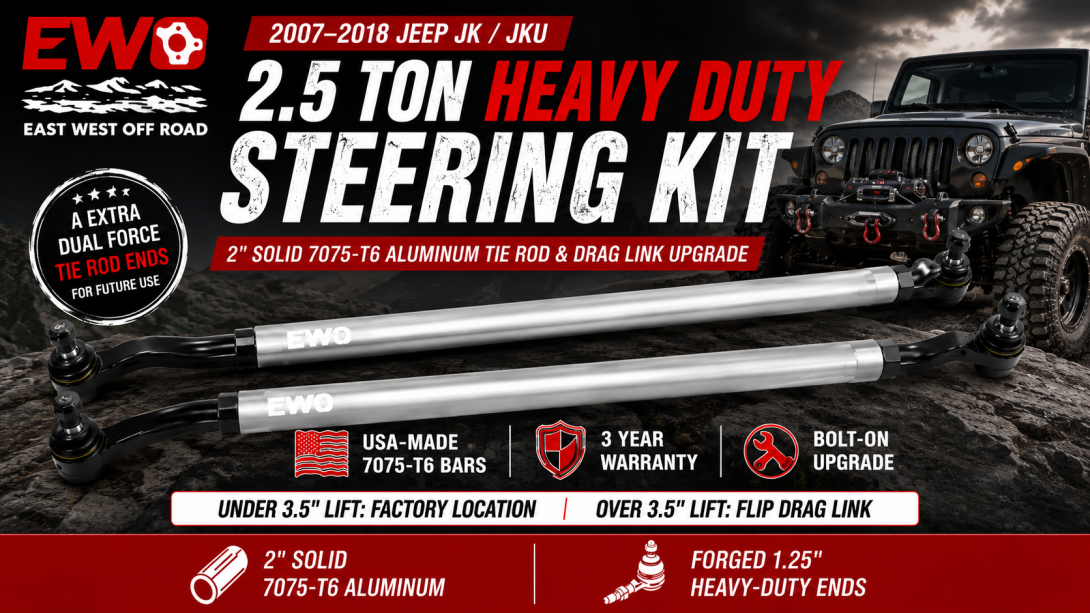
The East West Off Road 2.5 Ton Jeep JK / JKU Heavy Duty 7075 Aluminum Tie Rod & Drag Link Steering Kit for 2007–2018 is designed for Wrangler owners seeking an upgraded steering linkage package with multiple configuration options.
In this comprehensive guide, we'll explain how a tie rod and drag link work, when replacement makes sense, how 7075 aluminum compares with conventional steering materials, what to consider for lifted Jeeps, and how to choose the right setup for your vehicle.
What Is a Jeep JK Tie Rod and Drag Link Kit?
A Jeep JK tie rod and drag link kit replaces the two primary steering links that connect the steering system to the front wheels.
Both components serve different purposes, but they work together to translate steering-wheel movement into directional control.
What Does the Tie Rod Do?
The tie rod connects the left and right steering knuckles, helping both front wheels turn together.
It also plays an important role in maintaining the vehicle's front-wheel toe setting.
On a stock Jeep JK, the tie rod is positioned where it may be exposed to rocks, trail obstacles, and road debris.
When drivers install oversized tires or regularly drive across uneven terrain, impacts and additional steering loads can place greater demands on this component.
A heavy-duty tie rod is intended to provide a more robust steering-link alternative for compatible modified vehicles.
What Does the Drag Link Do?
The drag link transfers movement from the pitman arm, which is connected to the steering box, toward the passenger-side steering knuckle.
While the tie rod coordinates the movement of the two front wheels, the drag link delivers steering input.
This makes the drag link particularly important when considering suspension lift height and steering geometry.
An improperly configured drag link can contribute to undesirable steering behavior, even if the component itself is relatively strong.
Why Replace Both Steering Links Together?
Replacing both components as a matched system can simplify planning for a complete steering upgrade.
A comprehensive steering-linkage replacement offers several potential advantages:
- Addresses both primary steering links instead of leaving one older component in service.
- Allows buyers to select a system designed around their vehicle's modifications.
- Provides an opportunity to inspect and service steering-end connections.
- Helps avoid mixing components with incompatible threads, tapers, or adjustment methods.
- Supports a more complete front-end inspection and alignment process.
If you're planning a Jeep JK steering linkage upgrade, evaluating the tie rod and drag link together is a sensible starting point.
How to Know When Your Jeep JK Needs a New Tie Rod and Drag Link
A replacement steering kit should be selected based on the condition of the existing components and the demands of the vehicle.
Not every Wrangler needs a heavy-duty steering system, and steering symptoms should be diagnosed before purchasing parts.
1. Loose or Unresponsive Steering
If your Wrangler feels vague or requires frequent steering-wheel corrections, worn steering joints may be contributing to the problem.
Excessive movement at the tie rod ends or drag link connections can affect steering response.
However, similar symptoms can result from other front-end components, including the track bar, ball joints, steering box, or suspension bushings.
2. Visible Damage to the Factory Tie Rod
A tie rod that has been bent by trail contact may change the vehicle's toe setting.
This can lead to uneven tire wear or steering that no longer feels correct.
Any visibly damaged steering linkage should be inspected before the vehicle returns to normal use.
3. Worn or Damaged Steering Ends
Tie rod ends use articulated joints to allow steering movement.
Over time, those joints may experience wear or develop excessive play.
Damaged dust boots can also allow contamination to enter the joint.
Replacing worn steering ends may be sufficient in some situations. However, if the complete linkage is damaged or you are preparing for a larger build, a matched replacement kit may be more practical.
4. Larger Tires and More Demanding Terrain
A steering kit for Jeep JK running larger tires is a common consideration among owners moving to more aggressive wheel-and-tire packages.
Larger tires can introduce additional steering loads, particularly when maneuvering through difficult off-road obstacles.
The actual demands depend on tire construction, wheel offset, vehicle weight, terrain, and driving technique.
5. Suspension Lift and Steering Geometry Changes
A lifted Jeep JK steering kit must account for more than component strength.
Suspension lifts change the relationship between steering and suspension components.
When selecting a replacement drag link, the mounting location and relationship to the track bar become important factors.
The correct setup can help preserve suitable steering geometry for a particular lift configuration.
Why Jeep Owners Choose a 2.5-Ton Steering Upgrade
Aftermarket manufacturers frequently describe upgraded steering systems using terms such as "1-ton" and "2.5-ton."
These terms generally identify product categories and steering-component designs. They do not represent a standardized payload or towing rating.
A 2.5 ton Jeep steering kit is typically marketed toward owners seeking more substantial steering components for modified vehicles.
Common applications include:
- Jeeps running larger-than-stock tires.
- Vehicles equipped with aftermarket suspension lifts.
- Rock crawlers exposed to rough terrain and steering-link impacts.
- Trail vehicles with additional armor and accessories.
- JK and JKU builds undergoing a complete front-end upgrade.
The exact bar dimensions, steering-end construction, and installation requirements vary among manufacturers.
For that reason, buyers should evaluate the documented specifications rather than relying on the "2.5-ton" designation alone.
What Does a Complete 2.5-Ton Kit Typically Replace?
Component
Purpose
Why It Matters
Tie rod
Connects the front steering knuckles
Coordinates wheel movement and affects toe
Drag link
Transfers input from the steering box
Controls steering input and steering-wheel centering
Steering ends
Connect linkage to mounting points
Permit necessary articulation
Adjustment hardware
Secures adjusted linkage dimensions
Helps maintain the intended setup
Installation hardware
Connects the system to the vehicle
Must match the application and manufacturer's requirements
Always inspect the actual contents of a specific kit. Not every manufacturer includes the same steering ends, brackets, clamps, or mounting components.
Why 7075 Aluminum Is Popular for Jeep JK Steering Links
One feature that attracts attention in premium Wrangler steering systems is the use of 7075 aluminum.
A 7075 aluminum tie rod Jeep JK application combines a high-strength aluminum alloy with a steering-link design intended for demanding use.
Strength-to-Weight Characteristics
7075 aluminum offers high strength relative to its weight compared with many conventional aluminum alloys.
This makes it useful for appropriately engineered components where both material strength and weight are important.
However, an aluminum bar should not be judged by the alloy name alone.
Its dimensions, design, material condition, and connections all influence performance.
How Aluminum Responds to Trail Impacts
Some aftermarket steering manufacturers highlight the ability of properly designed aluminum steering bars to elastically deflect under load.
Elastic deformation means the material can temporarily change shape and return toward its original form once the load is removed.
This behavior has limits.
A severe impact can still cause permanent deformation or component failure.
Descriptions such as "memory metal" should not be interpreted to mean that an aluminum tie rod is indestructible.
Aluminum vs. Steel Steering Components
Consideration
7075 Aluminum
Conventional Steel
Weight
Generally lighter for comparable dimensions
Generally heavier for comparable dimensions
Strength
Depends on alloy, temper, and design
Depends on steel grade and construction
Corrosion
Does not develop red rust like carbon steel
May require protective finishes
Trail impact behavior
Depends on bar geometry and applied force
Depends on material, wall thickness, and design
Common aftermarket use
Heavy-duty aluminum steering systems
OEM and heavy-duty steel steering systems
The right material choice depends on the complete steering system and the demands of the vehicle.
For Jeep JK owners comparing premium steering parts, compatibility and proven engineering should take priority over material-related marketing claims.
East West Off Road Jeep JK / JKU 2.5-Ton Steering Kit
The East West Off Road 2.5 Ton Jeep JK / JKU Heavy Duty 7075 Aluminum Tie Rod & Drag Link Steering Kit for 2007–2018 offers a complete steering-linkage upgrade option for compatible JK and JKU applications.
Product Specifications
Feature
Product Details
Product Name
2.5 Ton Jeep JK / JKU Heavy Duty Steering Kit
Brand
East West Off Road
Item Number
E35115
Vehicle Application
2007–2018 Jeep Wrangler JK / JKU
Steering Link Material
7075 aluminum
Main Steering Components
Tie rod and drag link
Factory-Location Option
Under the knuckle
Flip Configuration
Over the knuckle
Factory-Location Lift Range
3.50 inches or less
Flip-Kit Lift Range
Over 3.50 inches
Extra Steering Ends
Product imagery advertises four extra Dual Force tie rod ends
For Jeep owners shopping for a 2.5 ton Jeep steering kit, this EWO kit provides a product option worth evaluating alongside your vehicle's axle, suspension, and wheel setup.
Why the Steering Configuration Matters
One of the most useful details of the EWO kit is the ability to choose a steering configuration based on lift height.
Instead of treating every Wrangler as having identical steering geometry, the product listing distinguishes between a factory-location arrangement and a flipped drag link.
That distinction is important because selecting a suitable mounting configuration is a central part of a successful steering upgrade.
Factory-Location vs. Flip Drag Link for Jeep JK
Choosing between under-the-knuckle and over-the-knuckle steering is an important step when ordering a Jeep JK drag link kit.
Your decision should be based on the vehicle's actual configuration, not simply the appearance of the components.
Factory Location / Under the Knuckle
East West Off Road lists the factory-location configuration for vehicles with 3.50 inches of lift or less.
This arrangement retains a lower drag link mounting position in the factory-style location.
It is generally the first option to evaluate for a stock-height Wrangler or one with a moderate lift within the manufacturer's recommended range.
However, fitment still depends on the vehicle's specific steering knuckles and suspension components.
Flip Kit / Over the Knuckle
The EWO flip configuration is listed for vehicles with more than 3.50 inches of lift.
An over-the-knuckle drag link arrangement relocates the drag link connection to a higher mounting position when the compatible steering setup is installed.
This configuration may be part of maintaining suitable steering geometry on a more heavily lifted Wrangler.
It is important to understand that a drag link flip may require additional components or steering-knuckle modifications.
A properly configured track bar arrangement is particularly important.
The drag link and track bar should work together through suspension travel to avoid introducing excessive unwanted steering movement.
Which Option Is Right for Your Jeep?
Vehicle Setup
EWO Option to Evaluate
Additional Considerations
Stock-height JK
Factory Location
Axle and wheel clearance
JK with up to 3.50-inch lift
Factory Location
Joint articulation and steering geometry
JK with over 3.50-inch lift
Flip Kit
Track bar relationship and required modifications
JKU with custom suspension
Verify configuration with EWO
Actual lift height and mounting locations
JK with aftermarket axle
Confirm before ordering
Knuckles, tapers, and steering linkage compatibility
Important: A different brand's lift-height recommendations or installation instructions should not be substituted for the requirements of the EWO product.
Does This Tie Rod and Drag Link Kit Fit Stock Dana 30 or Dana 44 Axles?
Many owners searching for a Jeep JK Dana 30 steering kit or a Jeep JK Dana 44 steering kit want to know whether an aftermarket system will fit their existing axle.
That is an important question because the steering knuckles and mounting points determine how the linkage connects to the front axle.
Stock Axle Considerations
Some Wrangler JK configurations use a Dana 30 front axle, while certain models use a Dana 44.
Before selecting a steering kit, confirm the exact axle and steering-knuckle arrangement on your vehicle.
A product advertised for the JK/JKU platform should not be assumed to fit every possible factory and aftermarket axle configuration.
Aftermarket Axles and Steering Knuckles
If your Wrangler has been modified with replacement axles, aftermarket knuckles, or a custom steering system, the fitment requirements may be different.
Check the mounting tapers, drag link connection, tie rod clearance, and compatibility with the rest of the suspension.
When in doubt, contact the manufacturer with your specific axle details.
Wheel and Brake Clearance
Larger steering ends can occupy more space than factory parts.
Before installation, verify clearance around:
- Wheel barrels and wheel weights.
- Brake calipers and nearby brake hardware.
- Steering knuckles.
- Differential covers.
- Track bar brackets.
- Steering stabilizer mounts.
- Suspension components at full steering lock.
Clearance needs to be checked throughout the expected range of steering and suspension movement.
Do not assume that aftermarket wheels or spacers will automatically be necessary—or that the factory wheels will definitely clear—without confirming the actual dimensions.
Tie Rod Ends: A Critical Part of the Steering System
A heavy-duty steering bar is only as useful as the complete assembly's ability to connect and articulate correctly.
The tie rod ends and drag link ends must match the steering knuckles and accommodate the required movement.
What Makes a Heavy-Duty Steering End Different?
Some aftermarket systems advertise larger threaded ends, forged housings, or specialized alloy-steel ball studs.
These details can help buyers compare different steering designs.
However, specifications such as forged 1.25-inch tie rod ends, 4130 chromoly, or 4340 hardened ball studs are not universal across all 2.5-ton systems.
They should not be attributed to a specific product without confirmation.
Why Spare Steering Ends Can Be Useful
Steering ends contain moving joint surfaces and protective boots.
Over time, joint wear or damaged boots may require replacement.
Having compatible service parts available can be helpful for an owner who regularly drives in remote locations or maintains a heavily modified trail vehicle.
The EWO E35115 product imagery advertises four extra Dual Force tie rod ends.
Before purchasing, confirm the current package contents and whether those replacements match your chosen steering configuration.
Jeep JK Steering Upgrade for Lifted Wranglers
A heavy-duty tie rod and drag link kit becomes especially relevant when your Jeep has a suspension lift.
However, installing larger steering components does not automatically correct every geometry issue created by lifting the vehicle.
Why Steering Geometry Matters
As the front suspension moves, the axle follows a path controlled by the suspension links and track bar.
The drag link follows its own movement path.
If the steering and suspension geometry are mismatched, suspension movement may cause unwanted changes in steering direction.
This behavior is commonly known as bump steer.
Choosing a compatible drag link location can be part of addressing these concerns.
What About Drop Pitman Arms?
A drop pitman arm is sometimes used in modified steering systems, but it is not a universal solution for every lifted Jeep JK.
Changing the pitman arm can affect the relationship between the drag link and track bar.
Before using one, confirm that it is appropriate for the complete suspension and steering configuration.
Does a Steering Stabilizer Fix Steering Geometry?
No.
A steering stabilizer can help damp certain steering movements, but it does not replace proper alignment, secure steering joints, or correctly matched suspension geometry.
If your Wrangler has steering problems, the underlying mechanical causes should be diagnosed first.
How to Choose a Jeep JK Tie Rod Replacement Kit
Not every Jeep owner needs the same steering upgrade.
Some drivers simply need to replace worn stock components, while others are building a Wrangler for challenging off-road terrain.
A useful purchasing decision starts with evaluating the actual vehicle.
For a Daily-Driven Wrangler JK
A daily-driven Wrangler needs predictable steering response and reliable road manners.
If the factory components are worn, replacing them with correctly matched parts is the priority.
A heavy-duty steering system can be considered, but it should not introduce clearance problems or compromised geometry.
For a Lifted Jeep JKU
A four-door Wrangler Unlimited may carry additional equipment and see regular use on highways and trails.
The right Jeep Wrangler JKU tie rod kit should match the suspension height, axle setup, and intended driving conditions.
A lift alone is not enough information to determine the correct configuration.
For a Rock-Crawling Build
Rock crawling places greater emphasis on component exposure, steering loads, articulation, and serviceability.
Drivers preparing a Wrangler for rocks and difficult trail obstacles may prefer a complete heavy-duty linkage system over a basic factory-style replacement.
The rest of the front end must be suitable for the same conditions.
Steering Kit Buying Checklist
Question
Why It Matters
Is my Jeep a JK/JKU?
Prevents ordering parts for a different Wrangler generation
What front axle do I have?
Determines steering-knuckle and mounting compatibility
How much actual lift does the vehicle have?
Helps select factory-location or flip steering
What wheels and tires am I running?
Affects clearance and steering demands
Are the existing joints worn?
Identifies replacement and inspection needs
Do I have a modified track bar?
Relevant to steering geometry
Is my steering stabilizer compatible?
May affect clamp and mounting choices
Are replacement ends available?
Supports future servicing
What installation work is required?
Helps estimate the complete project cost
Installation Considerations for a Jeep JK Tie Rod and Drag Link Kit
A steering-linkage replacement should be performed according to the specific manufacturer's instructions.
Because these components directly affect vehicle control, installation should be handled by someone qualified to work on automotive steering systems.
Inspect Before Removing the Existing Components
Inspect the tie rod, drag link, track bar, ball joints, mounting points, wheel bearings, and suspension bushings.
A new steering kit cannot compensate for worn or loose components elsewhere in the front end.
Confirm the Correct Configuration
Before installing the replacement components, verify the steering ends, mounting locations, adjustment hardware, and required clearances.
For a flip configuration, confirm any additional track bar or steering-knuckle requirements.
Never assume the instructions for one manufacturer's kit apply to another.
Set Toe and Center the Steering Wheel
The tie rod is involved in setting front-wheel toe.
The drag link is involved in centering the steering wheel.
After installing the steering linkage, the vehicle should receive an appropriate professional alignment and front-end inspection.
The technician should verify that the steering moves smoothly, the hardware is secured to the manufacturer's specified requirements, and the components do not interfere with each other.
Verify Clearance Before Driving
Check the steering system through its operating range.
The tie rod and drag link should not contact nearby components at full steering lock or during the suspension's intended movement.
After installation, follow the manufacturer's recommendations for reinspection.
Will a New Tie Rod and Drag Link Fix Jeep Death Wobble?
Death wobble is a severe oscillation that can affect solid-front-axle vehicles when certain steering, suspension, or tire-related conditions are present.
Loose or worn tie rod ends may contribute to the problem, but they are not the only possible cause.
Potential contributors include:
- Worn track bar joints or bushings.
- Loose track bar mounting hardware.
- Damaged ball joints.
- Worn steering linkage.
- Suspension bushing movement.
- Wheel or tire problems.
- Incorrect alignment or steering geometry.
Replacing damaged steering components can be part of the repair.
However, buying a heavy-duty kit without diagnosing the front end may leave the original cause unresolved.
If your Wrangler experiences severe shaking, have the entire steering and suspension system professionally inspected.
How Much Does a Jeep JK Tie Rod and Drag Link Kit Cost?
Pricing depends on the manufacturer, material, included steering ends, steering configuration, and any additional hardware.
A complete aluminum steering upgrade may cost more than a basic factory-style replacement, but the purchase price should not be the only deciding factor.
When comparing options, consider:
- Tie rod and drag link construction.
- Quality and serviceability of steering ends.
- Applicable axle and lift configurations.
- Included installation hardware.
- Additional brackets or clamps.
- Professional installation and alignment.
- Warranty terms and replacement-part availability.
The EWO product listing should be checked for current pricing and availability because online prices and promotions can change.
Think Beyond the Initial Purchase
A steering kit that needs extra mounting components or modifications may have a higher total installed cost than the product price suggests.
Conversely, purchasing a complete compatible system may simplify a planned replacement compared with sourcing unrelated components individually.
The best value comes from choosing the correct system for the Jeep, not simply the product with the largest advertised steering bars.
Where to Buy a Jeep JK Tie Rod and Drag Link Kit
If you're looking for a Jeep JK heavy duty steering kit for sale, the East West Off Road E35115 is an option to consider for compatible 2007–2018 Wrangler JK and JKU builds.
Its 7075 aluminum tie rod and drag link package is offered with factory-location and flip steering configurations based on lift height.
Before purchasing, confirm your vehicle's model year, axle type, lift height, wheels, and steering mounting requirements.
You can Shop Jeep JKU tie rod and drag link kit options directly through East West Off Road and select the configuration appropriate for your build.
Whether your Wrangler is a weekend trail vehicle or a daily driver with larger tires, properly matched steering components are essential to a dependable upgrade.
Frequently Asked Questions (FAQs)
1. What does a Jeep JK tie rod and drag link kit include?
A complete kit generally includes a replacement tie rod, drag link, and compatible steering ends. Exact hardware and accessories vary by manufacturer. Check the specific product listing for current package contents.
2. Will this steering kit fit a 2007–2018 Jeep Wrangler JK?
The EWO E35115 is advertised for 2007–2018 Jeep Wrangler JK and JKU applications. Exact compatibility still depends on the axle, steering knuckles, suspension, wheels, and any modifications.
3. Is the Jeep JK tie rod and drag link kit compatible with a four-door JKU?
EWO lists its 2.5-ton steering kit for both JK and JKU applications. Confirm the configuration for your specific Wrangler Unlimited before ordering.
4. What is the difference between the tie rod and the drag link?
The tie rod connects the front steering knuckles and influences toe alignment. The drag link transfers steering input from the pitman arm toward the front axle.
5. Is a 2.5-ton steering kit stronger than a factory steering system?
A 2.5-ton aftermarket kit is generally marketed as a heavy-duty upgrade, but actual performance depends on the complete design, material, steering ends, and installation. The designation is not a standardized strength rating.
6. Is 7075 aluminum better than steel for Jeep steering?
7075 aluminum offers high strength relative to its weight and can be useful in properly engineered steering links. Steel also has advantages in suitable designs. The best option depends on the complete steering assembly and application.
7. Can I install a heavy-duty tie rod with a factory drag link?
Some aftermarket components can be combined with factory systems, but compatibility must be confirmed. A complete matched steering kit is often easier to evaluate when both links are being upgraded.
8. When should I replace my Jeep JK tie rod?
Consider inspection and replacement if the tie rod is bent, damaged, or fitted with worn steering ends. A qualified technician should determine whether individual repairs or complete replacement are appropriate.
9. When should I replace the drag link?
A drag link may require replacement if it is damaged or if its joints show excessive wear. A new drag link may also be needed when changing to a compatible upgraded steering configuration.
10. What is the difference between an under-the-knuckle and over-the-knuckle drag link?
An under-the-knuckle arrangement uses the lower knuckle mounting location. An over-the-knuckle arrangement relocates the drag link connection to a higher location when the steering system is configured for it.
11. Which steering configuration should I choose for a lifted Jeep JK?
EWO lists the factory-location option for 3.50 inches of lift or less and the flip option for lifts over 3.50 inches. Verify the complete steering and track bar arrangement before purchasing.
12. Do I need a track bar bracket with a drag link flip?
A flip configuration may require a compatible raised track bar mounting arrangement to maintain appropriate geometry. Check the requirements for the exact steering kit and suspension.
13. Will this kit work with a Dana 30 or Dana 44 front axle?
The EWO kit is advertised for the JK/JKU platform, but exact compatibility with your Dana 30, Dana 44, or aftermarket axle configuration should be confirmed before ordering.
14. Does the EWO kit include extra tie rod ends?
The current EWO product imagery advertises four extra Dual Force tie rod ends. Verify the latest included parts and their compatibility when purchasing.
15. Does the EWO steering kit use 7075-T6 aluminum?
The product listing identifies the steering-link material as 7075 aluminum. Buyers who specifically require confirmation of the T6 temper should contact EWO before ordering.
16. Does this steering kit fit a Jeep JK with 35-inch or 37-inch tires?
A heavy-duty steering kit may be suitable for a Jeep with larger tires, but tire size alone does not establish compatibility. Axle configuration, suspension, wheel clearance, and steering geometry also matter.
17. Can a new tie rod and drag link eliminate death wobble?
Not always. Worn steering linkage may contribute to severe front-end oscillation, but other components may also be involved. The entire front end must be diagnosed.
18. Do I need an alignment after replacing my Jeep JK tie rod and drag link?
Yes. Toe adjustment, steering-wheel centering, and overall front-end inspection should be performed after installing replacement steering linkage.
19. Can I use my factory steering stabilizer with the upgraded kit?
Compatibility depends on the steering bar dimensions, clamps, brackets, and mounting layout. Verify the stabilizer arrangement before installation.
20. Is a heavy-duty steering kit worth buying for a daily-driven Jeep JK?
It may be worthwhile for a modified daily driver or one with worn factory linkage. The deciding factors should be correct fitment, steering geometry, component condition, and installation quality rather than the heavy-duty label alone.
Final Thoughts: Upgrade Your Jeep JK Steering With Confidence
Choosing the right Jeep JK tie rod and drag link kit is about more than installing larger steering components.
A dependable upgrade starts with understanding how the tie rod and drag link work, inspecting the vehicle's existing front-end components, and confirming compatibility with its axle, suspension, wheels, and tires.
For owners of compatible 2007–2018 Jeep Wrangler JK and JKU vehicles, the East West Off Road 2.5-ton 7075 aluminum steering kit offers an option for upgrading both primary steering links together.
The choice between factory-location and flipped steering should be made carefully, with particular attention to lift height and steering geometry.
With the right parts, proper installation, and professional alignment, a steering-linkage upgrade can be a valuable part of preparing your Wrangler for everyday driving and demanding off-road adventures.