

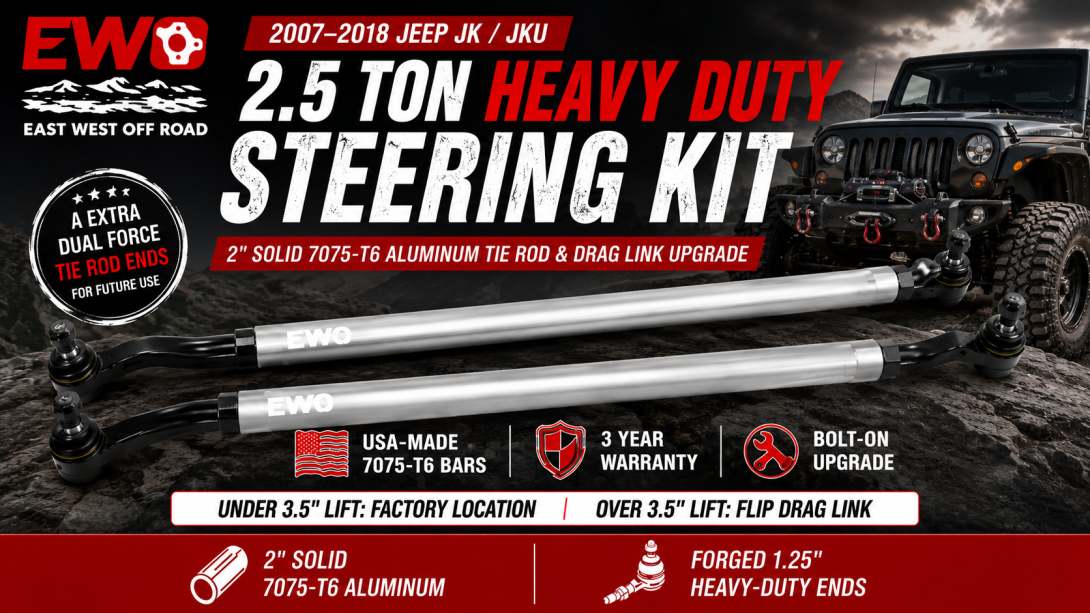
A Jeep JK tie rod and drag link kit is an important upgrade to consider when your Wrangler's steering linkage is worn, damaged, or no longer suited to the demands of your build. Whether you drive a two-door Jeep Wrangler JK or a four-door JKU, the steering system needs to respond consistently on the highway, during daily driving, and on challenging off-road terrain.
For 2007–2018 Jeep Wrangler owners, upgrading the tie rod and drag link together can provide a coordinated approach to replacing the factory steering linkage. This is particularly relevant for Jeeps equipped with larger tires, suspension lifts, aftermarket axles, or other modifications that change the demands placed on steering components.
However, choosing a heavy-duty steering kit involves more than selecting the thickest steering bars available. You need to understand how the parts work, when replacement is necessary, which materials are available, and how the kit interacts with your vehicle's suspension geometry.
This guide explains those decisions and introduces the East West Off Road 2.5 Ton Jeep JK / JKU Heavy Duty 7075 Aluminum Tie Rod & Drag Link Steering Kit for 2007–2018 applications.
Understanding the Jeep JK Steering Linkage System
The steering linkage connects driver input to the front wheels. Two major components in this system are the tie rod and drag link.
Although these parts work together, they perform different mechanical functions.
What Does the Tie Rod Do?
The tie rod connects the steering knuckles and helps both front wheels turn together.
It also plays an important role in maintaining proper front-wheel toe alignment.
When a tie rod becomes bent, damaged, or develops excessive joint movement, steering alignment and handling may be affected.
Off-road impacts can place substantial loads on steering linkage components, especially when a Wrangler encounters rocks, ruts, or obstacles.
A Jeep JK tie rod replacement kit may be appropriate when the existing tie rod is damaged or its joints have reached the end of their service life.
However, determining whether the complete tie rod assembly needs replacement requires a proper front-end inspection.
What Does the Drag Link Do?
The drag link transfers steering movement from the pitman arm to the steering knuckle.
When the driver turns the steering wheel, the drag link helps translate that input into wheel movement.
Wear, damage, or excessive movement in drag-link joints can contribute to imprecise steering response.
A heavy duty drag link Jeep Wrangler owners consider purchasing should be compatible with the vehicle's steering geometry, front axle, and suspension configuration.
Replacing a drag link without accounting for lift height and related components can lead to additional fitment or geometry problems.
Why Do These Components Need to Work Together?
The tie rod coordinates movement between the front wheels, while the drag link transfers steering input.
If one component is upgraded while the other remains worn or damaged, the steering system may still exhibit unwanted movement or inconsistent response.
A complete steering linkage replacement allows both components to be evaluated together.
That does not mean every Jeep needs both parts replaced simultaneously. It means the decision should be based on the condition and compatibility of the entire steering system.
Signs Your Jeep JK May Need Tie Rod or Drag Link Replacement
Steering problems can develop gradually or appear after a particularly difficult off-road trip.
Recognizing potential symptoms helps you determine when a professional inspection is necessary.
1. Excessive Steering Play
If you notice unusually large steering-wheel movement before the front wheels respond, worn steering linkage joints may be one possible cause.
Excessive play can also originate elsewhere, including the steering box and other front-end components.
A technician should inspect the system rather than assuming the tie rod is responsible.
2. Steering Wander on the Highway
A Wrangler that requires frequent steering corrections may have an alignment problem, worn linkage components, tire-related issues, or other suspension concerns.
Installing a new Jeep JK steering linkage upgrade without identifying the underlying cause may not resolve the problem.
3. Visible Tie Rod Damage
A tie rod can suffer direct impacts during trail driving.
If an impact leaves the bar visibly bent or damages its ends, the affected components should be inspected before continued operation.
Do not assume a damaged steering component is safe simply because the Jeep can still be driven.
4. Loose or Worn Steering Joints
Tie rod ends and drag-link joints can develop excessive movement through wear or damage.
Signs may include unusual looseness, damaged dust boots, or grease leakage, depending on joint design.
A qualified mechanic can determine whether a joint has reached an unsafe condition.
5. Steering Vibration or Shimmy
Vibration through the steering wheel deserves attention, especially when it becomes more noticeable after hitting road irregularities.
However, vibration has many possible causes.
Wheel balance, tires, track-bar connections, alignment, ball joints, and other front-end components should all be evaluated.
Important: A new tie rod and drag link kit is not a guaranteed repair for death wobble or other steering instability.
Should You Replace the Tie Rod Only or Upgrade the Complete Kit?
This is one of the most common purchasing questions among Wrangler JK owners.
A tie rod-only repair may make sense if professional inspection identifies damage limited to that assembly.
A complete kit may be more practical when both major steering links need replacement or when a modified Jeep requires a coordinated linkage upgrade.
Consideration
Tie Rod Only
Complete Tie Rod & Drag Link Kit
Primary purpose
Replaces the tie rod assembly
Addresses both major steering links
Best application
Localized tie rod damage or wear
Broader steering linkage replacement
Drag link included
No
Yes, when specified in the kit
Compatibility review
Tie rod and related components
Entire linkage and suspension geometry
Installation considerations
Toe adjustment and inspection
Toe adjustment, steering-wheel centering, and inspection
Purchase decision
Based on condition of existing drag link
Based on condition and compatibility of both links
For Jeep owners planning a comprehensive upgrade, a complete Jeep JK tie rod and drag link kit offers a starting point for evaluating both components as one package.
The final choice should depend on the vehicle's condition, existing modifications, and confirmed product specifications.
Why Consider a 2.5 Ton Heavy-Duty Jeep Steering Kit?
The term 2.5 ton Jeep steering kit is commonly used in the aftermarket steering industry to describe certain heavy-duty steering product lines.
It does not mean the Jeep gains an additional 2.5 tons of load capacity.
It also does not establish a universal strength rating across manufacturers.
Different steering kits may use different materials, bar dimensions, joint configurations, and manufacturing processes.
For a Jeep JK used on rocky trails, the main goal is to select linkage components designed for the intended vehicle application and operating conditions.
Heavy-Duty Construction
Heavy-duty steering kits may use larger-diameter links, upgraded joints, or alternative materials compared with certain factory components.
However, bar size alone does not determine whether a steering system is suitable for a particular Jeep.
Joint design, mounting geometry, material selection, adjustment capability, and clearance are equally important.
Upgrading Both Major Links
A complete steering kit can provide an opportunity to replace worn factory linkage and evaluate compatible components together.
It is especially useful for owners already planning significant steering or suspension modifications.
Long-Term Service Considerations
Steering components should be evaluated for replacement-part availability, maintenance requirements, and compatibility with future modifications.
A product may appear attractive based on its initial purchase price, but replacement joints and service support also matter.
What Makes 7075 Aluminum Relevant to Jeep JK Steering?
Owners comparing steering upgrades frequently encounter products advertised with 7075 aluminum steering bars.
7075 is a high-strength aluminum alloy family used in a variety of demanding applications.
For a 7075 aluminum tie rod Jeep JK upgrade, the suitability of the material depends on how the actual steering link has been engineered.
Bar dimensions, temper, geometry, threaded connections, and joint design all affect the complete assembly.
Aluminum vs. Steel Steering Links
Both aluminum and steel can be used in aftermarket steering systems.
The differences extend beyond simple comparisons of weight or bar diameter.
Some aluminum steering bars are designed with controlled elastic behavior under certain loads. Steel steering assemblies may use tubing or solid-bar constructions with different mechanical characteristics.
Neither material should automatically be considered superior for every vehicle and off-road application.
Compare manufacturer-documented specifications for the exact kits you are considering.
Does 7075 Mean 7075-T6?
Not automatically.
7075 identifies the alloy family, while T6 identifies a specific heat-treatment condition.
If a product description states only “7075 aluminum,” buyers should not assume the material is 7075-T6 without additional documentation.
This is particularly important when comparing a 7075-T6 aluminum steering kit with other aftermarket options.
Jeep JK vs. Jeep JKU: What Buyers Should Know
The 2007–2018 Wrangler JK includes both two-door and four-door Unlimited models.
The basic steering-system functions are similar, but vehicle modifications can change compatibility requirements.
A Jeep Wrangler JKU tie rod kit should be selected based on more than body style alone.
Consider the actual axle, steering knuckles, suspension lift, and wheel configuration.
Front Axle Compatibility
Wrangler JK models may use different factory front axle configurations, and modified Jeeps may have aftermarket axles or steering knuckles.
Before ordering a steering kit, identify whether the Jeep has its original front axle or a modified setup.
Do not assume a kit marketed for Dana 30 and Dana 44 applications automatically fits every replacement axle housing or knuckle configuration.
Suspension Lift
Suspension lift height can affect steering geometry and the suitability of different drag-link mounting configurations.
A kit described as a factory-location option may serve a different application than an over-the-knuckle or flip drag-link arrangement.
Wheel and Tire Clearance
Larger steering components can introduce clearance considerations near wheels, tires, differential covers, sway-bar mounts, and steering stabilizers.
The available space should be checked throughout the steering range and suspension travel.
Factory-Location vs. Flip Drag-Link Configuration
Choosing the correct drag-link mounting position is one of the most important parts of a Jeep Wrangler JK steering upgrade.
Factory-Location Drag Link
A factory-location configuration generally maintains the original drag-link mounting arrangement.
It may be suitable for certain stock-height and lifted applications, depending on the specific product.
The appropriate lift-height range must come from the manufacturer's instructions for that kit.
Flip Drag-Link Configuration
A flip or over-the-knuckle drag-link configuration changes the connection location at the steering knuckle.
This arrangement is often considered on taller suspension lifts, but it may require coordinated changes to track-bar mounting geometry.
A flip drag link should not be treated as a standalone solution to steering or bump-steer problems.
The drag link and track bar must be evaluated as a system.
Which Configuration Should You Choose?
Before selecting either option, confirm:
- Your Jeep's actual suspension lift height
- Existing front axle and steering knuckles
- Current drag-link attachment location
- Track-bar mounting configuration
- Wheel, tire, and suspension clearance
- Manufacturer installation requirements
Never rely on a universal lift-height cutoff when choosing between steering configurations from different manufacturers.
How to Compare Heavy-Duty Steering Kit Options
When shopping online, several kits may appear similar because they target the same vehicle.
A meaningful comparison should focus on the actual components supplied and the requirements for installation.
Compare Bar Specifications
Review advertised material, construction, dimensions, and any documented finishing or treatment process.
Avoid assuming that two products use the same materials simply because their marketing descriptions share keywords.
Compare Tie Rod Ends
Heavy duty tie rod ends Jeep JK products may use different joint designs, threading arrangements, and service procedures.
Look for documented replacement-part numbers and confirm whether the joints are serviceable.
If a supplier advertises forged joints, specific chromoly grades, or hardened ball studs, those details should be supported by product-specific information.
Compare Mounting Options
Some kits provide multiple steering configurations.
Others are designed for a specific mounting arrangement.
Make sure the chosen option fits the actual suspension and steering setup.
Compare Total Installation Cost
The purchase price is only one part of the overall upgrade.
Professional labor, alignment, optional hardware, replacement components, and required steering-geometry corrections can affect the final cost.
That is why a lower advertised kit price does not necessarily mean a lower installed cost.
Introducing the East West Off Road 2.5 Ton Jeep JK/JKU Steering Kit
East West Off Road offers a product listed as:
2.5 Ton Jeep JK / JKU Heavy Duty 7075 Aluminum Tie Rod & Drag Link Steering Kit for 2007–2018
This product is aimed at Wrangler JK and JKU owners seeking a heavy-duty aluminum steering linkage upgrade.
The product name identifies three important purchasing considerations:
Vehicle application: 2007–2018 Wrangler JK/JKU
Steering components: Tie rod and drag link
Advertised material: 7075 aluminum
Before ordering, review the current product page and confirm your required mounting configuration, included joints and hardware, axle compatibility, and any additional installation requirements.
If you are ready to evaluate a 2.5 ton Jeep steering kit, the East West Off Road listing provides a dedicated starting point for your 2007–2018 Wrangler build.
Installation and Alignment: What Happens After Purchase?
Replacing major steering linkage components requires careful installation and verification.
The exact procedure depends on the selected product and vehicle configuration.
Inspect the Existing Front End
Before replacing the tie rod and drag link, a qualified technician should inspect surrounding suspension and steering components.
Potential wear elsewhere can affect the performance of a newly installed linkage system.
Follow Product-Specific Installation Instructions
Use the manufacturer's current installation documentation and specified hardware.
Correct fastener tightening procedures, thread engagement, joint orientation, and clearance checks are essential.
Do not apply generic torque values taken from a different steering kit.
Perform a Professional Alignment
Steering linkage replacement typically requires alignment work.
The tie rod affects toe adjustment, while the drag link affects steering-wheel centering.
The technician should also verify that the steering linkage does not bind or contact surrounding components.
Inspect the System After Initial Use
Follow the manufacturer's recommended inspection and maintenance schedule.
For vehicles used off-road, periodic inspection becomes especially important because steering components may experience direct impacts.
Common Buying Mistakes to Avoid
Selecting a complete steering kit is easier when you know which mistakes can cause problems.
Buying Based Only on Tire Size
Tire diameter matters, but so do wheel offset, axle configuration, suspension travel, and steering geometry.
A kit should not be selected based solely on a statement such as “fits Jeeps with 37-inch tires.”
Assuming Every 2.5 Ton Kit Is Identical
Products marketed as 2.5 ton kits can differ significantly in material, geometry, and included hardware.
Compare verified specifications, not just naming conventions.
Ignoring the Track Bar
Changes to drag-link mounting geometry may need to be coordinated with track-bar geometry.
Ignoring that relationship can create handling problems.
Treating a Steering Upgrade as a Guaranteed Repair
A new kit cannot automatically fix every vibration, wobble, wandering, or alignment problem.
Diagnose the front end before ordering replacement components.
Ordering Without Confirming the Package Contents
Confirm exactly what is included.
Do not assume a specific warranty, stabilizer clamp, extra tie rod ends, replacement boots, or installation hardware is supplied unless stated in the current listing.
Is a Complete Jeep JK Steering Upgrade Worth Considering?
A complete steering linkage upgrade may make sense when the existing components are worn, damaged, incompatible with planned modifications, or otherwise inadequate for the intended application.
For a mostly stock daily-driven Wrangler, a properly selected replacement assembly may be sufficient.
For a modified Jeep that regularly encounters rough trails, a heavy-duty steering system can be worth evaluating as part of a broader front-end plan.
The decision should be based on actual vehicle requirements, documented product specifications, and professional installation considerations.
An upgraded kit is not a substitute for regular inspection, proper alignment, or safe driving practices.
Final Thoughts: Choose a Steering Kit That Fits Your Build
A Jeep JK tie rod and drag link kit is more than a collection of replacement steering bars.
It is a critical part of the front-end steering system, and its compatibility can affect alignment, handling, and overall vehicle safety.
Before ordering, understand the condition of your existing linkage, verify the front axle and suspension setup, compare material and joint specifications, and confirm installation requirements.
For Wrangler owners considering a complete 2007–2018 steering upgrade, the East West Off Road 7075 aluminum package is one option to review.
Explore the Jeep Wrangler JK steering upgrade and confirm the appropriate configuration before purchasing.
Frequently Asked Questions (FAQs)
What Is Included in a Jeep JK Tie Rod and Drag Link Kit?
A complete kit generally includes the two major steering linkage assemblies: the tie rod and drag link. Depending on the manufacturer and product configuration, it may also include rod ends, fasteners, or optional accessories.
Always confirm the exact contents on the current product page.
What Is the Difference Between a Jeep JK Tie Rod and a Drag Link?
The tie rod connects the front steering knuckles and helps coordinate wheel movement.
The drag link transfers steering input from the pitman arm toward the steering knuckle.
Both are important components of the steering system, but they perform different functions.
Will a 2.5 Ton Steering Kit Fit a 2007–2018 Jeep Wrangler JKU?
Some aftermarket 2.5 ton steering kits are marketed for both JK and JKU applications.
However, compatibility depends on the specific product, axle configuration, lift, steering knuckles, and other modifications.
Confirm fitment with the supplier before ordering.
Is a 7075 Aluminum Tie Rod Better Than a Steel Tie Rod?
Neither material is automatically better for every build.
The design, construction, geometry, joint interfaces, and intended operating conditions are all important.
Compare the exact manufacturer specifications rather than relying on material names alone.
Can a Heavy-Duty Tie Rod and Drag Link Kit Fix Death Wobble?
Not necessarily.
Death wobble and other steering instability can involve multiple front-end components.
Replacing worn or damaged steering linkage may be part of a repair, but a complete diagnosis is essential.
Do I Need a Flip Drag Link on My Lifted Jeep JK?
That depends on the specific suspension and steering configuration.
Some lifted applications use a factory-location drag link, while others require a properly engineered flip arrangement.
Any change should account for the track bar and the manufacturer's installation requirements.
Can I Install a Jeep JK Steering Kit Without Professional Help?
Installation requirements vary by product and vehicle modifications.
Because steering is safety-critical, professional installation and alignment are strongly recommended.
The installer should follow the exact manufacturer's instructions.
Will a Jeep JK Tie Rod and Drag Link Upgrade Require Alignment?
Yes, alignment and steering-wheel centering should be checked after linkage replacement.
Correct adjustments and a full operational inspection help ensure the components function as intended.
Is a Complete Tie Rod and Drag Link Kit Better Than Replacing One Component?
It depends on the condition of the existing steering system.
A single-component replacement may be sufficient for localized damage.
A complete kit can be appropriate when both links need replacement or when a coordinated steering upgrade is planned.
Where Can I Buy a Jeep JK Tie Rod and Drag Link Kit?
East West Off Road offers a 2.5 Ton Jeep JK / JKU Heavy Duty 7075 Aluminum Tie Rod & Drag Link Steering Kit for 2007–2018 Wrangler applications.
Review the current product listing, confirm fitment, and select the appropriate configuration before purchasing.