
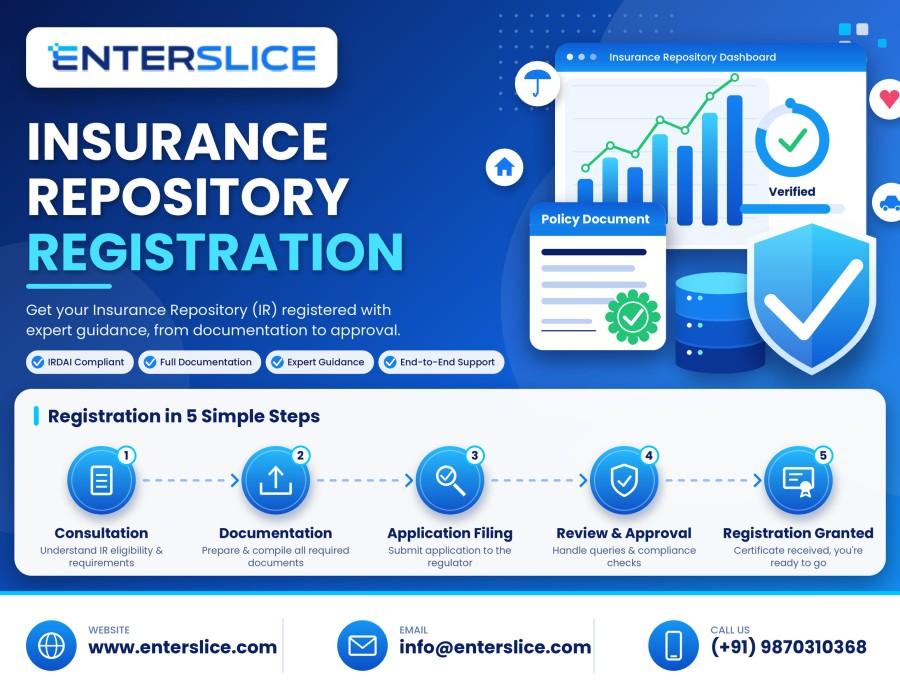
The insurance industry in India is gradually moving towards digital policy management, making it easier for policyholders to access and maintain their insurance records. Traditionally, insurance policies were issued and maintained in physical documents, which could be misplaced, damaged or difficult to manage. Insurance repositories address this challenge by allowing insurance policies to be held and maintained in electronic form.
For businesses planning to enter this segment, obtaining an Insurance Repository License from the Insurance Regulatory and Development Authority of India (IRDAI) is an important regulatory step. An insurance repository provides the infrastructure through which policyholders can maintain their insurance policies electronically through an electronic insurance account (eIA).
However, operating an insurance repository involves more than setting up a digital platform. An applicant must understand the applicable regulatory framework, eligibility conditions, registration requirements, operational responsibilities and policyholder protection obligations.
This guide explains the Insurance Repository License in India, its importance, the registration process and the key considerations for businesses planning to operate in this sector.
What Is an Insurance Repository?
An insurance repository is an entity authorised by IRDAI to maintain insurance policies in electronic form on behalf of policyholders. It provides a digital facility through which individuals can hold and access their insurance policies without depending entirely on physical documents.
The concept is similar to a securities depository, where financial securities are maintained electronically. In the insurance sector, repositories help policyholders manage multiple insurance policies through a single electronic insurance account.
An insurance repository can facilitate the electronic maintenance of different types of insurance policies, subject to applicable regulations and the systems supported by insurers.
Its primary functions include:
- Maintaining insurance policies in electronic form.
- Providing electronic insurance accounts to policyholders.
- Facilitating access to policy information.
- Supporting policy servicing through digital records.
- Maintaining the security and confidentiality of policyholder information.
- Coordinating with insurance companies for electronic policy-related services.
An Insurance Repository License is therefore relevant to businesses seeking to provide regulated electronic insurance record-keeping services in India.
Why Is an Insurance Repository License Important?
The shift towards electronic insurance records has created a need for reliable systems that protect policy information and make it accessible to policyholders. Insurance repositories help address this requirement by providing an organised digital infrastructure.
The registration framework also ensures that entities performing repository functions operate under regulatory supervision.
Some important benefits include:
1. Centralised insurance records
Policyholders can maintain multiple insurance policies in one electronic insurance account instead of managing separate physical documents.
2. Reduced paperwork
Electronic records reduce dependence on printed policy documents and make record management more convenient.
3. Better accessibility
Policyholders can access their electronic insurance information through the facilities provided by the repository.
4. Improved policy management
Digital records can make it easier to track policy information, access details and manage servicing-related requests.
5. Better record security
Regulated repositories are expected to maintain appropriate systems and safeguards for protecting electronic insurance records and sensitive policyholder information.
Regulatory Framework for Insurance Repository Registration
The Insurance Repository framework in India is supervised by IRDAI. The regulatory framework has developed through IRDAI guidelines and circulars governing electronic insurance policies, repository operations and policyholder services.
Businesses should particularly review the following regulatory developments:
- IRDAI Guidelines on Insurance Repositories, 2011: Introduced the framework for electronic insurance records and repository operations.
- IRDAI Revised Guidelines on Insurance Repositories, 2015: Revised eligibility conditions, operational requirements and registration-related procedures.
- IRDAI (Issuance of e-Insurance Policies) Regulations, 2016: Addressed the issuance of insurance policies in electronic form.
- IRDAI (Maintenance of Insurance Records) Regulations, 2015: Provides a regulatory reference for maintaining insurance-related records.
The applicable provisions, subsequent amendments and directions issued by IRDAI should be checked before submitting an application. The 2015 guidelines should not be treated as an automatic, currently open application window.
Eligibility Criteria for Insurance Repository Registration
An entity intending to establish an insurance repository must satisfy the eligibility and regulatory conditions prescribed by IRDAI.
Under the revised guidelines issued in 2015, the eligible applicant categories included:
- A public limited company registered under the Companies Act, 2013.
- A public financial institution recognised under the Companies Act.
- A wholly owned subsidiary of an existing depository registered with SEBI under the Depositories Act, 1996.
- A company promoted by the Life Insurance Council, General Insurance Council or both, either independently or jointly with other eligible institutions.
- Other institutions specifically permitted by IRDAI.
The guidelines also prescribed important conditions concerning the applicant's financial position, ownership and operational capability.
Important Eligibility Considerations
Minimum net worth: The 2015 revised guidelines prescribed a minimum net worth of ₹25 crore at the stage of in-principle approval.
Business experience: The applicant or its promoters were expected to demonstrate relevant experience and competence in similar activities, including technology and operational capabilities.
Financial strength: The applicant must demonstrate sufficient financial and organisational capacity to establish and operate the repository.
Ownership structure: The guidelines included restrictions relating to foreign direct investment and conflicts of interest with insurance business.
Main business objective: Acting as an insurance repository and maintaining electronic insurance policies must form part of the applicant's principal business objectives.
These conditions are based on the 2015 framework. Applicants should obtain confirmation from IRDAI regarding the currently applicable eligibility requirements before relying on these thresholds for investment or incorporation decisions.
Documents Required for Insurance Repository Registration
Preparing the relevant documents is an important part of the registration exercise. IRDAI may require corporate, financial, ownership, technical and operational information to evaluate the applicant's suitability.
The following documents represent a practical preparation checklist rather than a universally prescribed, exhaustive filing list:
Document category
Documents and information
Corporate documents
Certificate of Incorporation, MOA and AOA
Management details
Details of directors, promoters and key managerial personnel
Financial documents
Audited financial statements and net-worth certificate
Shareholding details
Shareholding pattern and ownership structure
Business information
Business plan and proposed operational model
Technical details
IT infrastructure, data security and disaster recovery arrangements
Operational documents
Internal policies, procedures and proposed service arrangements
Regulatory information
Details of existing registrations, approvals and regulatory history
IRDAI may request additional documents, clarifications, declarations or supporting evidence depending on the applicant's structure and proposed operations.
A business should ensure that its financial statements, shareholding information and proposed technology infrastructure are consistent with the representations made in its application.
Step-by-Step Process to Obtain an Insurance Repository License
Obtaining an Insurance Repository License involves regulatory evaluation, eligibility assessment and verification of the applicant's operational infrastructure.
The following steps explain the broad registration framework.
Step 1: Establish the Eligible Business Structure
The applicant should first evaluate whether its proposed business structure falls within the categories permitted under the applicable IRDAI framework.
The company's constitutional documents should clearly reflect the proposed insurance repository activities.
Step 2: Evaluate Financial and Ownership Eligibility
The applicant must review its capital structure, net worth, promoter background and shareholding arrangements.
Any ownership restrictions or conflict-of-interest conditions should be examined before proceeding further.
Step 3: Prepare the Business and Technology Plan
An insurance repository depends heavily on reliable technology infrastructure. The applicant should prepare a detailed plan explaining how electronic insurance records will be maintained, accessed, protected and updated.
The plan should address:
- Electronic policy record management.
- Data protection and information security.
- Backup and disaster recovery.
- User authentication and access controls.
- Policyholder service facilities.
- Internal monitoring and risk management.
Step 4: Submit the Application to IRDAI
The application must follow the process and format specified by IRDAI.
Importantly, the revised 2015 guidelines contemplated an application process linked to an IRDAI invitation or Request for Proposals (RFP). Therefore, an eligible company should not assume that it can obtain registration simply by submitting an application at any time.
Step 5: Regulatory Review and In-Principle Approval
IRDAI examines the applicant's eligibility, financial strength, business objectives and proposed operational capabilities.
The Authority may request additional information, explanations or supporting documents before taking a decision.
Step 6: Infrastructure and System Verification
The regulatory framework provides for verification of the applicant's infrastructure and systems before the grant of registration.
This assessment is particularly relevant because an insurance repository handles sensitive policyholder information and electronic insurance records.
Step 7: Grant of Certificate of Registration
After evaluating the application and relevant verification reports, IRDAI may grant a Certificate of Registration if the applicant satisfies the applicable requirements.
The applicant must comply with the conditions attached to the registration before commencing permitted repository activities.
Responsibilities of an IRDAI-Registered Insurance Repository
Obtaining registration is only the beginning. An insurance repository must maintain appropriate operational standards throughout its business activities.
Some important responsibilities include:
1. Maintaining electronic insurance records: The repository must maintain policy information accurately and ensure that records remain accessible as required.
2. Protecting policyholder information: Appropriate security measures must be implemented to prevent unauthorised access, alteration, loss or misuse of information.
3. Maintaining backup systems: Data backup and recovery arrangements are essential for business continuity and protection of electronic records.
4. Providing policyholder services: The repository should facilitate eligible account and policy-related service requests in accordance with its permitted functions.
5. Maintaining audit and monitoring systems: Internal controls and independent system audits help assess the reliability of operational processes.
6. Following IRDAI directions: The repository must comply with applicable regulations, guidelines, circulars and conditions of registration.
Insurance Repository vs Insurance Broker: Understanding the Difference
Businesses should understand that an insurance repository and an insurance broker perform different functions under the insurance regulatory framework.
Particulars
Insurance Repository
Insurance Broker
Primary function
Maintains electronic insurance policies
Arranges or facilitates insurance business
Regulatory authority
IRDAI
IRDAI
Main purpose
Electronic policy record management
Insurance distribution and intermediation
Policy solicitation
Not permitted as a repository function
Permitted within the registered category
Regulatory framework
Repository guidelines and applicable directions
IRDAI (Insurance Brokers) Regulations, 2018
An insurance repository cannot use its registration as authority to solicit or sell insurance policies. Businesses interested in insurance distribution should separately evaluate the appropriate intermediary registration.
e-Insurance Account (eIA): How Does It Work?
An e-Insurance Account is a digital account that allows policyholders to hold and manage their insurance policies electronically.
It is one of the key services facilitated by an insurance repository.
The process generally works as follows:
- The policyholder submits an e-Insurance Account opening request to an insurance repository or its authorised service channel.
- The required identity and address verification is completed.
- The repository creates the electronic insurance account.
- The policyholder receives the account access details.
- Existing eligible insurance policies can be converted into electronic form by submitting a dematerialisation request.
- New insurance policies can be issued electronically by providing the eIA details to the insurer, subject to the applicable arrangements.
An eIA can help policyholders maintain different insurance policies through a single digital account.
It is important to understand that opening an eIA is different from obtaining an Insurance Repository License. An individual opens an eIA to manage personal insurance records, whereas a company seeks regulatory registration to operate as an insurance repository.
Key Challenges in Setting Up an Insurance Repository
Although digital insurance record management offers business opportunities, establishing an insurance repository involves several regulatory and operational challenges.
Regulatory eligibility: Meeting the prescribed ownership, financial and organisational conditions can be challenging for new businesses.
Technology infrastructure: Maintaining secure electronic records requires reliable systems, appropriate access controls and disaster recovery arrangements.
Data confidentiality: Insurance policies contain sensitive personal and financial information. Protecting this information requires appropriate technical and organisational safeguards.
Integration with insurers: An effective repository must coordinate with insurance companies to support electronic policy issuance and servicing.
Regulatory compliance: Ongoing compliance, audit requirements and changes in regulatory directions require continuous monitoring.
Businesses should evaluate these factors before committing resources to an insurance repository project.
List of IRDAI-Approved Insurance Repositories in India
Insurance repositories are entities authorised by IRDAI to maintain insurance policies electronically.
According to the IRDAI Annual Report 2024–25, four insurance repositories were approved as of 31 March 2025:
- NSDL National Insurance Repository
- CDSL Insurance Repository Limited
- CAMS Repository Services Limited
- Karvy Insurance Repository Limited
The list should be checked against the latest IRDAI records before making any business or operational decisions. The historical IRDAI repository directory contains older licence-validity information and should not be treated as a current registration-status confirmation.
Life in Council+1
How Enterslice Can Help with Insurance Repository Registration
Establishing a regulated financial services business requires careful planning, documentation and an understanding of the applicable regulatory framework.
Enterslice provides business advisory, regulatory and compliance support to companies planning to enter regulated sectors.
For businesses exploring an Insurance Repository License, professional assistance can help with:
- Understanding the applicable IRDAI registration framework.
- Evaluating the proposed business structure and eligibility.
- Reviewing corporate and financial documentation.
- Preparing business and operational documentation.
- Assessing regulatory compliance requirements.
- Providing guidance on regulatory submissions and related formalities.
Planning to establish an insurance repository in India? Connect with Enterslice for professional assistance in understanding the registration framework, evaluating eligibility and planning the regulatory compliance process.
Most popular services :
Alternative investment fund registration
Frequently Asked Questions (FAQs)
1. What is an Insurance Repository License in India?
An Insurance Repository License refers to the Certificate of Registration granted by IRDAI to an eligible entity to operate as an insurance repository. It authorises the entity to maintain insurance policies in electronic form on behalf of insurers.
2. Who can apply for Insurance Repository Registration?
Entities falling within the eligible categories specified under the applicable IRDAI framework may apply. These historically included eligible public limited companies, public financial institutions, certain depository subsidiaries and entities promoted by insurance industry bodies.
3. What is the minimum net worth required for an Insurance Repository?
The revised IRDAI guidelines issued in 2015 prescribed a minimum net worth of ₹25 crore at the in-principle approval stage. Applicants should verify whether this requirement remains applicable under the latest directions before proceeding.
4. Can an insurance repository sell insurance policies?
No. An insurance repository is authorised to maintain insurance policies electronically and provide permitted repository-related services. Its repository registration does not authorise it to solicit or sell insurance policies.
5. What is an e-Insurance Account?
An e-Insurance Account (eIA) is an electronic account through which policyholders can hold and access their eligible insurance policies digitally. It helps individuals manage multiple insurance policies through a single account.
6. Is IRDAI registration mandatory for operating an insurance repository?
Yes. An entity cannot operate as an insurance repository without obtaining the required Certificate of Registration from IRDAI.
7. Can a startup establish an insurance repository in India?
A startup may explore this business opportunity if it satisfies the applicable eligibility, ownership, financial and operational requirements. However, meeting the eligibility conditions alone does not guarantee registration, as the registration process may depend on IRDAI's invitation or RFP.