

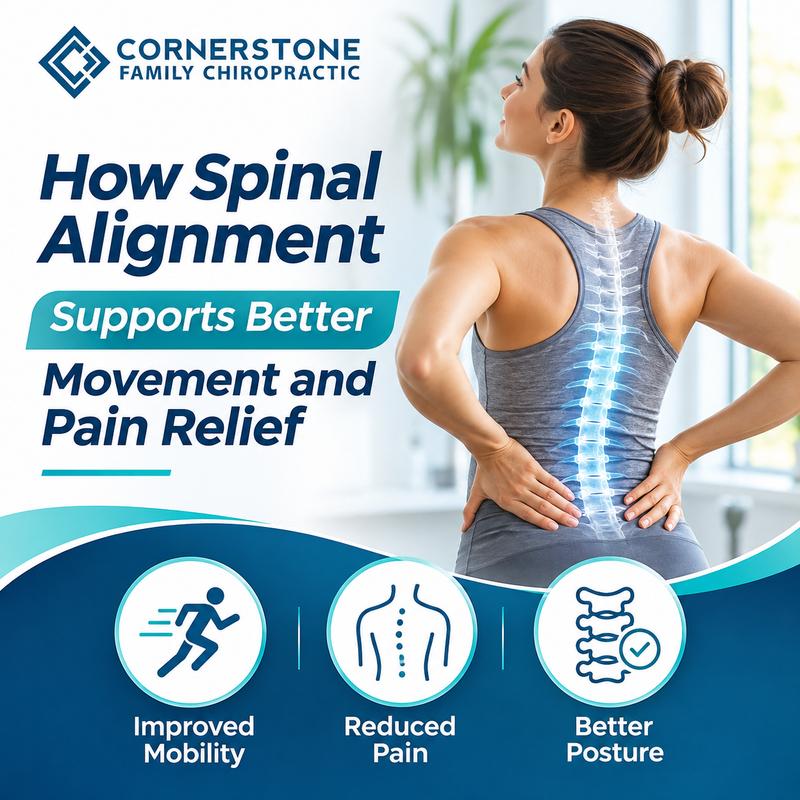
Your spine allows you to perform a wide variety of movements, including bending and lifting, walking, sitting, and turning your head. Your spine, along with its ligaments and muscles, supports the different movements your body is capable of performing.
Long-term sitting, poor movement habits, and physical injury or strain can lead to restricted movement, discomfort, and pain in your neck and back. Understanding spinal alignment can help you understand how spinal health, posture, and joint movement may affect your normal physical function.
At Cornerstone Family Chiropractic, we provide individualized chiropractic care focusing on spinal health and other musculoskeletal concerns. This is just one of the many reasons to consider a chiropractic care in Huntsville.
What Is Spinal Alignment?
Spinal alignment refers to the relative position of the spinal vertebrae and the natural curvature of the spine.
The spine is made up of 33 vertebrae across five regions: cervical (neck), thoracic (mid-back), lumbar (lower back), sacral, and coccygeal (tailbone). The natural curves of the spine help distribute physical forces, maintain balance, and support body movement.
Several structures work together to maintain normal spinal function:
· Vertebrae: Provide structural support and protect the spinal cord.
· Intervertebral discs: Help distribute loads between vertebrae.
· Spinal joints: Allow movements such as bending, extending, and rotating.
· Muscles and ligaments: Support stability, posture, and controlled movement.
· Nervous system: Coordinates movement and communicates sensory information.
Healthy spinal alignment does not mean having a completely straight spine. The natural curves of the spine are important for maintaining strength, flexibility, balance, and physical support.
How Spinal Alignment Supports Better Movement
Being able to move comfortably depends on a variety of factors, such as joint function, muscle strength, flexibility, coordination, and nervous system function. The spine plays an important role in bringing these factors together.
1. Supports Natural Joint Movement
The joints between the vertebrae allow for different movements of the spine, such as bending, extending, and rotating. These movements help you perform everyday activities, including reaching, lifting, and turning.
Restricted movement at certain spinal joints may contribute to discomfort and stiffness. Appropriate chiropractic care may help address selected joint mobility limitations through spinal manipulation and mobilization.
2. Helps Maintain Postural Balance
Your spine, along with the muscles of the abdomen, back, shoulders, and hips, helps you maintain balance and support the rest of your body.
Maintaining this balance requires your spine and supporting structures to function properly. Sitting in one position for a long time can contribute to discomfort and stiffness in the muscles of the spine. Regular movement breaks, comfortable workstation positioning, and physical activity can promote better movement habits.
3. Encourages Coordinated Movement
Walking, bending, and lifting require coordination between your spine, pelvis, hips, and other joints.
When one area becomes painful or restricted, you may unconsciously change how you move. These compensatory patterns can sometimes place additional demands on other muscles and joints.
Addressing the contributing problem can help support more comfortable everyday movement.
Can Spinal Alignment Affect Back and Neck Pain?
Back and neck pain can develop for several reasons, including muscle strain, joint irritation, injuries, disc-related conditions, and other musculoskeletal problems.
While some people may experience discomfort as a result of postural habits and restrictions in their joints' range of motion, spinal alignment is just one of many potential pain sources and may not be a factor in every case.
Common symptoms include:
· Recurring lower back discomfort.
· Neck stiffness and difficulty turning your head.
· Discomfort when bending or twisting.
· Muscle tightness around the shoulders and back.
· Stiffness after prolonged sitting or standing.
· Reduced flexibility during everyday activities.
You should consider seeking the opinion of a health professional if you have any of the symptoms listed above and they begin to interfere with your normal activities. A professional evaluation can help identify possible causes and appropriate treatment options.
How Chiropractic Care May Support Movement and Pain Relief
Chiropractic adjustments consist of a chiropractor applying a controlled force to a selected joint in the spine. The goal of an adjustment may be to improve the range of motion in that joint and help alleviate certain types of musculoskeletal discomfort.
Here are some ways chiropractic care may support spinal health.
1. Addressing Restricted Joint Mobility
Spinal joint restrictions can lead to stiffness in that region of the spine. A chiropractic manipulation of a restricted spinal joint may improve its range of motion and support more comfortable movement.
2. Helping Manage Back Pain
Research suggests spinal manipulation may provide modest improvements in pain and physical function for some adults with low back pain. The results vary, and it is not a guaranteed solution for every condition.
The National Center for Complementary and Integrative Health (NCCIH) recognizes spinal manipulation as one of several nondrug approaches that may help some people with low back pain.
3. Supporting Comfortable Movement
When neck or back discomfort makes ordinary activities difficult, an individualized assessment can help determine whether chiropractic treatment, exercise, activity modification, or another approach may be appropriate.
Treatment recommendations should always consider your symptoms, medical history, and examination findings.
Everyday Habits That Support Spinal Health
Improving and maintaining comfortable movement in your daily life involves a variety of factors, including the habits you incorporate into your daily routine.
Consider these practical steps:
· Maintain comfortable sitting posture: Keep your feet supported and your computer screen at a comfortable viewing height.
· Take movement breaks: Avoid remaining seated for long periods without changing positions.
· Practice appropriate lifting techniques: Keep objects close to your body and avoid sudden twisting movements.
· Strengthen supporting muscles: Suitable exercises can improve core strength and muscular endurance.
· Stay physically active: Walking and other appropriate activities help maintain mobility and physical conditioning.
· Prioritize recovery: Adequate sleep and rest support general physical health.
These habits can complement professional care and help you maintain comfortable movement.
Who May Benefit From Chiropractic Care in Huntsville?
Consider chiropractic care to address musculoskeletal discomfort that restricts your ability to perform daily activities.
People who may consider an evaluation include:
Individuals with recurring back pain: Lower back discomfort can negatively impact everyday activities, including sitting, standing, walking, and lifting.
People experiencing neck stiffness: Extended computer use and repetitive activities may contribute to neck discomfort and restricted movement.
Active individuals and athletes: Physical activity places varying demands on muscles and joints. Appropriate care may help address certain musculoskeletal complaints.
People experiencing posture-related discomfort: Prolonged sitting and repeated movements may contribute to muscular tightness and discomfort.
Treatment suitability depends on the individual's health history, symptoms, and clinical assessment.
What to Expect During a Chiropractic Visit
If you are searching for a chiropractor in Huntsville, understanding the initial evaluation can help you prepare for your visit.
A chiropractic appointment generally involves:
1. Discussion of your concerns: Explain where you experience discomfort, when it started, and which activities make it worse.
2. Health history review: Your provider considers previous injuries, existing conditions, and relevant medical information.
3. Physical examination: This may include evaluating your posture, range of motion in the spinal joints, joint mobility, and flexibility of the muscles.
4. Personalized recommendations: Your chiropractor will talk with you about appropriate treatment options and their potential benefits, risks, and side effects.
5. Progress evaluation: Your symptoms and functional abilities may be reassessed to determine whether the care plan is helping.
A thorough evaluation helps determine whether chiropractic treatment is appropriate or whether another healthcare professional should be consulted.
Find Chiropractic Care in Huntsville, AL
Your spine, muscles, joints, and movement habits all contribute to everyday physical function. When back pain, neck stiffness, or restricted mobility begins affecting your routine, understanding the possible causes is an important first step.
Cornerstone Family Chiropractic provides chiropractic services for individuals and families in Huntsville, Alabama. Interested individuals are encouraged to contact the office to discuss their concerns and determine whether an evaluation would be appropriate. The office can also provide information about the specific adjustment methods used in its practice.
Cornerstone Family Chiropractic
Address: 2124 Cecil Ashburn Dr, Suite 150, Huntsville, AL 35802
Phone: (256) 401-7775
Website: https://cornerstone4health.com/
Contact his office for an appointment and additional information about available services.
Frequently Asked Questions
1. How does spinal alignment affect movement?
The spine allows us to bend, turn, and perform many other movements. Each component of the body, including the spine, muscles, joints, and nervous system, works together to support everyday mobility.
2. Can chiropractic adjustments help with back pain?
Spinal manipulation may provide some individuals with short-term improvements in pain and back function, particularly for certain cases of low back pain. Results vary depending on the individual and the underlying condition.
3. Can chiropractic care improve posture?
Posture is determined by many factors, including muscle strength, physical activity, and daily habits. While chiropractic care may improve joint mobility and reduce musculoskeletal discomfort, it does not necessarily change posture.
4. How often should I visit a chiropractor?
There is no one-size-fits-all treatment plan. Factors such as symptoms, personal goals, health history, and how you respond to treatment can influence how often you may need to see a chiropractor.
5. Is chiropractic care suitable for everyone?
No. Certain medical conditions and injuries may make particular chiropractic techniques inappropriate. A proper health history and examination are important before treatment.
6. Where can I find a chiropractor in Huntsville, Alabama?
Cornerstone Family Chiropractic is located at 2124 Cecil Ashburn Dr, Suite 150, Huntsville, AL 35802. Call (256) 401-7775 to ask about services and appointments.
The Article “How Spinal Alignment Supports Better Movement and Pain Relief” was originally posted here.